
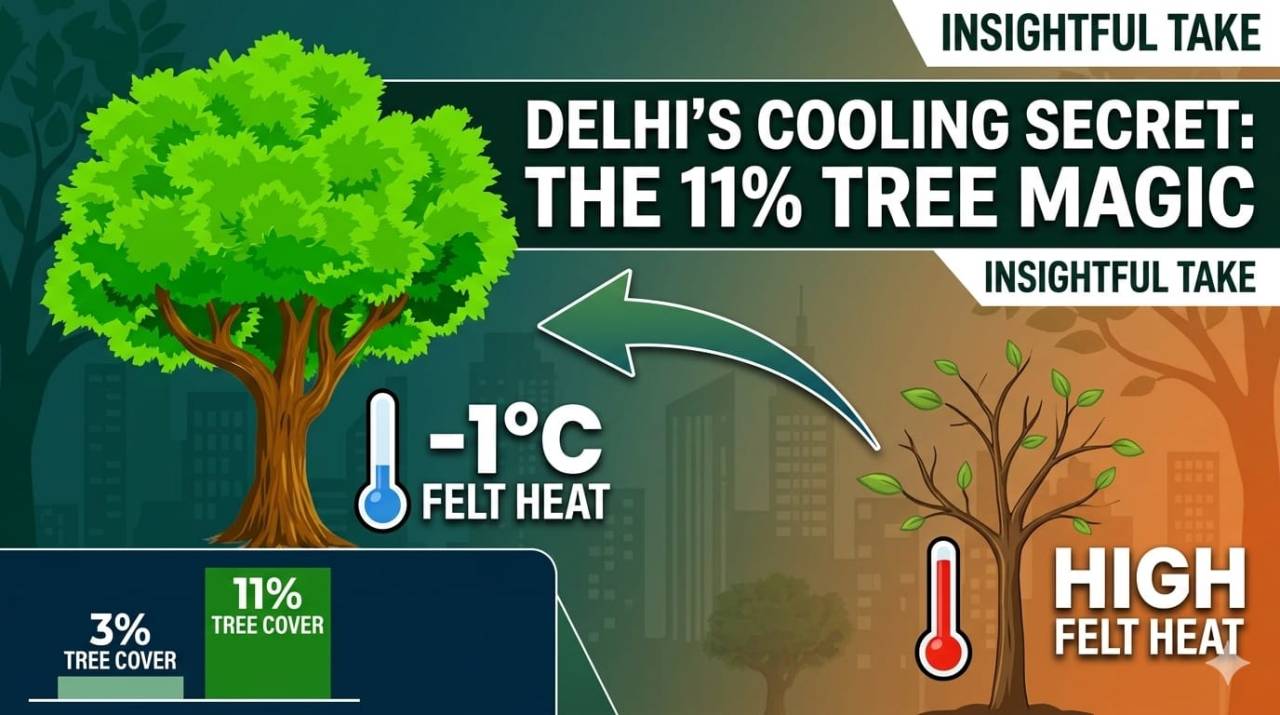
Just 11% more trees can cool Delhi, cut heat stress, and protect livelihoods—making greenery the city’s most powerful summer defence.
Every year, residents of Delhi brace for the brutal “Loo”—hot, dry winds that turn streets into heat traps and homes into ovens. Most people look for relief in air conditioners, coolers, or endless glasses of cold water. But a new study suggests that the most effective cooling solution might already be growing around us—trees.
A report by Artha Global and data.org reveals a striking insight. Increasing a neighbourhood’s tree cover from just 3% to 11% can reduce the felt temperature by 1°C. While that may sound small, in a city where temperatures regularly cross 45°C, even a single degree can significantly improve daily life.
The Power of Green vs. The Weight of Concrete
The report, Mapping Heat Inequality Across Neighbourhoods in Delhi, highlights a critical imbalance in how the city heats up.
When green spaces are replaced with concrete, raising built-up areas from 25% to 55%, temperatures increase by around 0.6°C. However, adding even a modest amount of greenery produces a stronger cooling effect.
In simple terms, trees cool cities more effectively than concrete heat them.
This finding changes how we think about urban planning. It suggests that Delhi does not need massive forest projects overnight. Instead, targeted greening in dense neighbourhoods, planting trees along streets, parks, and open spaces, can deliver meaningful relief.
More Than Discomfort: The Real Cost of Heat
Extreme heat in Delhi has serious economic and health consequences.
The study, based on a survey of over 2,300 households, shows how rising temperatures deepen inequality:
- Sleep and Health: For every 3°C rise in experienced heat, sleep disruption increases by up to 6%, leading to a 15% rise in reported illnesses.
- Loss of Income: Heat leads to a 10% increase in missed workdays, especially affecting daily wage earners.
- Unequal Impact: Households without air conditioning face 18% more work loss compared to those with ACs.
- Electricity Burden: Families with ACs spend nearly ₹2,560 per month, compared to ₹1,405 for those without—highlighting a growing economic divide.
Heat, in this sense, becomes a structural challenge, not just a seasonal inconvenience.
Rethinking Heat: The Case for Micro-Level Planning
The report calls for a shift in how the city approaches heat management.
Instead of treating Delhi as a single temperature zone, planners must identify “hot pockets”—areas with low tree cover and high exposure to heat. These neighbourhoods often house the most vulnerable populations.
The solution lies in micro-level heat action plans, including:
- Creating shaded corridors along roads and walkways
- Expanding tree cover in dense residential areas
- Protecting and restoring wetlands and green spaces
- Treating greenery as essential infrastructure, just like roads or water systems
Such targeted interventions can deliver faster and more equitable results than city-wide averages.
What This Means for Residents
This study offers a rare sense of clarity in the face of climate anxiety. While global warming may feel overwhelming, local action can make an immediate difference.
Reaching that 11% tree cover benchmark is not just about beautification. It can:
- Lower everyday temperatures
- Improve sleep and health outcomes
- Reduce income loss caused by extreme heat
- Make neighbourhoods more livable for everyone
For residents, this also means rethinking civic priorities—supporting tree plantation drives, protecting existing green spaces, and holding local authorities accountable for sustainable planning.
A Simple but Powerful Idea
Delhi’s battle against heat does not have to rely only on electricity and infrastructure-heavy solutions. Sometimes, the answer is far simpler.
More trees. More shade. More balance.
In a city struggling with rising temperatures, every sapling planted is a natural air conditioner for the entire community.
Every year, residents of Delhi brace for the brutal “Loo”—hot, dry winds that turn streets into heat traps and homes into ovens. Most people look for relief in air conditioners, coolers, or endless glasses of cold water. But a new study suggests that the most effective cooling solution might already be growing around us—trees.
A report by Artha Global and data.org reveals a striking insight. Increasing a neighbourhood’s tree cover from just 3% to 11% can reduce the felt temperature by 1°C. While that may sound small, in a city where temperatures regularly cross 45°C, even a single degree can significantly improve daily life.
The Power of Green vs. The Weight of Concrete
The report, Mapping Heat Inequality Across Neighbourhoods in Delhi, highlights a critical imbalance in how the city heats up.
When green spaces are replaced with concrete, raising built-up areas from 25% to 55%, temperatures increase by around 0.6°C. However, adding even a modest amount of greenery produces a stronger cooling effect.
In simple terms, trees cool cities more effectively than concrete heat them.
This finding changes how we think about urban planning. It suggests that Delhi does not need massive forest projects overnight. Instead, targeted greening in dense neighbourhoods, planting trees along streets, parks, and open spaces, can deliver meaningful relief.
More Than Discomfort: The Real Cost of Heat
Extreme heat in Delhi has serious economic and health consequences.
The study, based on a survey of over 2,300 households, shows how rising temperatures deepen inequality:
- Sleep and Health: For every 3°C rise in experienced heat, sleep disruption increases by up to 6%, leading to a 15% rise in reported illnesses.
- Loss of Income: Heat leads to a 10% increase in missed workdays, especially affecting daily wage earners.
- Unequal Impact: Households without air conditioning face 18% more work loss compared to those with ACs.
- Electricity Burden: Families with ACs spend nearly ₹2,560 per month, compared to ₹1,405 for those without—highlighting a growing economic divide.
Heat, in this sense, becomes a structural challenge, not just a seasonal inconvenience.
Rethinking Heat: The Case for Micro-Level Planning
The report calls for a shift in how the city approaches heat management.
Instead of treating Delhi as a single temperature zone, planners must identify “hot pockets”—areas with low tree cover and high exposure to heat. These neighbourhoods often house the most vulnerable populations.
The solution lies in micro-level heat action plans, including:
- Creating shaded corridors along roads and walkways
- Expanding tree cover in dense residential areas
- Protecting and restoring wetlands and green spaces
- Treating greenery as essential infrastructure, just like roads or water systems
Such targeted interventions can deliver faster and more equitable results than city-wide averages.
What This Means for Residents
This study offers a rare sense of clarity in the face of climate anxiety. While global warming may feel overwhelming, local action can make an immediate difference.
Reaching that 11% tree cover benchmark is not just about beautification. It can:
- Lower everyday temperatures
- Improve sleep and health outcomes
- Reduce income loss caused by extreme heat
- Make neighbourhoods more livable for everyone
For residents, this also means rethinking civic priorities—supporting tree plantation drives, protecting existing green spaces, and holding local authorities accountable for sustainable planning.
A Simple but Powerful Idea
Delhi’s battle against heat does not have to rely only on electricity and infrastructure-heavy solutions. Sometimes, the answer is far simpler.
More trees. More shade. More balance.
In a city struggling with rising temperatures, every sapling planted is a natural air conditioner for the entire community.
























Leave a Comment