

Can a school textbook shape how an entire generation views the judiciary? The recent Supreme Court–NCERT controversy raises a deeper question: in teaching young students about real institutional challenges, where should education draw the line between honest critique and responsible balance?
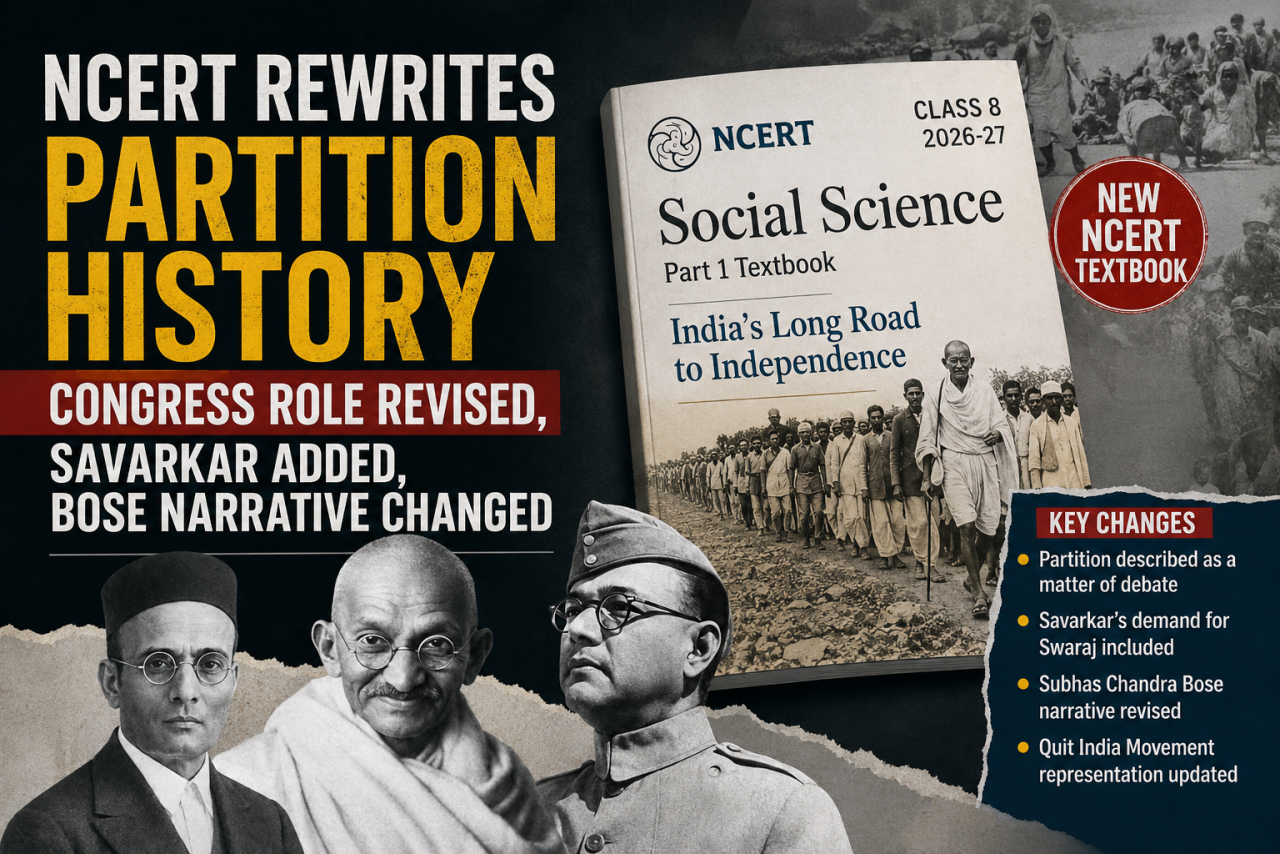
The recent disagreement between the Supreme Court of India and the National Council of Educational Research and Training over a Class 8 Social Science textbook has raised an important question: how should sensitive institutional issues be taught to school students? From an educational point of view, this debate is not only about the judiciary. It is about curriculum design, age-appropriate learning, critical thinking, and the responsibility of textbook writers in a democracy.
Education at the middle school level is meant to build foundational understanding. At the age of 13 or 14, students are introduced to concepts such as the Constitution, democracy, separation of powers, and the role of institutions. NCERT textbooks are widely used across India and often serve as the academic standard for many state boards as well. Therefore, the content included in these books has a strong influence on how young citizens understand governance and public institutions.
The controversial chapter discussed issues such as corruption within the judiciary and the backlog of pending cases. It referred to widely reported data that millions of cases are pending in courts across India. According to official judicial data, more than 4.7 crore (47 million) cases are pending at various levels of the judiciary, including district courts, High Courts, and the Supreme Court. Such statistics are factual and available in the public domain. From an academic perspective, discussing real data can help students understand structural challenges in governance.
However, education is not only about presenting facts. It is also about context, balance, and interpretation. At the middle school level, students are still developing analytical skills. If a chapter highlights problems like corruption or delays without equally explaining why such challenges exist, what reforms are underway, and how the judiciary protects fundamental rights, the learning may become incomplete. In civic education, the aim is not to glorify institutions, but to explain both their functions and limitations in a balanced manner.
From a pedagogical viewpoint, there are three important principles to consider. First is age appropriateness. Class 8 students are in the early stages of abstract reasoning. Complex institutional problems require careful framing so that students do not form oversimplified conclusions. Second is proportional representation. If one institution is discussed only in terms of its weaknesses while others are presented more neutrally, it may create a distorted perception. Third is constructive civic learning. The goal of Social Science education is to prepare informed citizens who can question responsibly, not to create cynicism or blind distrust.
The Supreme Court expressed concern that presenting only the negative aspects of the judiciary might weaken students’ faith in the justice system. In a democracy, trust in institutions such as courts is important for social stability. At the same time, democratic education encourages awareness of real issues, including corruption and administrative delays. The challenge for curriculum designers is to combine these two objectives: promoting informed awareness while maintaining institutional respect.
NCERT, as a national curriculum body, has the responsibility to follow a structured review process before publishing textbooks. Normally, textbooks are prepared by expert committees consisting of academics, subject specialists, and school teachers. Drafts are reviewed and revised multiple times. The controversy suggests that either the contextual balance was not adequately examined or the sensitivity of the subject was underestimated. In response to the Court’s objections, NCERT agreed to review and rewrite the chapter. This indicates that curriculum development is not static; it evolves through feedback and institutional dialogue.
From an educational reform perspective, this episode highlights the need for clearer guidelines on teaching about institutional accountability. For example, a chapter on the judiciary could include sections on the role of courts in safeguarding fundamental rights, landmark judgments that strengthened democracy, reasons behind case backlogs such as shortage of judges, and steps taken for reform like e-courts and alternative dispute resolution systems. Presenting both challenges and corrective measures allows students to see institutions as dynamic systems that can improve over time.
Another important dimension is teacher mediation. Textbooks are only one part of classroom learning. Teachers play a central role in explaining sensitive topics. Proper teacher training can ensure that discussions on corruption or delays are handled with care, encouraging students to think critically without becoming dismissive of democratic structures.
In conclusion, the dispute between the Supreme Court and NCERT should be viewed not merely as a legal conflict, but as an opportunity to reflect on civic education in India. Education must prepare students to understand reality, including institutional shortcomings. At the same time, it must do so with balance, context, and responsibility. A well-designed curriculum does not hide problems, nor does it present them in isolation. Instead, it helps students develop informed, rational, and constructive attitudes toward the institutions that shape their democratic life.
























Leave a Comment