
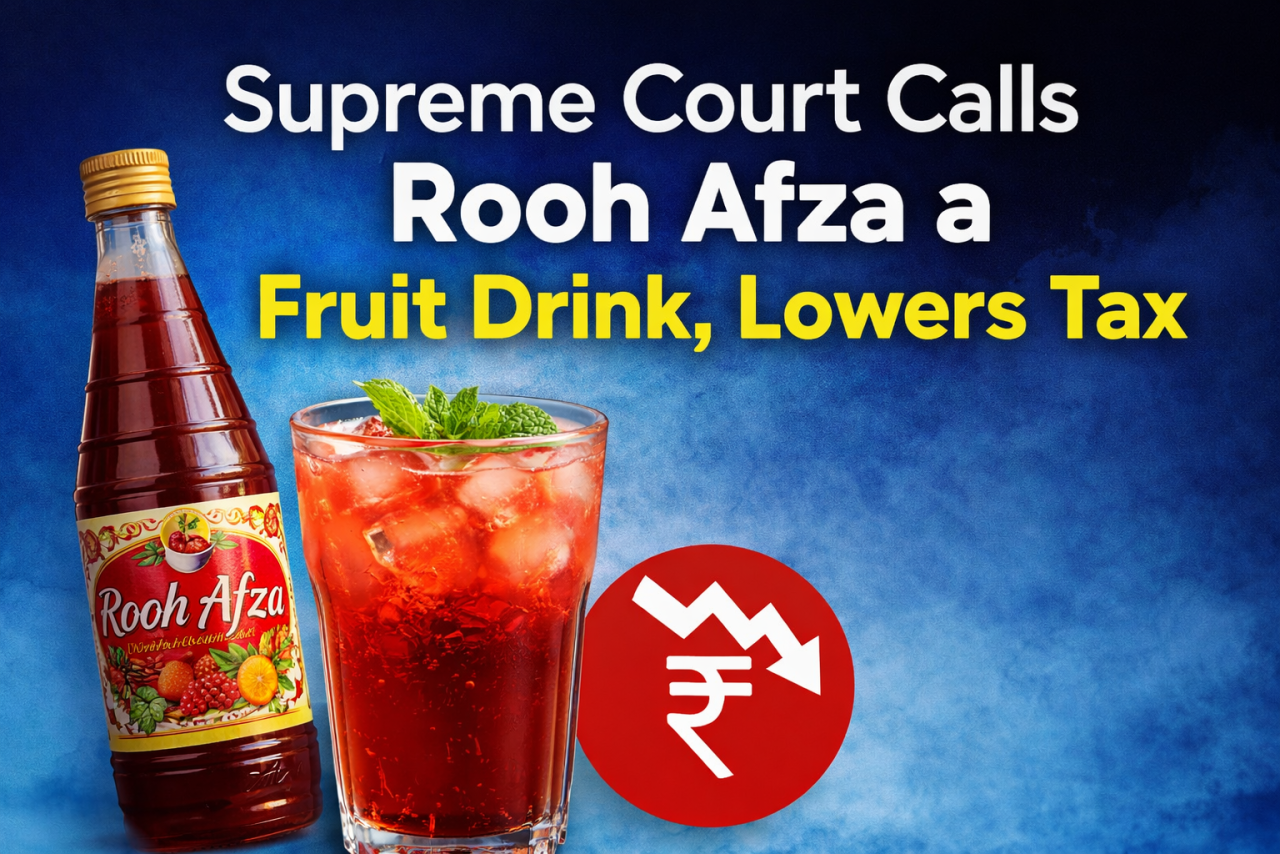
After years of tax confusion, the Supreme Court has finally settled the debate — Rooh Afza is officially a fruit drink, bringing big relief to its maker and clarity to the law.
The Supreme Court has brought clarity to a long-running tax dispute involving Rooh Afza, one of India’s most loved summer drinks. In a significant decision, the court ruled that Rooh Afza should be treated as a fruit-based drink and not as an unclassified product for tax purposes.
For decades, Rooh Afza has been a household name across India. From iftar tables during Ramzan to chilled summer glasses mixed with water or milk, it holds a strong emotional and cultural value. But behind this popularity was a legal battle over how the product should be taxed.
The dispute dates back to the period between January 2008 and March 2012, when the Uttar Pradesh Value Added Tax (UPVAT) system was in place. During this time, tax authorities classified Rooh Afza as an “unclassified” item. Because of this label, it attracted a higher VAT rate of 12.5 percent.
Hamdard Laboratories, the company that manufactures Rooh Afza, challenged this decision. The company argued that the drink is made using fruit-based ingredients and is meant to be diluted before consumption. Therefore, it should fall under the category of “fruit drink” or processed fruit product, which carries a lower tax rate of 4 percent.
One of the key issues in the case was the percentage of fruit content in the product. Rooh Afza contains around 10 percent fruit juice, along with sugar syrup and herbal extracts. Tax officials pointed to food safety guidelines that say a fruit syrup must contain at least 25 percent fruit juice. Since Rooh Afza did not meet this standard, they said it should not be considered a fruit drink.
However, the Supreme Court did not accept this argument. The judges observed that tax laws must be interpreted based on their own wording. If the tax law does not define a term clearly, then the common understanding of the product in the market becomes important.
The court noted that people buy Rooh Afza as a fruit-based drink concentrate. Even though sugar syrup forms a large part of its composition, it mainly acts as a base and preservative. The main character of the product, according to the court, remains that of a fruit drink.
By applying this reasoning, the Supreme Court overturned earlier decisions that had placed Rooh Afza in the higher tax bracket. It directed the Uttar Pradesh authorities to refund or adjust the excess tax collected. The disputed amount was reportedly more than ₹26 million.
While the ruling applies specifically to the VAT period before the introduction of GST, it carries wider importance. It shows that tax classification cannot depend only on technical definitions from other laws, such as food safety rules. Courts will also look at how ordinary consumers and businesses understand a product.
For companies, this judgment sends a strong message about fairness in tax interpretation. For consumers, it may not change the way they enjoy Rooh Afza, but it strengthens the brand’s position as a fruit-based beverage in legal terms.
The decision also highlights a larger principle: tax laws must be clear and practical. When confusion arises, the courts can step in to ensure that products are classified in a way that reflects how they are actually used and sold in the market.
After years of legal uncertainty, the matter has finally been settled. Rooh Afza, a drink closely linked with Indian summers and tradition, now has legal clarity to match its iconic status.























Leave a Comment