
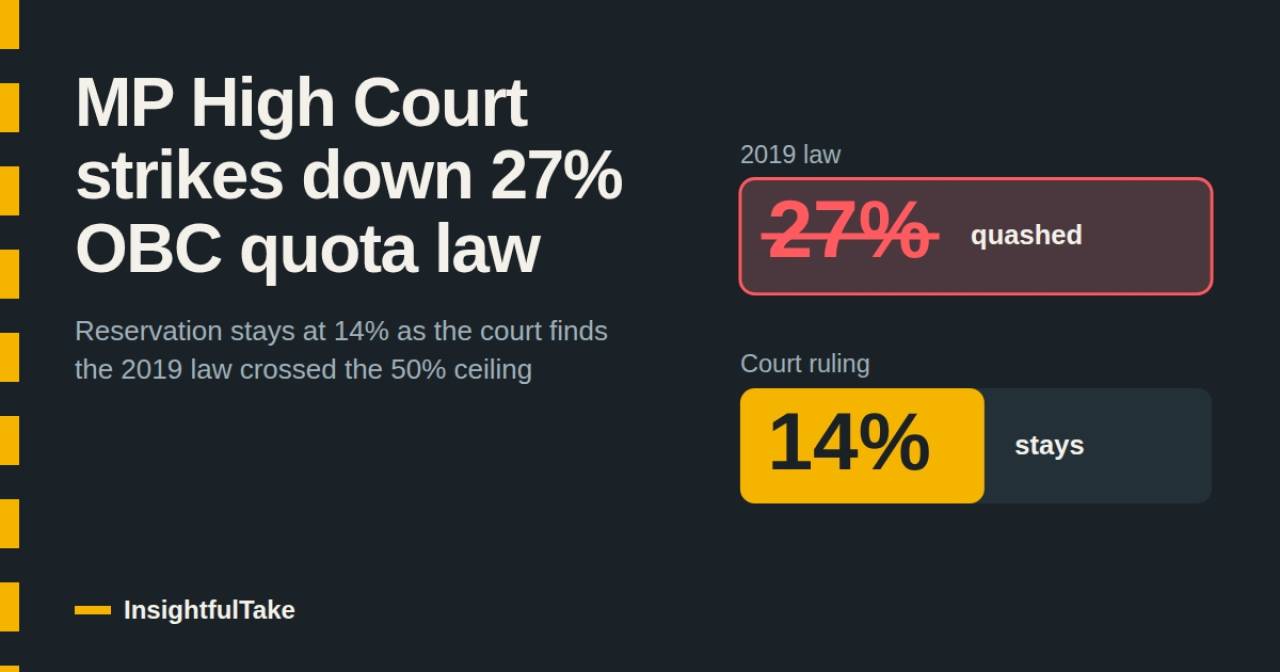
The Madhya Pradesh High Court has struck down the 27% OBC quota. Here is what the verdict means for government jobs, education and candidates appointed under the law.
The Madhya Pradesh High Court has struck down a 2019 law that increased reservation for Other Backward Classes (OBCs) from 14% to 27%, holding that the state failed to justify the increase beyond the Supreme Court’s 50% ceiling on reservations. The October 9 ruling keeps OBC reservation in public services and higher education at 14% and sets out directions for recruitment agencies to implement the decision.
A division bench of Justices Anand Pathak and Vinay Saraf delivered the verdict while deciding 94 petitions together.
Why the Court Rejected the 27% Quota
The bench held that the 2019 law was unconstitutional because it breached the 50% reservation ceiling laid down by the Supreme Court. Under the principles established in the Indra Sawhney and Jaishri Laxmanrao Patil judgments, states must demonstrate exceptional circumstances to justify exceeding this limit.
The court found that Madhya Pradesh had not established such circumstances. It also concluded that the available figures showed adequate OBC representation, weakening the case for increasing the quota under the principles applied in the ruling.
The bench questioned the process through which the law was introduced. It observed that the 2019 ordinance and amendment act had been prepared and passed in undue haste, with drafting errors.
The state’s reliance on the 1983 Mahajan Committee report and a 2023 report by Dr Bhimrao Ambedkar University of Social Science did not satisfy the court. It found that the recommendations of the State Backward Commission lacked fresh supporting data and raised concerns about whether the commission’s composition met the legal requirements for periodic revision.
The Data Behind the Verdict
The court relied on figures relating to OBC representation in higher education and government employment to support its conclusion.
According to the data cited in the ruling, OBCs accounted for 33.87% of higher education enrolment and 28.16% of government jobs, compared with the existing reservation quota of 14%.
The bench also referred to a 163% increase in OBC enrolment and figures from the All India Survey on Higher Education for 2021–22, which placed OBC students at 39% of the student population.
The court treated these figures as evidence of adequate representation. However, the interpretation of representation figures is likely to remain a point of debate.
Overall enrolment and employment numbers do not necessarily show whether OBC communities have equitable access to senior positions or whether representation varies across departments and institutions. Those supporting a higher quota may also question whether the data adequately captures the extent of social and educational disadvantage.
The central issue is whether the state can establish, through legally adequate and current evidence, the exceptional circumstances required to justify reservation beyond the 50% ceiling.
What Happens to Government Appointments?
The ruling has direct implications for recruitment conducted under the amended reservation law.
The court directed recruitment agencies, including the Madhya Pradesh Public Service Commission and the Employees Selection Board, to implement its order within three months.
The bench laid down the following directions:
- Appointments made under the amended law up to September 29, 2022, will remain valid.
- Appointments made after that date will be valid only to the extent of 87% of the relevant posts, with the remaining 13% to be filled from the unreserved list.
- OBC appointments exceeding the 14% quota made after the specified cut-off date were declared null and void.
These directions could affect recruitment outcomes and the position of candidates appointed or selected under the 27% quota. The implementation process will be closely watched by OBC aspirants and other candidates awaiting clarity on affected vacancies.
Congress and BJP Trade Charges
The 27% OBC reservation law was introduced in 2019 by the Congress government led by Kamal Nath. The Supreme Court subsequently sent the matter to the Madhya Pradesh High Court for consideration alongside connected petitions.
Political reactions to the verdict reflected the competing positions of the Congress and the BJP.
Congress leader JP Dhanopia blamed the present state government, alleging that it had failed to present the relevant facts effectively before the court.
Chief Minister Mohan Yadav, meanwhile, criticised the earlier Congress government for introducing the 27% quota through an ordinance. He described the measure as weak and legally flawed, arguing that it had been brought in hastily and without consultation with the National Commission for Backward Classes.
Yadav also questioned the intentions behind the earlier government's decision.
The two parties are focusing on different aspects of the case. The court’s criticism of the haste and drafting errors involved in making the law supports the Chief Minister’s argument about the legislation’s preparation. Congress, on the other hand, has questioned the present government’s handling of the legal proceedings.
Ultimately, the verdict rests on the court’s assessment of the law, the supporting evidence and the constitutional requirements for exceeding the reservation ceiling.
Can Madhya Pradesh Bring Back the 27% Quota?
The immediate question is whether the state government will challenge the ruling. No decision on a further challenge is specified in the information available here.
Any future attempt to increase OBC reservation would need to address the deficiencies identified by the court. This would require reliable and updated data, a properly constituted commission operating under the applicable legal framework, and evidence demonstrating the exceptional circumstances necessary to justify exceeding the 50% ceiling.
The judgment does not remove OBCs from the reservation framework. It strikes down the increase from 14% to 27% because the court found the legal and evidentiary justification insufficient.
For OBC candidates, the immediate consequence is the restoration of the 14% quota, subject to the court’s directions on appointments. For the state government, the challenge is to determine whether to pursue a further legal remedy or develop a fresh, legally sustainable basis for any proposed increase.
The ruling also reinforces a broader principle in reservation policy that the government’s decision to expand quotas must be supported by evidence and comply with constitutional and legal requirements, not merely by political commitments.
The Madhya Pradesh High Court has struck down a 2019 law that increased reservation for Other Backward Classes (OBCs) from 14% to 27%, holding that the state failed to justify the increase beyond the Supreme Court’s 50% ceiling on reservations. The October 9 ruling keeps OBC reservation in public services and higher education at 14% and sets out directions for recruitment agencies to implement the decision.
A division bench of Justices Anand Pathak and Vinay Saraf delivered the verdict while deciding 94 petitions together.
Why the Court Rejected the 27% Quota
The bench held that the 2019 law was unconstitutional because it breached the 50% reservation ceiling laid down by the Supreme Court. Under the principles established in the Indra Sawhney and Jaishri Laxmanrao Patil judgments, states must demonstrate exceptional circumstances to justify exceeding this limit.
The court found that Madhya Pradesh had not established such circumstances. It also concluded that the available figures showed adequate OBC representation, weakening the case for increasing the quota under the principles applied in the ruling.
The bench questioned the process through which the law was introduced. It observed that the 2019 ordinance and amendment act had been prepared and passed in undue haste, with drafting errors.
The state’s reliance on the 1983 Mahajan Committee report and a 2023 report by Dr Bhimrao Ambedkar University of Social Science did not satisfy the court. It found that the recommendations of the State Backward Commission lacked fresh supporting data and raised concerns about whether the commission’s composition met the legal requirements for periodic revision.
The Data Behind the Verdict
The court relied on figures relating to OBC representation in higher education and government employment to support its conclusion.
According to the data cited in the ruling, OBCs accounted for 33.87% of higher education enrolment and 28.16% of government jobs, compared with the existing reservation quota of 14%.
The bench also referred to a 163% increase in OBC enrolment and figures from the All India Survey on Higher Education for 2021–22, which placed OBC students at 39% of the student population.
The court treated these figures as evidence of adequate representation. However, the interpretation of representation figures is likely to remain a point of debate.
Overall enrolment and employment numbers do not necessarily show whether OBC communities have equitable access to senior positions or whether representation varies across departments and institutions. Those supporting a higher quota may also question whether the data adequately captures the extent of social and educational disadvantage.
The central issue is whether the state can establish, through legally adequate and current evidence, the exceptional circumstances required to justify reservation beyond the 50% ceiling.
What Happens to Government Appointments?
The ruling has direct implications for recruitment conducted under the amended reservation law.
The court directed recruitment agencies, including the Madhya Pradesh Public Service Commission and the Employees Selection Board, to implement its order within three months.
The bench laid down the following directions:
- Appointments made under the amended law up to September 29, 2022, will remain valid.
- Appointments made after that date will be valid only to the extent of 87% of the relevant posts, with the remaining 13% to be filled from the unreserved list.
- OBC appointments exceeding the 14% quota made after the specified cut-off date were declared null and void.
These directions could affect recruitment outcomes and the position of candidates appointed or selected under the 27% quota. The implementation process will be closely watched by OBC aspirants and other candidates awaiting clarity on affected vacancies.
Congress and BJP Trade Charges
The 27% OBC reservation law was introduced in 2019 by the Congress government led by Kamal Nath. The Supreme Court subsequently sent the matter to the Madhya Pradesh High Court for consideration alongside connected petitions.
Political reactions to the verdict reflected the competing positions of the Congress and the BJP.
Congress leader JP Dhanopia blamed the present state government, alleging that it had failed to present the relevant facts effectively before the court.
Chief Minister Mohan Yadav, meanwhile, criticised the earlier Congress government for introducing the 27% quota through an ordinance. He described the measure as weak and legally flawed, arguing that it had been brought in hastily and without consultation with the National Commission for Backward Classes.
Yadav also questioned the intentions behind the earlier government's decision.
The two parties are focusing on different aspects of the case. The court’s criticism of the haste and drafting errors involved in making the law supports the Chief Minister’s argument about the legislation’s preparation. Congress, on the other hand, has questioned the present government’s handling of the legal proceedings.
Ultimately, the verdict rests on the court’s assessment of the law, the supporting evidence and the constitutional requirements for exceeding the reservation ceiling.
Can Madhya Pradesh Bring Back the 27% Quota?
The immediate question is whether the state government will challenge the ruling. No decision on a further challenge is specified in the information available here.
Any future attempt to increase OBC reservation would need to address the deficiencies identified by the court. This would require reliable and updated data, a properly constituted commission operating under the applicable legal framework, and evidence demonstrating the exceptional circumstances necessary to justify exceeding the 50% ceiling.
The judgment does not remove OBCs from the reservation framework. It strikes down the increase from 14% to 27% because the court found the legal and evidentiary justification insufficient.
For OBC candidates, the immediate consequence is the restoration of the 14% quota, subject to the court’s directions on appointments. For the state government, the challenge is to determine whether to pursue a further legal remedy or develop a fresh, legally sustainable basis for any proposed increase.
The ruling also reinforces a broader principle in reservation policy that the government’s decision to expand quotas must be supported by evidence and comply with constitutional and legal requirements, not merely by political commitments.

















Leave a Comment