
A US degree may no longer be a predictable path to an American job. Indian students and professionals need to rethink the costs, risks and alternatives.
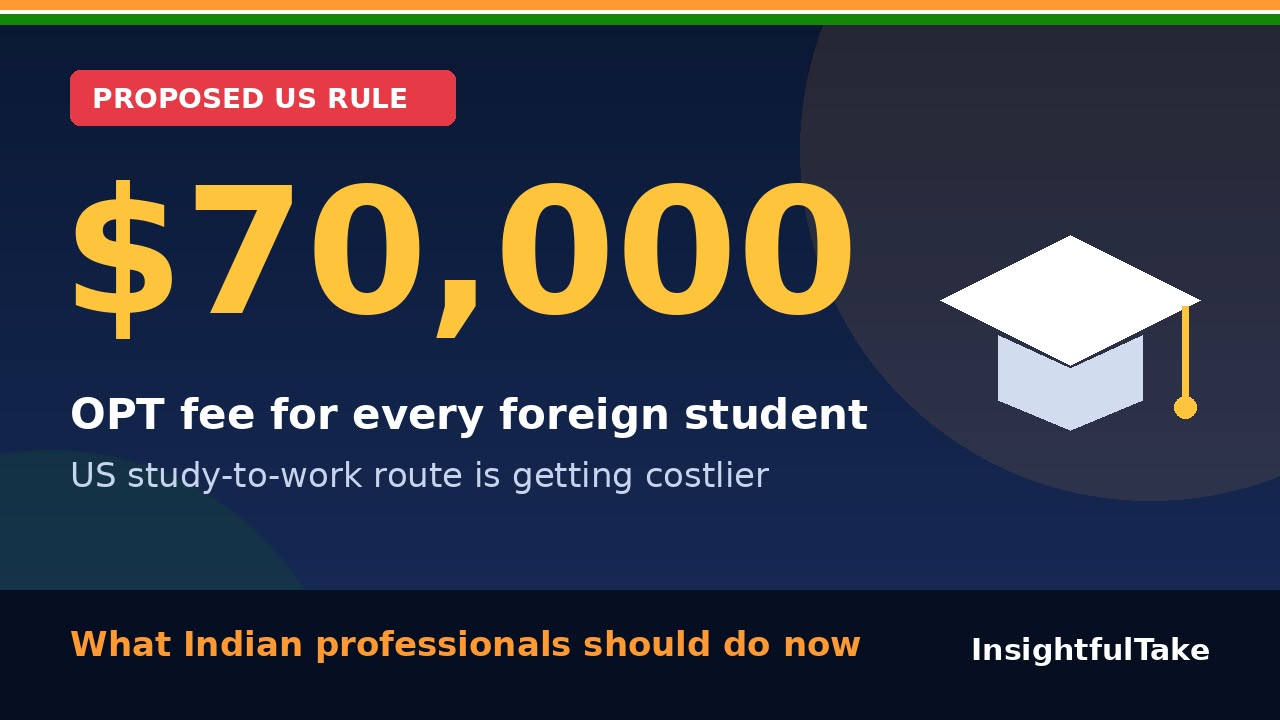
On September 07, 2026, the Department of Homeland Security (DHS) proposed a $70,000 fee tied to Optional Practical Training (OPT), the programme that allows international students to work in jobs related to their field of study during or after their education. For Indians planning to move to the United States through a master's degree, this is one of the most important policy signals in months.
The proposal is not yet law, so panic is the wrong response. But ignoring the potential consequences would be equally unwise.
What the Proposal Says
Under the draft rule, schools would pay the fee for every student participating in OPT. As reported, institutions would pay $70,000 for each new student's initial application and $30,000 for each renewal.
OPT normally allows international students to work in the United States for up to one year after graduation. Students in certain science, technology, engineering and mathematics (STEM) fields can qualify for an additional two years.
DHS has defended the proposed fee as a response to fraud and abuse, describing OPT as a "pipeline for cheap foreign labour". The public has 60 days to submit comments before the department can finalise the rule and bring it into effect.
The Cost Lands on Universities First
The proposed fee would be charged to educational institutions, not directly to students. This distinction, however, does not mean students will escape its financial consequences.
A university facing a five-figure charge for each OPT participant could respond in several ways. It might raise tuition fees, reduce international admissions or favour programmes whose graduates are less likely to participate in OPT.
Fanta Aw of NAFSA, an association of international educators, has argued that the measure would hurt American innovation and workforce development.
Whatever the final outcome, universities could face pressure to reconsider their admissions policies and fee structures for international students, particularly institutions that depend heavily on overseas tuition revenue.
For Indian families already spending substantial sums on American education, even a modest increase in costs or a reduction in post-study work opportunities could change the financial calculations.
A Wider Pattern of Uncertainty
The proposal comes amid a broader tightening of US immigration policies affecting international students.
Last year, the administration began terminating the legal status of thousands of international students. This summer, it finalised a rule aimed at preventing international students from remaining in the United States for more than four years without federal approval.
Higher education leaders argued that many academic programmes are designed to take longer than four years. A federal court stopped that rule from taking effect in September.
The direction of policy is becoming increasingly difficult for prospective students to ignore. Entry through a student visa may still be possible, but the predictability of the route from education to employment has weakened.
Courts have slowed some measures, but building a career plan around the expectation that a court will eventually intervene is a risky strategy.
What This Means for Different Professionals
1. If You Are Planning a US Master's Degree
If your primary reason for pursuing a master's degree in the United States is to secure a US job afterwards, reconsider the financial assumptions behind your decision.
The degree-to-OPT route has always depended on two major factors: gaining admission to a suitable university and obtaining post-study work opportunities. The second now carries greater uncertainty.
Calculate tuition fees, living expenses, loan repayments and potential earnings without assuming that you will receive three years of OPT employment. Consider whether the degree would still be worthwhile if you could not secure a US job immediately after graduation.
If your entire financial plan depends on recovering the cost of your education through OPT employment, treat that dependence as a warning sign.
2. If You Work for a Multinational Company
An internal transfer to a US office may offer an alternative to the student route, provided your employer has a suitable presence in the country and you meet the relevant visa requirements.
Speak to your human resources team early. Some employment-based transfer routes require a qualifying period of work with the company outside the United States, along with other eligibility conditions.
This option will not be available to everyone, but it may be worth exploring before committing to an expensive degree primarily for immigration purposes.
3. If You Have Specialised Skills or a Strong Professional Record
Professionals with specialised expertise, substantial achievements or strong employment records should examine employer-sponsored visas and, where appropriate, extraordinary-ability categories.
These routes can offer alternatives to entering the US through a student visa. However, they come with their own eligibility criteria, expenses, competition and processing delays.
Consult a qualified US immigration lawyer to determine whether your experience and qualifications make you a realistic candidate.
4. If You Are Already Studying in the US
Current students and recent graduates should follow developments closely rather than assume that existing OPT arrangements will remain unchanged.
The proposal may face legal challenges, and its final form and implementation timeline could differ from the draft. Contact your university's international student office to understand how it is monitoring the proposal and what guidance it can provide.
Avoid making major financial or employment decisions based on unconfirmed interpretations of the proposed rule.
Practical Steps Indian Professionals Should Take
Read the official proposal. Understand what DHS has actually proposed, the public comment period and any changes made before a final rule is issued.
Budget conservatively. Assess whether you can afford the degree if post-study employment takes longer to secure or work opportunities are more limited than expected.
Compare immigration routes, not just universities. An internal transfer, direct employer sponsorship or study in another country may offer a better balance of cost, opportunity and risk.
Seek qualified legal advice. Immigration rules can change quickly. Before committing large sums to education or relocation, obtain advice based on the latest regulations and your individual circumstances.
Keep a second option open. Canada, the United Kingdom, Germany and Australia also impose immigration and post-study work requirements. Their policies should be evaluated carefully rather than treated as automatic alternatives. Diversifying your options can reduce dependence on a single country's changing rules.
Final Take
The United States remains a major destination for Indian talent, offering access to leading universities, research institutions and global employers. But the student-to-worker route, long viewed as a relatively straightforward way to enter the American job market, is becoming harder to predict.
The proposed fee could be revised, delayed or blocked through legal action. Until the final outcome is known, Indian professionals should avoid treating the draft as settled law while preparing for the possibility that the route may become more expensive or restrictive.
The smartest decision is not necessarily to abandon the American dream. It is to stop building that dream around the assumption that a US degree will automatically lead to a US job.
On September 07, 2026, the Department of Homeland Security (DHS) proposed a $70,000 fee tied to Optional Practical Training (OPT), the programme that allows international students to work in jobs related to their field of study during or after their education. For Indians planning to move to the United States through a master's degree, this is one of the most important policy signals in months.
The proposal is not yet law, so panic is the wrong response. But ignoring the potential consequences would be equally unwise.
What the Proposal Says
Under the draft rule, schools would pay the fee for every student participating in OPT. As reported, institutions would pay $70,000 for each new student's initial application and $30,000 for each renewal.
OPT normally allows international students to work in the United States for up to one year after graduation. Students in certain science, technology, engineering and mathematics (STEM) fields can qualify for an additional two years.
DHS has defended the proposed fee as a response to fraud and abuse, describing OPT as a "pipeline for cheap foreign labour". The public has 60 days to submit comments before the department can finalise the rule and bring it into effect.
The Cost Lands on Universities First
The proposed fee would be charged to educational institutions, not directly to students. This distinction, however, does not mean students will escape its financial consequences.
A university facing a five-figure charge for each OPT participant could respond in several ways. It might raise tuition fees, reduce international admissions or favour programmes whose graduates are less likely to participate in OPT.
Fanta Aw of NAFSA, an association of international educators, has argued that the measure would hurt American innovation and workforce development.
Whatever the final outcome, universities could face pressure to reconsider their admissions policies and fee structures for international students, particularly institutions that depend heavily on overseas tuition revenue.
For Indian families already spending substantial sums on American education, even a modest increase in costs or a reduction in post-study work opportunities could change the financial calculations.
A Wider Pattern of Uncertainty
The proposal comes amid a broader tightening of US immigration policies affecting international students.
Last year, the administration began terminating the legal status of thousands of international students. This summer, it finalised a rule aimed at preventing international students from remaining in the United States for more than four years without federal approval.
Higher education leaders argued that many academic programmes are designed to take longer than four years. A federal court stopped that rule from taking effect in September.
The direction of policy is becoming increasingly difficult for prospective students to ignore. Entry through a student visa may still be possible, but the predictability of the route from education to employment has weakened.
Courts have slowed some measures, but building a career plan around the expectation that a court will eventually intervene is a risky strategy.
What This Means for Different Professionals
1. If You Are Planning a US Master's Degree
If your primary reason for pursuing a master's degree in the United States is to secure a US job afterwards, reconsider the financial assumptions behind your decision.
The degree-to-OPT route has always depended on two major factors: gaining admission to a suitable university and obtaining post-study work opportunities. The second now carries greater uncertainty.
Calculate tuition fees, living expenses, loan repayments and potential earnings without assuming that you will receive three years of OPT employment. Consider whether the degree would still be worthwhile if you could not secure a US job immediately after graduation.
If your entire financial plan depends on recovering the cost of your education through OPT employment, treat that dependence as a warning sign.
2. If You Work for a Multinational Company
An internal transfer to a US office may offer an alternative to the student route, provided your employer has a suitable presence in the country and you meet the relevant visa requirements.
Speak to your human resources team early. Some employment-based transfer routes require a qualifying period of work with the company outside the United States, along with other eligibility conditions.
This option will not be available to everyone, but it may be worth exploring before committing to an expensive degree primarily for immigration purposes.
3. If You Have Specialised Skills or a Strong Professional Record
Professionals with specialised expertise, substantial achievements or strong employment records should examine employer-sponsored visas and, where appropriate, extraordinary-ability categories.
These routes can offer alternatives to entering the US through a student visa. However, they come with their own eligibility criteria, expenses, competition and processing delays.
Consult a qualified US immigration lawyer to determine whether your experience and qualifications make you a realistic candidate.
4. If You Are Already Studying in the US
Current students and recent graduates should follow developments closely rather than assume that existing OPT arrangements will remain unchanged.
The proposal may face legal challenges, and its final form and implementation timeline could differ from the draft. Contact your university's international student office to understand how it is monitoring the proposal and what guidance it can provide.
Avoid making major financial or employment decisions based on unconfirmed interpretations of the proposed rule.
Practical Steps Indian Professionals Should Take
Read the official proposal. Understand what DHS has actually proposed, the public comment period and any changes made before a final rule is issued.
Budget conservatively. Assess whether you can afford the degree if post-study employment takes longer to secure or work opportunities are more limited than expected.
Compare immigration routes, not just universities. An internal transfer, direct employer sponsorship or study in another country may offer a better balance of cost, opportunity and risk.
Seek qualified legal advice. Immigration rules can change quickly. Before committing large sums to education or relocation, obtain advice based on the latest regulations and your individual circumstances.
Keep a second option open. Canada, the United Kingdom, Germany and Australia also impose immigration and post-study work requirements. Their policies should be evaluated carefully rather than treated as automatic alternatives. Diversifying your options can reduce dependence on a single country's changing rules.
Final Take
The United States remains a major destination for Indian talent, offering access to leading universities, research institutions and global employers. But the student-to-worker route, long viewed as a relatively straightforward way to enter the American job market, is becoming harder to predict.
The proposed fee could be revised, delayed or blocked through legal action. Until the final outcome is known, Indian professionals should avoid treating the draft as settled law while preparing for the possibility that the route may become more expensive or restrictive.
The smartest decision is not necessarily to abandon the American dream. It is to stop building that dream around the assumption that a US degree will automatically lead to a US job.

























Leave a Comment