
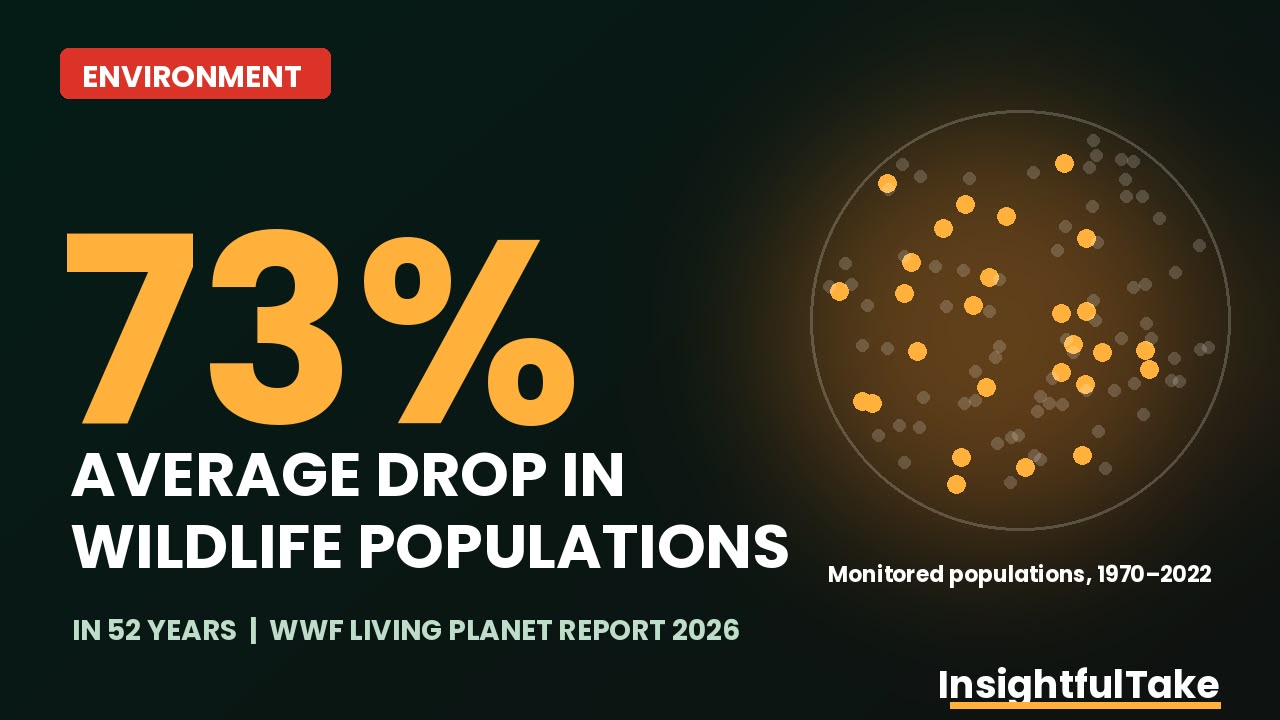
Monitored wildlife populations have declined 73% since 1970, with freshwater ecosystems facing the biggest losses. But some species are showing that recovery is possible.
WWF's Living Planet Report 2026 has put a striking number on the decline of wildlife. Monitored wildlife populations fell by an average of 73% between 1970 and 2022.
The figure covers mammals, birds, fish, reptiles and amphibians tracked across different parts of the world. It does not mean that 73% of the world's animals have disappeared. Instead, it shows how much the populations included in the study have declined over the past 52 years.
The distinction is important, but the trend itself is difficult to ignore. Wildlife populations are under growing pressure, and the decline has been particularly severe in freshwater ecosystems.
Freshwater wildlife has seen the biggest decline
According to the report, monitored wildlife populations in freshwater ecosystems have fallen by 85% since 1970. The decline is 69% for terrestrial populations and 59% for marine populations.
The freshwater figure is particularly relevant for India. Rivers, lakes and wetlands support agriculture, fisheries, drinking water and the livelihoods of millions of people. When these ecosystems deteriorate, the impact is not limited to wildlife.
The report also shows large differences between regions.
Latin America and the Caribbean recorded a 95% decline in monitored wildlife populations, followed by Africa at 80%. The decline was 49% in Asia and the Pacific, 28% in North America, and 23% in Europe and Central Asia.
These figures should be read in the context of the species and populations covered by the index. They do not mean that wildlife has declined by exactly these percentages across every country or ecosystem in each region.
The 73% figure does not mean 73% of animals are gone
This is one of the most important points in the report.
The Living Planet Index tracks changes in the size of monitored animal populations. It is not a count of how many individual animals remain on Earth.
For example, if a particular fish population falls from 10,000 to 5,000, that population has declined by 50%. The index combines changes across a very large number of monitored populations to show the broader trend.
So the 73% figure should not be interpreted as saying that nearly three-quarters of all animals have disappeared.
It does, however, show a major decline among the wildlife populations that scientists have been able to monitor.
There is another side to the story
The report also contains evidence that conservation efforts can produce results.
About half of the populations included in the index are stable or increasing. Some species, including green turtles, bluefin tuna, southern African elephants and tigers, have shown signs of recovery.
That is important because it shows that wildlife decline is not necessarily irreversible.
India's tiger conservation programme is one example.
India is home to about 75% of the world's wild tiger population. The 2022 All India Tiger Estimation recorded 3,682 tigers in the country.
The increase in tiger numbers did not happen by accident. It followed years of habitat protection, anti-poaching measures, scientific monitoring and conservation programmes, along with the involvement of local communities.
The tiger story does not mean India's wider biodiversity problems have been solved. It does show that sustained conservation efforts can make a measurable difference.
The bigger problem is how we use nature
WWF's report looks beyond individual species. It argues that the future of biodiversity will depend heavily on changes in three major areas: energy, food and finance.
The way countries produce and use energy affects emissions and ecosystems. The way food is produced affects land, water and wildlife. Financial decisions influence which economic activities receive investment and which environmental pressures continue.
The report's argument is that changes in these systems could help create what it calls "positive tipping points", where sustainable practices begin to spread quickly enough to reverse some of the damage.
That makes biodiversity conservation a much wider issue than protecting endangered animals.
Why wildlife decline gets less attention
A major reason wildlife loss often receives less public attention is that it usually happens gradually.
A forest may lose habitat over many years. A river may slowly lose fish. A wetland may become smaller as construction and other activities expand around it. None of these changes necessarily produces the kind of dramatic event that immediately becomes a major news story.
But the effects can eventually reach people.
Healthy ecosystems help provide clean water, support food production, protect soil and contribute to livelihoods. When those systems weaken, the consequences can extend well beyond the animals being monitored.
That is why the 73% figure deserves attention, but also careful interpretation.
The report is not saying that 73% of the world's wildlife has disappeared. It is showing that monitored wildlife populations have declined sharply over the past five decades.
At the same time, the recovery of species such as tigers and green turtles shows that the trend can change when conservation measures are sustained.
The warning is serious, but the evidence does not point only in one direction. Wildlife is declining in many places, while some populations are recovering.
What happens next will depend largely on whether those successful conservation efforts remain isolated examples or become part of much wider changes in how societies manage land, water, food, energy and natural resources.
WWF's Living Planet Report 2026 has put a striking number on the decline of wildlife. Monitored wildlife populations fell by an average of 73% between 1970 and 2022.
The figure covers mammals, birds, fish, reptiles and amphibians tracked across different parts of the world. It does not mean that 73% of the world's animals have disappeared. Instead, it shows how much the populations included in the study have declined over the past 52 years.
The distinction is important, but the trend itself is difficult to ignore. Wildlife populations are under growing pressure, and the decline has been particularly severe in freshwater ecosystems.
Freshwater wildlife has seen the biggest decline
According to the report, monitored wildlife populations in freshwater ecosystems have fallen by 85% since 1970. The decline is 69% for terrestrial populations and 59% for marine populations.
The freshwater figure is particularly relevant for India. Rivers, lakes and wetlands support agriculture, fisheries, drinking water and the livelihoods of millions of people. When these ecosystems deteriorate, the impact is not limited to wildlife.
The report also shows large differences between regions.
Latin America and the Caribbean recorded a 95% decline in monitored wildlife populations, followed by Africa at 80%. The decline was 49% in Asia and the Pacific, 28% in North America, and 23% in Europe and Central Asia.
These figures should be read in the context of the species and populations covered by the index. They do not mean that wildlife has declined by exactly these percentages across every country or ecosystem in each region.
The 73% figure does not mean 73% of animals are gone
This is one of the most important points in the report.
The Living Planet Index tracks changes in the size of monitored animal populations. It is not a count of how many individual animals remain on Earth.
For example, if a particular fish population falls from 10,000 to 5,000, that population has declined by 50%. The index combines changes across a very large number of monitored populations to show the broader trend.
So the 73% figure should not be interpreted as saying that nearly three-quarters of all animals have disappeared.
It does, however, show a major decline among the wildlife populations that scientists have been able to monitor.
There is another side to the story
The report also contains evidence that conservation efforts can produce results.
About half of the populations included in the index are stable or increasing. Some species, including green turtles, bluefin tuna, southern African elephants and tigers, have shown signs of recovery.
That is important because it shows that wildlife decline is not necessarily irreversible.
India's tiger conservation programme is one example.
India is home to about 75% of the world's wild tiger population. The 2022 All India Tiger Estimation recorded 3,682 tigers in the country.
The increase in tiger numbers did not happen by accident. It followed years of habitat protection, anti-poaching measures, scientific monitoring and conservation programmes, along with the involvement of local communities.
The tiger story does not mean India's wider biodiversity problems have been solved. It does show that sustained conservation efforts can make a measurable difference.
The bigger problem is how we use nature
WWF's report looks beyond individual species. It argues that the future of biodiversity will depend heavily on changes in three major areas: energy, food and finance.
The way countries produce and use energy affects emissions and ecosystems. The way food is produced affects land, water and wildlife. Financial decisions influence which economic activities receive investment and which environmental pressures continue.
The report's argument is that changes in these systems could help create what it calls "positive tipping points", where sustainable practices begin to spread quickly enough to reverse some of the damage.
That makes biodiversity conservation a much wider issue than protecting endangered animals.
Why wildlife decline gets less attention
A major reason wildlife loss often receives less public attention is that it usually happens gradually.
A forest may lose habitat over many years. A river may slowly lose fish. A wetland may become smaller as construction and other activities expand around it. None of these changes necessarily produces the kind of dramatic event that immediately becomes a major news story.
But the effects can eventually reach people.
Healthy ecosystems help provide clean water, support food production, protect soil and contribute to livelihoods. When those systems weaken, the consequences can extend well beyond the animals being monitored.
That is why the 73% figure deserves attention, but also careful interpretation.
The report is not saying that 73% of the world's wildlife has disappeared. It is showing that monitored wildlife populations have declined sharply over the past five decades.
At the same time, the recovery of species such as tigers and green turtles shows that the trend can change when conservation measures are sustained.
The warning is serious, but the evidence does not point only in one direction. Wildlife is declining in many places, while some populations are recovering.
What happens next will depend largely on whether those successful conservation efforts remain isolated examples or become part of much wider changes in how societies manage land, water, food, energy and natural resources.






















Leave a Comment