
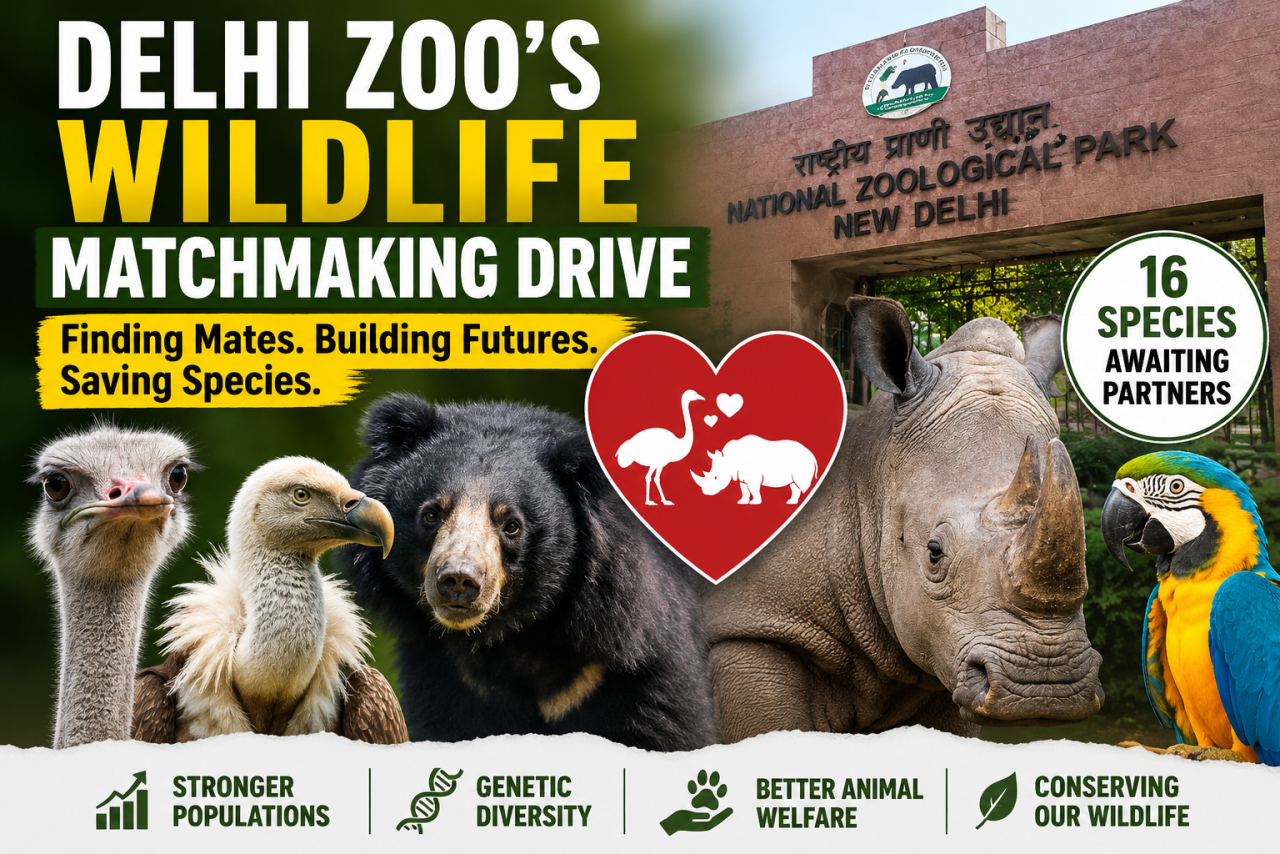
What if saving a species began with finding the right partner? Delhi Zoo's unusual matchmaking mission could shape the future of wildlife conservation in India.
In a world where dating apps promise to connect lonely hearts, an unusual matchmaking exercise is underway in the heart of India's capital. The difference is that the participants are not people but ostriches, rhinos, vultures, bears, langurs, swans, and even macaws. Their future relationships could determine the survival of entire captive populations.
The National Zoological Park in New Delhi, popularly known as Delhi Zoo, has launched an ambitious wildlife matchmaking initiative aimed at finding suitable partners for a range of animals and birds living without mates. Far from being a whimsical exercise, the programme is rooted in conservation science and reflects the growing challenges faced by zoos in maintaining healthy and genetically diverse animal populations.
A Search for Suitable Partners
According to zoo officials, at least 16 species currently housed in Delhi Zoo have individuals living alone or in same-sex groups, making natural breeding impossible. To address the issue, the zoo has begun discussions with zoological parks across the country to exchange animals and create compatible breeding pairs.
The list of species awaiting partners reads like a miniature catalogue of global biodiversity. It includes ostriches, rheas, Egyptian vultures, Indian grey hornbills, grey langurs, rhinoceroses, black bears, black swans, barn owls, porcupines, spoonbills and blue-winged macaws.
Some of these animals have spent years without a mate.
Two male ostriches have shared an enclosure since 2021 with no female companion in sight. A female rhinoceros, now around 18 years old, lost her mate last year. An Egyptian vulture that has crossed two decades of age has remained without a partner for years, while a female rhea has been waiting since 2018.
For zoo managers, these are not merely statistics. Every year that passes without successful breeding represents a lost opportunity to strengthen captive populations and preserve valuable genetic traits.
Why Zoos Need Matchmaking
Modern zoos have evolved far beyond their traditional role as exhibition spaces. Across the world, they increasingly function as conservation centres, genetic reservoirs and breeding hubs for threatened species.
A healthy breeding programme requires more than simply placing a male and female animal together. Conservation biologists must carefully assess genetics, age, health, behaviour and breeding history before recommending a match.
When a zoo houses only one individual of a species—or multiple animals of the same sex—the breeding chain effectively stops. Over time, isolated populations can become genetically vulnerable. Limited gene pools increase the risk of inherited disorders and reduce a species' ability to adapt to changing environmental conditions.
This is why Delhi Zoo's current initiative focuses not only on reproduction but also on genetic diversity. By bringing in unrelated animals from other zoos, officials hope to introduce fresh bloodlines into captive populations.
The Complex Art of Animal Pairing
Unlike human matchmaking, conservation pairing requires extensive planning and coordination.
Delhi Zoo is exploring exchange programmes with facilities in Chhatbir, Ranchi, Rohtak, Bilaspur and several other zoological parks. Such exchanges involve veterinary examinations, transport planning, quarantine protocols and approvals from wildlife authorities.
The challenge becomes particularly significant when dealing with rare species.
Take the zoo's black bears. The facility currently has four females after the death of a male bear in 2024. Without a suitable male, breeding prospects remain uncertain.
Similarly, a male rhinoceros brought to serve as a companion for a female rhino reportedly died last year before the pairing could deliver conservation benefits.
The zoo is also searching for partners for a male grey langur, a male black swan, a male barn owl, a male black francolin, a male Indian civet, and female blue-winged macaws, among others.
Each case presents unique biological and behavioural considerations. Some species bond quickly, while others require careful introductions over weeks or even months.
Conservation Beyond Charisma
Public attention often gravitates towards iconic species such as tigers, lions and elephants. Yet the Delhi Zoo initiative highlights the importance of lesser-known animals that rarely dominate conservation headlines.
Birds like the Egyptian vulture, for instance, have witnessed dramatic declines in parts of South Asia. Hornbills play a crucial role in forest ecosystems by dispersing seeds. Spoonbills help maintain wetland biodiversity, while porcupines contribute to ecological balance through their feeding habits.
By attempting to establish breeding populations for these species, zoos help create insurance populations that may become increasingly important as wild habitats face mounting pressure from urbanisation, climate change and human activity.
Ethical Questions and Conservation Realities
The idea of animals living alone in captivity raises broader questions about zoo management and animal welfare.
For highly social species, companionship can significantly improve quality of life. A suitable partner often provides behavioural stimulation, reduces stress and allows animals to express natural social behaviours.
Zoo authorities argue that the current drive serves a dual purpose: improving animal welfare while simultaneously advancing conservation objectives.
The emphasis on pairing solitary animals therefore reflects a shift in modern zoo philosophy—from simply displaying wildlife to actively managing populations in scientifically informed ways.
A National Network for Wildlife Survival
Delhi Zoo's initiative also demonstrates the importance of cooperation among Indian zoological institutions. No single zoo can maintain sustainable populations of every species on its own.
The future of captive conservation increasingly depends on coordinated national networks where animals are moved strategically to maximise breeding success and genetic diversity. Similar approaches are already used internationally through managed breeding programmes for endangered species.
India's zoos are gradually adopting these principles, turning animal exchanges into an important conservation tool rather than a logistical exercise.
More Than a Matchmaking Story
At first glance, the zoo officials searching for mates for ostriches, bears and vultures may appear amusing. Yet behind the headlines lies a serious conservation mission.
Every successful pairing could lead to the birth of offspring carrying valuable genetic diversity. Every new breeding pair strengthens the long-term viability of captive populations. And every coordinated exchange between zoos contributes to a broader effort to safeguard species facing uncertain futures.
The lonely ostrich, the waiting rhea, the partnerless rhino and the solitary vulture are reminders that conservation is often about details invisible to the public eye. Sometimes, saving a species begins not with a dramatic rescue operation but with finding the right companion.
In that sense, Delhi Zoo's latest initiative is not merely a search for mates. It is a search for the future of conservation itself.
In a world where dating apps promise to connect lonely hearts, an unusual matchmaking exercise is underway in the heart of India's capital. The difference is that the participants are not people but ostriches, rhinos, vultures, bears, langurs, swans, and even macaws. Their future relationships could determine the survival of entire captive populations.
The National Zoological Park in New Delhi, popularly known as Delhi Zoo, has launched an ambitious wildlife matchmaking initiative aimed at finding suitable partners for a range of animals and birds living without mates. Far from being a whimsical exercise, the programme is rooted in conservation science and reflects the growing challenges faced by zoos in maintaining healthy and genetically diverse animal populations.
A Search for Suitable Partners
According to zoo officials, at least 16 species currently housed in Delhi Zoo have individuals living alone or in same-sex groups, making natural breeding impossible. To address the issue, the zoo has begun discussions with zoological parks across the country to exchange animals and create compatible breeding pairs.
The list of species awaiting partners reads like a miniature catalogue of global biodiversity. It includes ostriches, rheas, Egyptian vultures, Indian grey hornbills, grey langurs, rhinoceroses, black bears, black swans, barn owls, porcupines, spoonbills and blue-winged macaws.
Some of these animals have spent years without a mate.
Two male ostriches have shared an enclosure since 2021 with no female companion in sight. A female rhinoceros, now around 18 years old, lost her mate last year. An Egyptian vulture that has crossed two decades of age has remained without a partner for years, while a female rhea has been waiting since 2018.
For zoo managers, these are not merely statistics. Every year that passes without successful breeding represents a lost opportunity to strengthen captive populations and preserve valuable genetic traits.
Why Zoos Need Matchmaking
Modern zoos have evolved far beyond their traditional role as exhibition spaces. Across the world, they increasingly function as conservation centres, genetic reservoirs and breeding hubs for threatened species.
A healthy breeding programme requires more than simply placing a male and female animal together. Conservation biologists must carefully assess genetics, age, health, behaviour and breeding history before recommending a match.
When a zoo houses only one individual of a species—or multiple animals of the same sex—the breeding chain effectively stops. Over time, isolated populations can become genetically vulnerable. Limited gene pools increase the risk of inherited disorders and reduce a species' ability to adapt to changing environmental conditions.
This is why Delhi Zoo's current initiative focuses not only on reproduction but also on genetic diversity. By bringing in unrelated animals from other zoos, officials hope to introduce fresh bloodlines into captive populations.
The Complex Art of Animal Pairing
Unlike human matchmaking, conservation pairing requires extensive planning and coordination.
Delhi Zoo is exploring exchange programmes with facilities in Chhatbir, Ranchi, Rohtak, Bilaspur and several other zoological parks. Such exchanges involve veterinary examinations, transport planning, quarantine protocols and approvals from wildlife authorities.
The challenge becomes particularly significant when dealing with rare species.
Take the zoo's black bears. The facility currently has four females after the death of a male bear in 2024. Without a suitable male, breeding prospects remain uncertain.
Similarly, a male rhinoceros brought to serve as a companion for a female rhino reportedly died last year before the pairing could deliver conservation benefits.
The zoo is also searching for partners for a male grey langur, a male black swan, a male barn owl, a male black francolin, a male Indian civet, and female blue-winged macaws, among others.
Each case presents unique biological and behavioural considerations. Some species bond quickly, while others require careful introductions over weeks or even months.
Conservation Beyond Charisma
Public attention often gravitates towards iconic species such as tigers, lions and elephants. Yet the Delhi Zoo initiative highlights the importance of lesser-known animals that rarely dominate conservation headlines.
Birds like the Egyptian vulture, for instance, have witnessed dramatic declines in parts of South Asia. Hornbills play a crucial role in forest ecosystems by dispersing seeds. Spoonbills help maintain wetland biodiversity, while porcupines contribute to ecological balance through their feeding habits.
By attempting to establish breeding populations for these species, zoos help create insurance populations that may become increasingly important as wild habitats face mounting pressure from urbanisation, climate change and human activity.
Ethical Questions and Conservation Realities
The idea of animals living alone in captivity raises broader questions about zoo management and animal welfare.
For highly social species, companionship can significantly improve quality of life. A suitable partner often provides behavioural stimulation, reduces stress and allows animals to express natural social behaviours.
Zoo authorities argue that the current drive serves a dual purpose: improving animal welfare while simultaneously advancing conservation objectives.
The emphasis on pairing solitary animals therefore reflects a shift in modern zoo philosophy—from simply displaying wildlife to actively managing populations in scientifically informed ways.
A National Network for Wildlife Survival
Delhi Zoo's initiative also demonstrates the importance of cooperation among Indian zoological institutions. No single zoo can maintain sustainable populations of every species on its own.
The future of captive conservation increasingly depends on coordinated national networks where animals are moved strategically to maximise breeding success and genetic diversity. Similar approaches are already used internationally through managed breeding programmes for endangered species.
India's zoos are gradually adopting these principles, turning animal exchanges into an important conservation tool rather than a logistical exercise.
More Than a Matchmaking Story
At first glance, the zoo officials searching for mates for ostriches, bears and vultures may appear amusing. Yet behind the headlines lies a serious conservation mission.
Every successful pairing could lead to the birth of offspring carrying valuable genetic diversity. Every new breeding pair strengthens the long-term viability of captive populations. And every coordinated exchange between zoos contributes to a broader effort to safeguard species facing uncertain futures.
The lonely ostrich, the waiting rhea, the partnerless rhino and the solitary vulture are reminders that conservation is often about details invisible to the public eye. Sometimes, saving a species begins not with a dramatic rescue operation but with finding the right companion.
In that sense, Delhi Zoo's latest initiative is not merely a search for mates. It is a search for the future of conservation itself.















Leave a Comment