
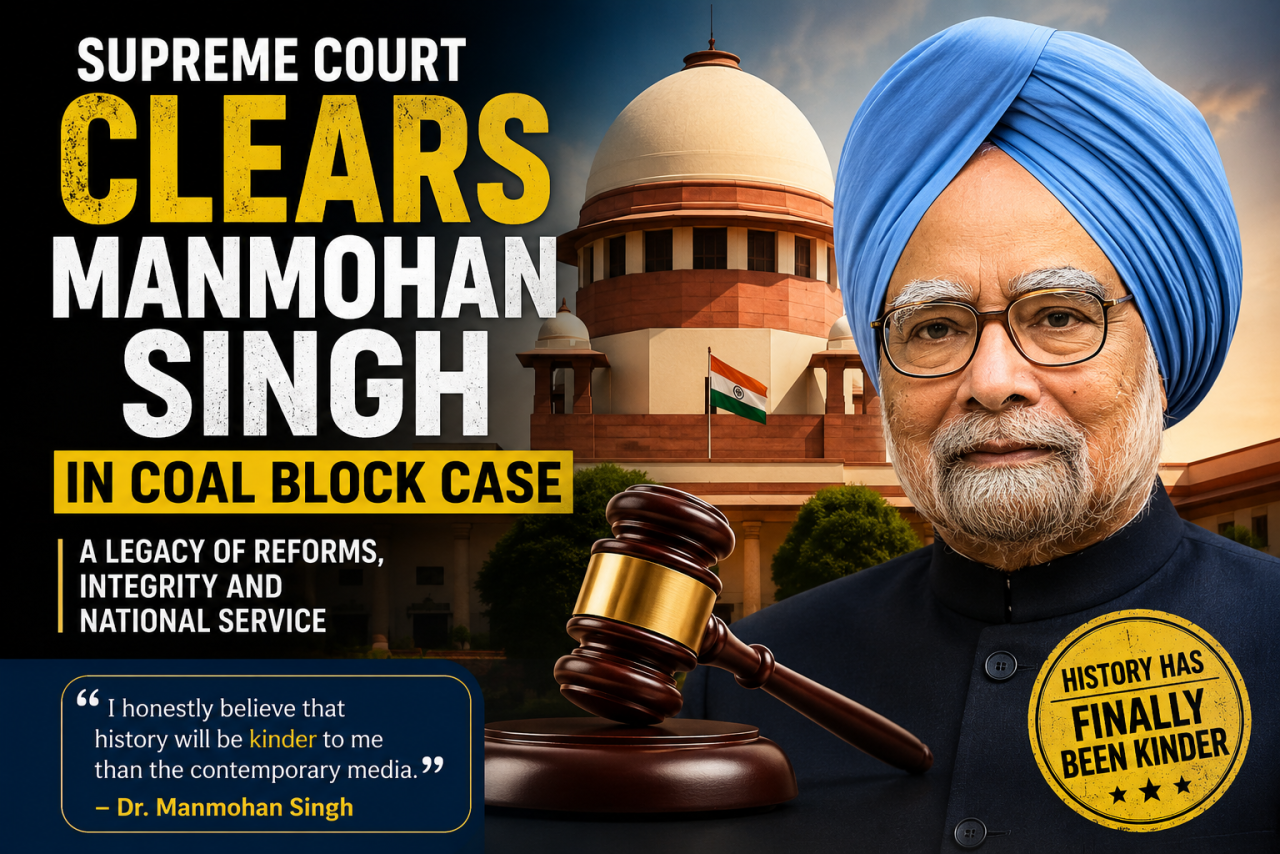
The Supreme Court has cleared Manmohan Singh in the coal block case, bringing long-awaited legal closure and renewing debate over the legacy of the economist who reshaped modern India.
For years, former Prime Minister Dr. Manmohan Singh carried a political burden that often overshadowed one of the most consequential public careers in independent India. While his critics repeatedly invoked the coal block allocation controversy to question his leadership, many overlooked a simple fact that no court had ever found evidence with criminal intent against him.
Now, months after his passing, the Supreme Court has finally brought that long and painful chapter to a close.
In a landmark judgment, the apex court formally exonerated Dr. Singh in the coal block allocation case, setting aside the trial court's order that had summoned him as an accused despite two CBI closure reports concluding that no criminal case was made out against him. Though the legal battle became technically infructuous after his death in December 2024, the Supreme Court chose to decide the matter because of its immense legal and moral significance.
In doing so, the court restored something that had remained under a cloud for more than a decade. The public reputation of one of India's most understated statesmen was finally vindicated.
More Than a Legal Victory
This judgment is not merely about one criminal case. It is about the responsibility of institutions to protect the dignity of public office and the principle that suspicion cannot replace evidence.
The Supreme Court observed that there was no material justifying prosecution when investigating agencies themselves had twice filed closure reports. It also questioned the legality of summoning an individual under such circumstances and emphasised that courts must exercise caution before disregarding investigative findings without sufficient grounds.
The verdict reinforces an essential principle of justice that the public office does not make anyone above the law, but neither should it make someone an easy target in the absence of evidence.
A Leader Who Reshaped India's Economic Destiny
History rarely judges leaders only by the controversies surrounding them. It also remembers the transformations they leave behind.
As Finance Minister in 1991, Dr. Manmohan Singh steered India through one of its gravest economic crises. Foreign exchange reserves had almost vanished, the country faced the possibility of sovereign default, and confidence in India's economy was collapsing.
The liberalisation reforms introduced under Prime Minister P.V. Narasimha Rao, with Dr. Singh as the architect, fundamentally changed India's economic direction. Markets opened, industries expanded, foreign investment increased, and millions were lifted into the expanding middle class over the following decades.
Today's India, aspiring to become a multi-trillion-dollar economy, continues to benefit from foundations laid during those difficult years.
The Quiet Prime Minister
When Dr. Singh became Prime Minister in 2004, he brought with him a leadership style that contrasted sharply with the personality-driven politics often seen around the world.
Reserved, scholarly and measured, he rarely sought headlines. Critics frequently described him as soft-spoken or politically weak. Supporters saw something different: a leader who believed institutions mattered more than individuals.
His government delivered sustained economic growth for several years, expanded welfare programmes through initiatives such as the Right to Information Act and the Mahatma Gandhi National Rural Employment Guarantee Act, strengthened India's banking system, and invested heavily in education and infrastructure.
Yet perhaps his boldest political decision came in foreign policy.
The Nuclear Deal That Changed India's Global Standing
The India-United States Civil Nuclear Agreement remains one of the defining moments of Dr. Singh's premiership.
The agreement ended decades of India's nuclear isolation and opened the doors for global civil nuclear cooperation without requiring India to abandon its strategic nuclear programme.
The political cost was enormous. His government nearly collapsed after losing Left Party support. Facing a confidence vote in Parliament, Dr. Singh refused to abandon what he believed served India's long-term national interest.
Today, the agreement is widely recognised as a turning point that enhanced India's global strategic stature and strengthened its partnerships with major powers.
"History Will Be Kinder to Me"
Perhaps the most memorable words spoken by Dr. Manmohan Singh about his own legacy came during his final press conference as Prime Minister in 2014.
He said, "I honestly believe that history will be kinder to me than the contemporary media."
At the time, many dismissed it as the reflection of a departing leader facing criticism over corruption allegations that dominated public discourse.
More than a decade later, those words seem remarkably prophetic.
Economic historians increasingly recognise the significance of the 1991 reforms. Foreign policy experts continue to praise the nuclear agreement. Welfare economists acknowledge the lasting impact of several rights-based legislations introduced during his tenure.
Now, even the judicial system has removed one of the most persistent legal shadows that followed him.
Reputation Beyond Politics
Political debates will continue. Governments will be praised and criticised. Policies will always remain open to disagreement.
But reputations should ultimately rest on facts rather than narratives.
The Supreme Court's decision does not rewrite political history, nor does it erase every criticism directed at the UPA years. What it does establish is something equally important: that allegations unsupported by evidence should not define a person's legacy.
For Dr. Manmohan Singh, who spent much of his career avoiding confrontation and allowing his work to speak for itself, this judicial vindication arrives too late for him to witness personally.
Yet it arrives at a moment when India is once again reflecting on the leaders who shaped its modern journey.
A Delayed but Significant Justice
Justice delayed is never ideal. When it comes after the passing of the person concerned, it carries an unmistakable sense of sadness.
Dr. Manmohan Singh devoted decades to public service as an economist, reformer, finance minister and prime minister. His career witnessed extraordinary achievements, fierce political attacks and prolonged legal scrutiny.
The Supreme Court's decision cannot return the years spent under suspicion. It cannot undo the political narratives that took root during one of India's most turbulent periods.
But it does something history often struggles to achieve on its own. It places the official record where it belongs.
Perhaps that is why the verdict resonates beyond the courtroom.
In the end, history has indeed been kinder to Manmohan Singh. It simply took longer than it should have.
For years, former Prime Minister Dr. Manmohan Singh carried a political burden that often overshadowed one of the most consequential public careers in independent India. While his critics repeatedly invoked the coal block allocation controversy to question his leadership, many overlooked a simple fact that no court had ever found evidence with criminal intent against him.
Now, months after his passing, the Supreme Court has finally brought that long and painful chapter to a close.
In a landmark judgment, the apex court formally exonerated Dr. Singh in the coal block allocation case, setting aside the trial court's order that had summoned him as an accused despite two CBI closure reports concluding that no criminal case was made out against him. Though the legal battle became technically infructuous after his death in December 2024, the Supreme Court chose to decide the matter because of its immense legal and moral significance.
In doing so, the court restored something that had remained under a cloud for more than a decade. The public reputation of one of India's most understated statesmen was finally vindicated.
More Than a Legal Victory
This judgment is not merely about one criminal case. It is about the responsibility of institutions to protect the dignity of public office and the principle that suspicion cannot replace evidence.
The Supreme Court observed that there was no material justifying prosecution when investigating agencies themselves had twice filed closure reports. It also questioned the legality of summoning an individual under such circumstances and emphasised that courts must exercise caution before disregarding investigative findings without sufficient grounds.
The verdict reinforces an essential principle of justice that the public office does not make anyone above the law, but neither should it make someone an easy target in the absence of evidence.
A Leader Who Reshaped India's Economic Destiny
History rarely judges leaders only by the controversies surrounding them. It also remembers the transformations they leave behind.
As Finance Minister in 1991, Dr. Manmohan Singh steered India through one of its gravest economic crises. Foreign exchange reserves had almost vanished, the country faced the possibility of sovereign default, and confidence in India's economy was collapsing.
The liberalisation reforms introduced under Prime Minister P.V. Narasimha Rao, with Dr. Singh as the architect, fundamentally changed India's economic direction. Markets opened, industries expanded, foreign investment increased, and millions were lifted into the expanding middle class over the following decades.
Today's India, aspiring to become a multi-trillion-dollar economy, continues to benefit from foundations laid during those difficult years.
The Quiet Prime Minister
When Dr. Singh became Prime Minister in 2004, he brought with him a leadership style that contrasted sharply with the personality-driven politics often seen around the world.
Reserved, scholarly and measured, he rarely sought headlines. Critics frequently described him as soft-spoken or politically weak. Supporters saw something different: a leader who believed institutions mattered more than individuals.
His government delivered sustained economic growth for several years, expanded welfare programmes through initiatives such as the Right to Information Act and the Mahatma Gandhi National Rural Employment Guarantee Act, strengthened India's banking system, and invested heavily in education and infrastructure.
Yet perhaps his boldest political decision came in foreign policy.
The Nuclear Deal That Changed India's Global Standing
The India-United States Civil Nuclear Agreement remains one of the defining moments of Dr. Singh's premiership.
The agreement ended decades of India's nuclear isolation and opened the doors for global civil nuclear cooperation without requiring India to abandon its strategic nuclear programme.
The political cost was enormous. His government nearly collapsed after losing Left Party support. Facing a confidence vote in Parliament, Dr. Singh refused to abandon what he believed served India's long-term national interest.
Today, the agreement is widely recognised as a turning point that enhanced India's global strategic stature and strengthened its partnerships with major powers.
"History Will Be Kinder to Me"
Perhaps the most memorable words spoken by Dr. Manmohan Singh about his own legacy came during his final press conference as Prime Minister in 2014.
He said, "I honestly believe that history will be kinder to me than the contemporary media."
At the time, many dismissed it as the reflection of a departing leader facing criticism over corruption allegations that dominated public discourse.
More than a decade later, those words seem remarkably prophetic.
Economic historians increasingly recognise the significance of the 1991 reforms. Foreign policy experts continue to praise the nuclear agreement. Welfare economists acknowledge the lasting impact of several rights-based legislations introduced during his tenure.
Now, even the judicial system has removed one of the most persistent legal shadows that followed him.
Reputation Beyond Politics
Political debates will continue. Governments will be praised and criticised. Policies will always remain open to disagreement.
But reputations should ultimately rest on facts rather than narratives.
The Supreme Court's decision does not rewrite political history, nor does it erase every criticism directed at the UPA years. What it does establish is something equally important: that allegations unsupported by evidence should not define a person's legacy.
For Dr. Manmohan Singh, who spent much of his career avoiding confrontation and allowing his work to speak for itself, this judicial vindication arrives too late for him to witness personally.
Yet it arrives at a moment when India is once again reflecting on the leaders who shaped its modern journey.
A Delayed but Significant Justice
Justice delayed is never ideal. When it comes after the passing of the person concerned, it carries an unmistakable sense of sadness.
Dr. Manmohan Singh devoted decades to public service as an economist, reformer, finance minister and prime minister. His career witnessed extraordinary achievements, fierce political attacks and prolonged legal scrutiny.
The Supreme Court's decision cannot return the years spent under suspicion. It cannot undo the political narratives that took root during one of India's most turbulent periods.
But it does something history often struggles to achieve on its own. It places the official record where it belongs.
Perhaps that is why the verdict resonates beyond the courtroom.
In the end, history has indeed been kinder to Manmohan Singh. It simply took longer than it should have.









Leave a Comment