
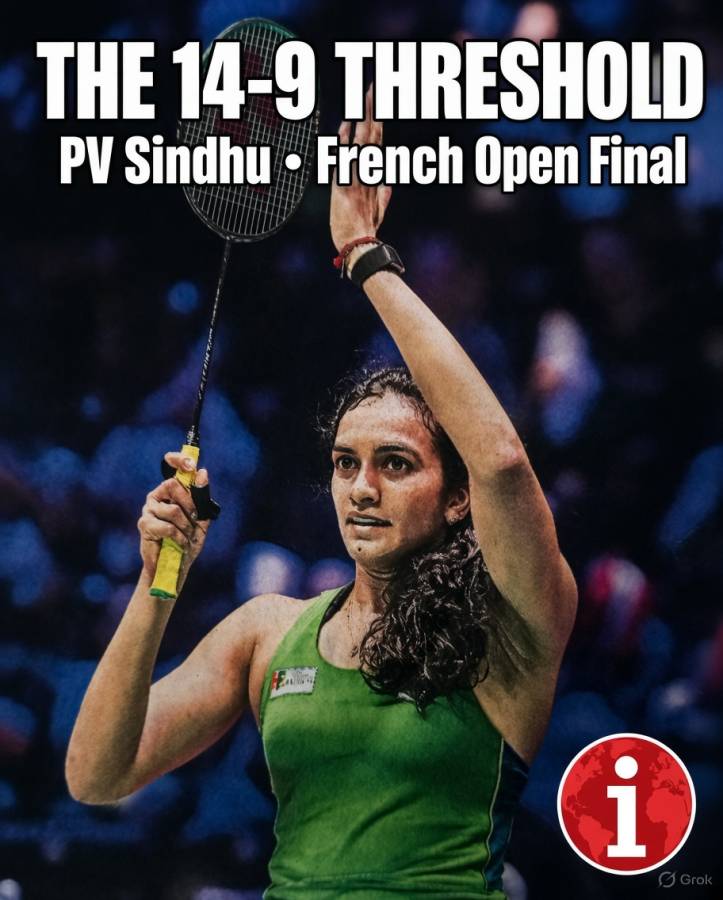
The Indian badminton star fought back from 9-14 in the deciding game against Japan's Hina Akechi to reach the French Open final, where world No. 1 An Se Young awaits.
PV Sindhu has played enough big matches to recognise when a contest is slipping away. Trailing 9-14 in the deciding game of her French Open semifinal against Japan's Hina Akechi, the Indian badminton star faced one of those moments when experience, physical endurance and mental strength mattered more than reputation.
At the Arena Grand Paris on Saturday, Sindhu responded with six consecutive points to turn the contest around. She eventually secured a 21-10, 20-22, 21-16 victory, booking her place in the final of the BWF World Tour Super 750 tournament.
The result was significant not simply because Sindhu reached another major final. It offered evidence of a player gradually recovering the consistency and confidence that once made her one of the most formidable competitors in women's badminton.
A Five-Point Deficit That Changed the Match
Sindhu began the semifinal with authority, dominating the opening game 21-10. Her court coverage, attacking precision and ability to control the rallies left Akechi struggling to establish a rhythm.
The Japanese player, however, refused to surrender.
Akechi improved her defensive organisation in the second game, extended rallies and forced Sindhu into uncomfortable positions. The Indian eventually lost the closely contested game 20-22, allowing her opponent to force a decider.
The third game brought another difficult phase.
Akechi moved ahead 14-9, leaving Sindhu with little room for error. At that stage, the Japanese player appeared to have the momentum and a clear opportunity to close out the match.
Sindhu later described 14-9 as "a very dangerous score."
Her response demonstrated why she remains a difficult opponent even when the scoreboard appears unfavourable.
Instead of attempting risky winners, Sindhu concentrated on controlling the rallies, reducing unforced errors and forcing Akechi to play additional shots.
Six consecutive points transformed a five-point deficit into a 15-14 advantage. Sindhu maintained the pressure and eventually completed the comeback 21-16.
The victory reflected patience and tactical discipline rather than an overwhelming display of attacking power.
Sindhu's Return Is Built on Careful Preparation
The French Open performance comes after a challenging period in Sindhu's career.
Injuries, interruptions to training and inconsistent results have tested the former world champion and two-time Olympic medallist. Returning to elite competition has required more than restoring physical fitness.
Sindhu has worked to rebuild the professional support structure around her.
Her team includes coach Irwansyah, sports scientist Wayne Lombard, physiotherapist Heera Mundluru and strength and conditioning coach Shreyasi Sanjay.
Each has contributed to a programme designed to improve her physical preparation, recovery and ability to manage demanding matches.
Sindhu has acknowledged the importance of reviewing her training methods and understanding the physical demands of modern badminton.
She described the rebuilding process as starting from scratch, assembling a team and identifying areas that needed improvement.
Her reference to doing "donkey's work" while progressing intelligently reflects the demanding preparation behind her return.
For an experienced player, the challenge is not simply to train harder. It is to manage physical resources effectively across tournaments, particularly when matches extend into deciding games.
That preparation appeared to make a difference against Akechi.
Experience Becomes Sindhu's Biggest Strength
Women's badminton has become increasingly demanding, with younger players combining exceptional speed, defensive ability and attacking variety.
Sindhu, however, possesses something that cannot be developed quickly.
She has spent years competing in Olympic finals, world championships and major international tournaments. Those experiences have taught her how to recognise changing match situations and respond under pressure.
Against Akechi, her comeback was not built on spectacular smashes alone.
It depended on making better decisions at critical moments.
Sindhu avoided unnecessary risks, maintained the quality of her returns and gradually forced her opponent into mistakes.
The semifinal also highlighted the importance of mental recovery within a match.
Losing a closely contested second game can affect even experienced players. Falling five points behind in the decider makes the challenge considerably harder.
Sindhu managed both situations without allowing the match to escape completely.
Her ability to recover from 9-14 suggests that the work being done away from competition is beginning to influence her performances on court.
An Se Young Presents the Toughest Challenge
Sindhu's reward for reaching the final is a meeting with South Korea's An Se Young, the world No. 1 and one of the most consistent players in international badminton.
The challenge is considerable.
An Se Young has won all ten of her previous meetings with Sindhu, giving the South Korean a commanding 10-0 head-to-head advantage.
Her exceptional defensive skills, court coverage and ability to sustain long rallies have made her particularly difficult to defeat.
Sindhu understands the scale of the challenge.
Speaking ahead of the final, she acknowledged An Se Young's outstanding form while stressing the importance of competing for every point.
Her approach is based on preparation rather than predictions.
For Sindhu, the final presents an opportunity to test whether her improved physical condition and tactical adjustments can help her compete more effectively against an opponent who has consistently troubled her.
An Se Young will enter as the favourite, but Sindhu's semifinal comeback provides a reminder that matches are not decided by previous results alone.
More Than Another Tournament Final
Sindhu's French Open campaign carries significance beyond the immediate result.
Her Japan Open title in July had already suggested that she was finding her competitive rhythm again. Reaching another Super 750 final strengthens the argument that her improvement may be sustainable.
There is still considerable work ahead.
Consistency across tournaments, recovery between demanding matches and the ability to challenge the world's leading players will determine how far her resurgence can progress.
Nevertheless, her performance against Akechi offers encouraging signs.
The opening game demonstrated her attacking ability. The second tested her composure. The deciding game revealed her capacity to adapt when circumstances became difficult.
Together, those three games presented a clearer picture of Sindhu's current development than a straightforward victory might have done.
A Champion Learning to Win Differently
Sindhu's career has often been discussed through the contrasting ideas of dominance and decline.
Her major victories established her as one of India's greatest badminton players. Subsequent injuries and inconsistent performances prompted questions about whether she could return to the highest level.
Neither description fully explains her present situation.
She is an experienced athlete adjusting her game, improving her physical preparation and finding ways to remain competitive against a younger generation.
The changes may not always produce spectacular moments, but they can make an important difference during close matches.
Against Akechi, the most revealing passage came when Sindhu was five points behind and running out of opportunities.
She did not need to reproduce every element of her younger self. She needed to understand the situation, choose the right shots and remain patient.
It helped her turn the match around.
The French Open final against An Se Young will provide a much tougher examination of her progress. Victory would represent a major breakthrough against an opponent who has dominated their rivalry.
Even a competitive performance would offer useful evidence of where Sindhu stands in her rebuilding process.
For now, the semifinal has delivered an important reminder.
PV Sindhu may be changing the way she wins, but her ability to fight back when a match appears lost remains one of her greatest strengths.
























Leave a Comment