
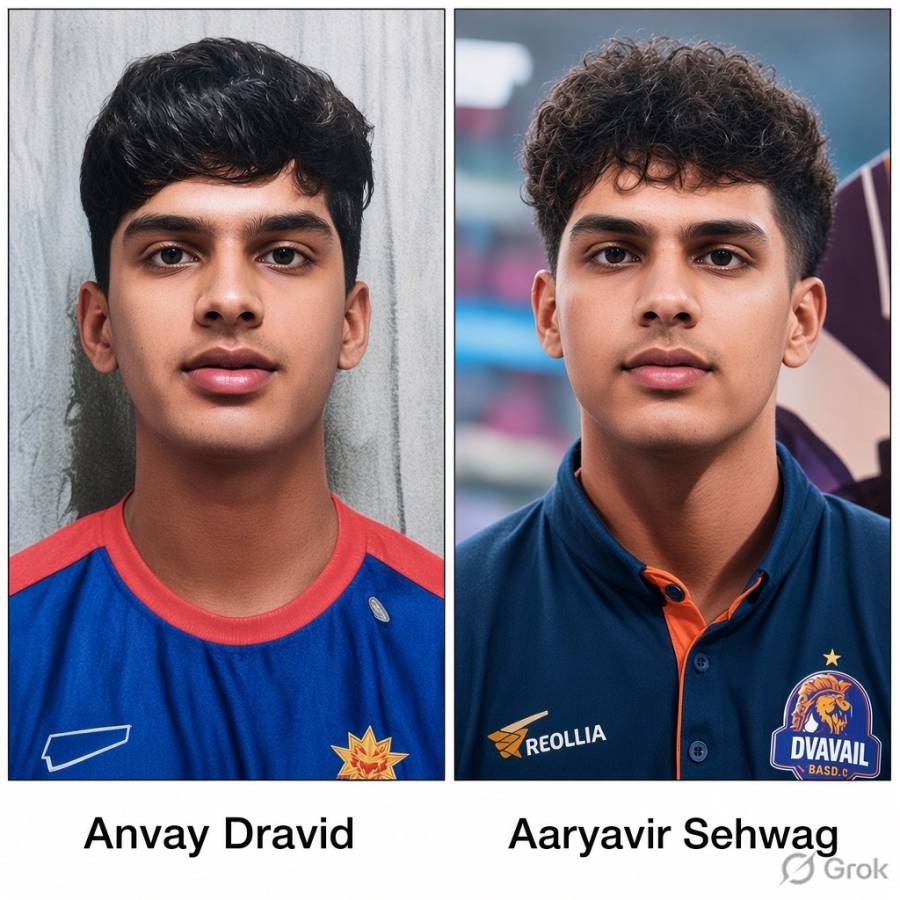
Two legendary Indian cricket surnames return against Australia, this time through the next generation.
Two of the most familiar surnames in Indian cricket are back on the same team sheet, this time carried by a new generation.
The BCCI's junior selection committee has named Aaryavir Sehwag and Anvay Dravid in India's Under-19 squad for the home series against Australia U19, beginning September 18. Neither has been picked for the multi-day leg, but their selection for the three-match one-day series is enough to revive memories of an era their fathers helped define.
Virender Sehwag and Rahul Dravid last played together for India in the Adelaide Test in January 2012. Fourteen years on, it is their sons who will represent India together, not as opening partners or senior campaigners, but as teammates in the same Under-19 dressing room.
Aaryavir Sehwag's Rise Through the Ranks
For 18-year-old Aaryavir, this is a maiden call-up to the India U19 side.
His journey to this point has moved quickly. He made his Delhi Under-19 debut in the Vinoo Mankad Trophy in 2024, scoring 49 against Manipur. A year later came the innings that brought his name into wider circulation: a remarkable 297 against Meghalaya in the Cooch Behar Trophy.
The knock inevitably invited comparisons with his father, one of India's most destructive opening batters. But Aaryavir has since begun building a cricketing identity of his own.
He has stepped into senior domestic cricket with the West Delhi Lions in the Delhi Premier League, opening the batting much as his father once did for India. His square drives and cover drives have drawn attention, with their resemblance to Virender Sehwag's strokeplay fuelling anticipation ahead of his junior international debut.
The attacking instinct is certainly familiar. Aaryavir appears willing to hit through the line rather than simply defend a good delivery.
Yet comparisons can only take a young player so far. At this level, the surname may open the door, but performances will determine how far he walks through it.
Anvay Dravid's Quieter but Substantial Path
Anvay Dravid's journey has been less dramatic in the headlines, but equally encouraging on the field.
The wicketkeeper-batter is the younger son of Rahul Dravid and has already captained Karnataka Under-19. In the Vinoo Mankad Trophy, he scored 220 runs across six matches at an average of 55, including an unbeaten 82 against Himachal Pradesh that helped Karnataka chase down 236.
Those performances earned him his first India U19 call-up earlier this year for a series against Sri Lanka.
On his debut in July, Anvay scored 87 off 67 balls, striking nine fours and a six. He also helped India recover from 81 for 4 through a crucial 145-run partnership.
His retention in the squad for the Australia series therefore represents more than a sentimental selection. It suggests that his performances at the junior level have earned genuine cricketing recognition.
Australia Makes the Reunion Even More Significant
That both young players have been selected to face Australia adds another layer to the story.
Australia featured prominently in some of the finest chapters of both their fathers' careers.
Rahul Dravid's 180 at Eden Gardens in 2001 formed part of one of Indian cricket's most celebrated comebacks, as India defeated Australia after the visitors had won 16 consecutive Tests.
Three years later, in Adelaide, Dravid produced another defining performance, scoring an unbeaten double century as India secured a famous victory. He finished the 2003-04 Australia series with 619 runs and was named Player of the Series.
Sehwag, meanwhile, played his own memorable role on that tour. His 195 at the Melbourne Cricket Ground, scored across two sessions, became one of the most celebrated attacking innings of his career. He finished the series with 464 runs.
Together, Dravid and Sehwag represented two very different approaches to batting, yet both helped transform India into a side capable of challenging Australia consistently during the 2000s.
Now, the same surnames return against the same opponent.
Only the players have changed.
A New Chapter Begins in Rajkot
The three-match one-day series will be played in Rajkot, giving Aaryavir and Anvay an opportunity to begin writing their own international stories.
For Indian cricket fans, however, the moment carries an emotional significance that goes beyond runs, averages and selection numbers.
Sehwag and Dravid represented contrasting philosophies at the crease. One was built around fearless aggression, the other around patience, technique and discipline. Yet together, they became part of one of the most memorable generations in Indian cricket.
Seeing their sons walk into the same Under-19 dressing room offers a striking link between two eras.
It is tempting to look at Aaryavir and see glimpses of Sehwag, or at Anvay and search for echoes of Dravid. But neither player has inherited a finished cricketing story. They have inherited surnames, expectations and perhaps a little of the cricketing education that comes with growing up around the game.
What they do with those advantages will be their own story.
For now, their selection has done something simpler.
It has brought back memories of an Indian team that once stood toe-to-toe with Australia, while quietly announcing that a new generation is ready to take the field.
Two of the most familiar surnames in Indian cricket are back on the same team sheet, this time carried by a new generation.
The BCCI's junior selection committee has named Aaryavir Sehwag and Anvay Dravid in India's Under-19 squad for the home series against Australia U19, beginning September 18. Neither has been picked for the multi-day leg, but their selection for the three-match one-day series is enough to revive memories of an era their fathers helped define.
Virender Sehwag and Rahul Dravid last played together for India in the Adelaide Test in January 2012. Fourteen years on, it is their sons who will represent India together, not as opening partners or senior campaigners, but as teammates in the same Under-19 dressing room.
Aaryavir Sehwag's Rise Through the Ranks
For 18-year-old Aaryavir, this is a maiden call-up to the India U19 side.
His journey to this point has moved quickly. He made his Delhi Under-19 debut in the Vinoo Mankad Trophy in 2024, scoring 49 against Manipur. A year later came the innings that brought his name into wider circulation: a remarkable 297 against Meghalaya in the Cooch Behar Trophy.
The knock inevitably invited comparisons with his father, one of India's most destructive opening batters. But Aaryavir has since begun building a cricketing identity of his own.
He has stepped into senior domestic cricket with the West Delhi Lions in the Delhi Premier League, opening the batting much as his father once did for India. His square drives and cover drives have drawn attention, with their resemblance to Virender Sehwag's strokeplay fuelling anticipation ahead of his junior international debut.
The attacking instinct is certainly familiar. Aaryavir appears willing to hit through the line rather than simply defend a good delivery.
Yet comparisons can only take a young player so far. At this level, the surname may open the door, but performances will determine how far he walks through it.
Anvay Dravid's Quieter but Substantial Path
Anvay Dravid's journey has been less dramatic in the headlines, but equally encouraging on the field.
The wicketkeeper-batter is the younger son of Rahul Dravid and has already captained Karnataka Under-19. In the Vinoo Mankad Trophy, he scored 220 runs across six matches at an average of 55, including an unbeaten 82 against Himachal Pradesh that helped Karnataka chase down 236.
Those performances earned him his first India U19 call-up earlier this year for a series against Sri Lanka.
On his debut in July, Anvay scored 87 off 67 balls, striking nine fours and a six. He also helped India recover from 81 for 4 through a crucial 145-run partnership.
His retention in the squad for the Australia series therefore represents more than a sentimental selection. It suggests that his performances at the junior level have earned genuine cricketing recognition.
Australia Makes the Reunion Even More Significant
That both young players have been selected to face Australia adds another layer to the story.
Australia featured prominently in some of the finest chapters of both their fathers' careers.
Rahul Dravid's 180 at Eden Gardens in 2001 formed part of one of Indian cricket's most celebrated comebacks, as India defeated Australia after the visitors had won 16 consecutive Tests.
Three years later, in Adelaide, Dravid produced another defining performance, scoring an unbeaten double century as India secured a famous victory. He finished the 2003-04 Australia series with 619 runs and was named Player of the Series.
Sehwag, meanwhile, played his own memorable role on that tour. His 195 at the Melbourne Cricket Ground, scored across two sessions, became one of the most celebrated attacking innings of his career. He finished the series with 464 runs.
Together, Dravid and Sehwag represented two very different approaches to batting, yet both helped transform India into a side capable of challenging Australia consistently during the 2000s.
Now, the same surnames return against the same opponent.
Only the players have changed.
A New Chapter Begins in Rajkot
The three-match one-day series will be played in Rajkot, giving Aaryavir and Anvay an opportunity to begin writing their own international stories.
For Indian cricket fans, however, the moment carries an emotional significance that goes beyond runs, averages and selection numbers.
Sehwag and Dravid represented contrasting philosophies at the crease. One was built around fearless aggression, the other around patience, technique and discipline. Yet together, they became part of one of the most memorable generations in Indian cricket.
Seeing their sons walk into the same Under-19 dressing room offers a striking link between two eras.
It is tempting to look at Aaryavir and see glimpses of Sehwag, or at Anvay and search for echoes of Dravid. But neither player has inherited a finished cricketing story. They have inherited surnames, expectations and perhaps a little of the cricketing education that comes with growing up around the game.
What they do with those advantages will be their own story.
For now, their selection has done something simpler.
It has brought back memories of an Indian team that once stood toe-to-toe with Australia, while quietly announcing that a new generation is ready to take the field.






















Leave a Comment