
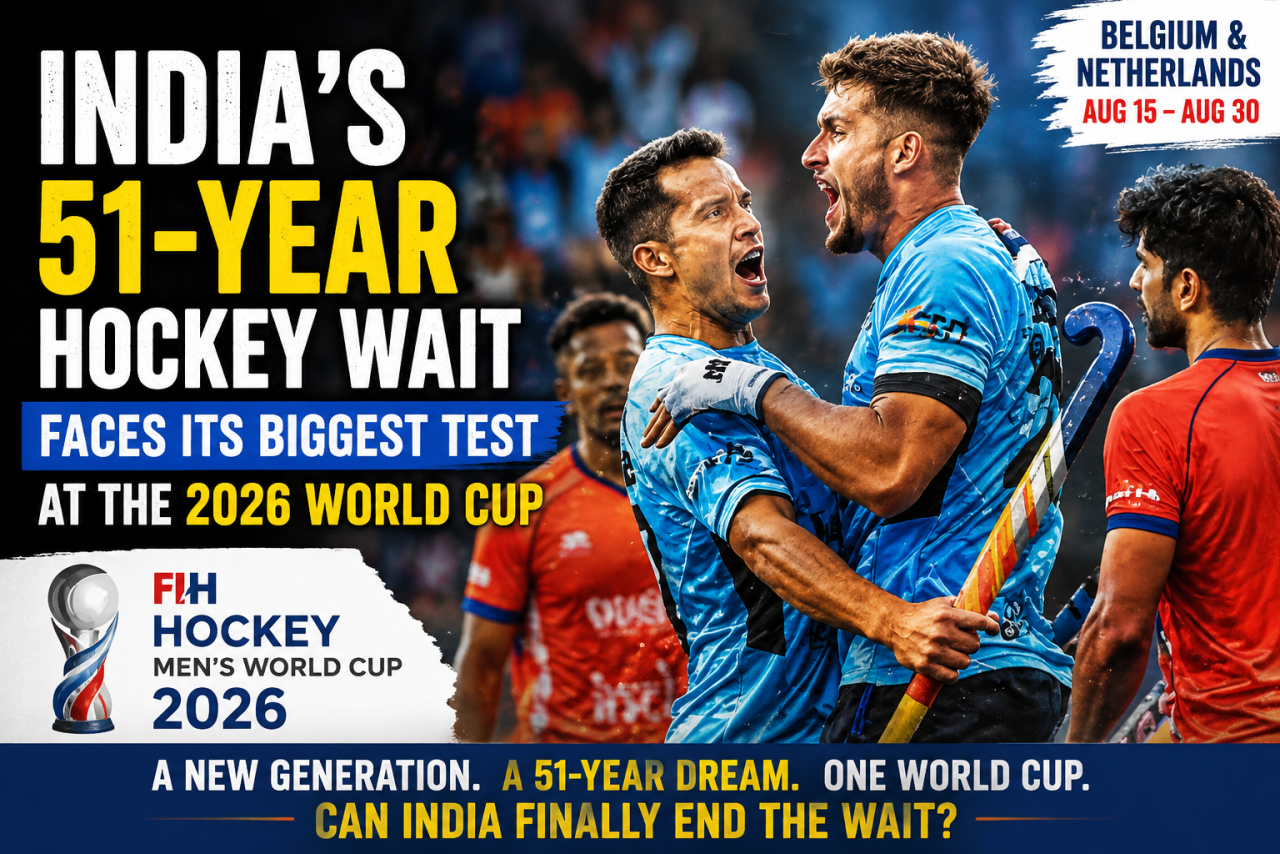
India’s quest for a second men’s Hockey World Cup title is about more than ending a 51-year wait. It is a test of how far the country’s hockey revival has really come.
The FIH Hockey World Cup 2026 is underway in Belgium and the Netherlands, with 16 of the world’s best men’s teams competing from August 15 to August 30. Matches are being played at the Wagener Stadium in Amstelveen and the Belfius Arena in Wavre.
For India, however, this tournament carries significance far beyond the prospect of another medal.
The Indian men’s team, led by drag-flick specialist Harmanpreet Singh, is chasing a World Cup title that has eluded the country for 51 years. India’s only triumph came in 1975, when Ajit Pal Singh led the team to glory in Kuala Lumpur.
Since then, India has produced generations of outstanding players and remains one of the most decorated nations in Olympic hockey, with eight gold medals. Yet the World Cup trophy has remained out of reach.
That gap between India’s glorious hockey past and its modern ambitions is what makes the 2026 tournament particularly important.
A Team Carrying History on Its Shoulders
India enters the World Cup after winning bronze at the Paris Olympics in 2024 and lifting the 2025 Asia Cup, a victory that secured its qualification for the tournament.
The current squad combines experienced players such as Manpreet Singh and Amit Rohidas with younger players experiencing World Cup hockey for the first time.
Head coach Craig Fulton has stressed the importance of turning history into motivation rather than allowing it to become a burden.
But India’s opening match against England showed that the road to redemption will not be easy.
India suffered a 2-4 defeat on August 15, exposing defensive weaknesses that have troubled the team at crucial moments.
England took the lead in the second minute through Stuart Rushmere after India failed to clear the danger inside its circle. Nicholas Bandurak then doubled England’s advantage in the 14th minute when goalkeeper HS Mohith was unable to control a low cross.
India responded strongly.
Dilpreet Singh pulled one goal back through a penalty corner before Harmanpreet Singh converted a penalty stroke to bring India level before half-time.
Yet the momentum did not last.
England regained the lead in the 25th minute when an unmarked Zak Jones was found at the back post. Henry Croft added England’s fourth goal late in the match after India again allowed gaps to appear around the top of the circle.
After the defeat, Fulton acknowledged that India needed to press more effectively and retain possession better when under pressure.
A Format That Gives India Room to Recover
The 2026 World Cup also introduces a new competition format.
Instead of moving directly from the pool stage into knockout matches, teams progress into a second group phase before the classification rounds and semi-finals determine the medalists.
That structure places greater emphasis on consistency across the tournament rather than allowing one poor performance to immediately end a team’s campaign.
For India, that could prove important.
The defeat against England was disappointing, but it has not ended the campaign. India now has an opportunity to respond, beginning with a high-profile clash against arch-rivals Pakistan on August 19.
The match carries significance beyond the points at stake. It is the first World Cup meeting between India and Pakistan in 16 years.
A convincing performance could help India regain confidence after its difficult opening match.
A Team in Transition
The World Cup is also an important test of India’s rebuilding process.
One of the biggest changes has come in goal.
PR Sreejesh retired after the Paris Olympics, bringing an end to one of the most influential goalkeeping careers in Indian hockey. Krishan Pathak and Suraj Karkera have since shared responsibility between the posts.
Replacing a player who provided years of experience and composure is never straightforward.
The defensive unit is also continuing to develop its understanding. The challenge is not simply technical. It is about building confidence and coordination while integrating younger players into a team that still carries the expectations created by its Olympic success.
India therefore finds itself at an important crossroads.
It has experienced players who know what it takes to perform on the biggest stage, but it is simultaneously introducing a new generation that must learn to handle the intensity of World Cup hockey.
More Than a Hockey Tournament
The importance of the World Cup extends beyond the Indian team.
Hockey has a special place in India’s sporting history, but its public visibility has been overshadowed by cricket for decades. A successful World Cup campaign could once again bring the sport into the national spotlight.
That could have consequences far beyond television ratings and headlines.
A strong performance could generate renewed interest in domestic hockey, encourage greater participation among young players and strengthen the argument for sustained investment in grassroots programmes.
India’s hockey revival ultimately depends on creating a reliable pipeline of talent rather than relying on individual generations of exceptional players.
The 2026 World Cup provides a valuable measure of how far that process has progressed.
The Real Test Begins Now
India’s campaign is still in its early stages, and the opening defeat does not tell the whole story.
There is time to correct mistakes, build momentum and find greater defensive stability before the decisive stages of the tournament.
But the England match has already highlighted the areas that need attention: composure inside the defensive circle, sharper marking near goal, better ball retention and greater discipline when protecting an advantage.
India has waited 51 years for another men’s Hockey World Cup title.
Whether that wait finally ends in 2026 will depend not only on talent, but on how effectively the team responds when the pressure becomes greatest.
For Indian hockey, therefore, this World Cup is about much more than lifting a trophy.
The FIH Hockey World Cup 2026 is underway in Belgium and the Netherlands, with 16 of the world’s best men’s teams competing from August 15 to August 30. Matches are being played at the Wagener Stadium in Amstelveen and the Belfius Arena in Wavre.
For India, however, this tournament carries significance far beyond the prospect of another medal.
The Indian men’s team, led by drag-flick specialist Harmanpreet Singh, is chasing a World Cup title that has eluded the country for 51 years. India’s only triumph came in 1975, when Ajit Pal Singh led the team to glory in Kuala Lumpur.
Since then, India has produced generations of outstanding players and remains one of the most decorated nations in Olympic hockey, with eight gold medals. Yet the World Cup trophy has remained out of reach.
That gap between India’s glorious hockey past and its modern ambitions is what makes the 2026 tournament particularly important.
A Team Carrying History on Its Shoulders
India enters the World Cup after winning bronze at the Paris Olympics in 2024 and lifting the 2025 Asia Cup, a victory that secured its qualification for the tournament.
The current squad combines experienced players such as Manpreet Singh and Amit Rohidas with younger players experiencing World Cup hockey for the first time.
Head coach Craig Fulton has stressed the importance of turning history into motivation rather than allowing it to become a burden.
But India’s opening match against England showed that the road to redemption will not be easy.
India suffered a 2-4 defeat on August 15, exposing defensive weaknesses that have troubled the team at crucial moments.
England took the lead in the second minute through Stuart Rushmere after India failed to clear the danger inside its circle. Nicholas Bandurak then doubled England’s advantage in the 14th minute when goalkeeper HS Mohith was unable to control a low cross.
India responded strongly.
Dilpreet Singh pulled one goal back through a penalty corner before Harmanpreet Singh converted a penalty stroke to bring India level before half-time.
Yet the momentum did not last.
England regained the lead in the 25th minute when an unmarked Zak Jones was found at the back post. Henry Croft added England’s fourth goal late in the match after India again allowed gaps to appear around the top of the circle.
After the defeat, Fulton acknowledged that India needed to press more effectively and retain possession better when under pressure.
A Format That Gives India Room to Recover
The 2026 World Cup also introduces a new competition format.
Instead of moving directly from the pool stage into knockout matches, teams progress into a second group phase before the classification rounds and semi-finals determine the medalists.
That structure places greater emphasis on consistency across the tournament rather than allowing one poor performance to immediately end a team’s campaign.
For India, that could prove important.
The defeat against England was disappointing, but it has not ended the campaign. India now has an opportunity to respond, beginning with a high-profile clash against arch-rivals Pakistan on August 19.
The match carries significance beyond the points at stake. It is the first World Cup meeting between India and Pakistan in 16 years.
A convincing performance could help India regain confidence after its difficult opening match.
A Team in Transition
The World Cup is also an important test of India’s rebuilding process.
One of the biggest changes has come in goal.
PR Sreejesh retired after the Paris Olympics, bringing an end to one of the most influential goalkeeping careers in Indian hockey. Krishan Pathak and Suraj Karkera have since shared responsibility between the posts.
Replacing a player who provided years of experience and composure is never straightforward.
The defensive unit is also continuing to develop its understanding. The challenge is not simply technical. It is about building confidence and coordination while integrating younger players into a team that still carries the expectations created by its Olympic success.
India therefore finds itself at an important crossroads.
It has experienced players who know what it takes to perform on the biggest stage, but it is simultaneously introducing a new generation that must learn to handle the intensity of World Cup hockey.
More Than a Hockey Tournament
The importance of the World Cup extends beyond the Indian team.
Hockey has a special place in India’s sporting history, but its public visibility has been overshadowed by cricket for decades. A successful World Cup campaign could once again bring the sport into the national spotlight.
That could have consequences far beyond television ratings and headlines.
A strong performance could generate renewed interest in domestic hockey, encourage greater participation among young players and strengthen the argument for sustained investment in grassroots programmes.
India’s hockey revival ultimately depends on creating a reliable pipeline of talent rather than relying on individual generations of exceptional players.
The 2026 World Cup provides a valuable measure of how far that process has progressed.
The Real Test Begins Now
India’s campaign is still in its early stages, and the opening defeat does not tell the whole story.
There is time to correct mistakes, build momentum and find greater defensive stability before the decisive stages of the tournament.
But the England match has already highlighted the areas that need attention: composure inside the defensive circle, sharper marking near goal, better ball retention and greater discipline when protecting an advantage.
India has waited 51 years for another men’s Hockey World Cup title.
Whether that wait finally ends in 2026 will depend not only on talent, but on how effectively the team responds when the pressure becomes greatest.
For Indian hockey, therefore, this World Cup is about much more than lifting a trophy.





















Leave a Comment