
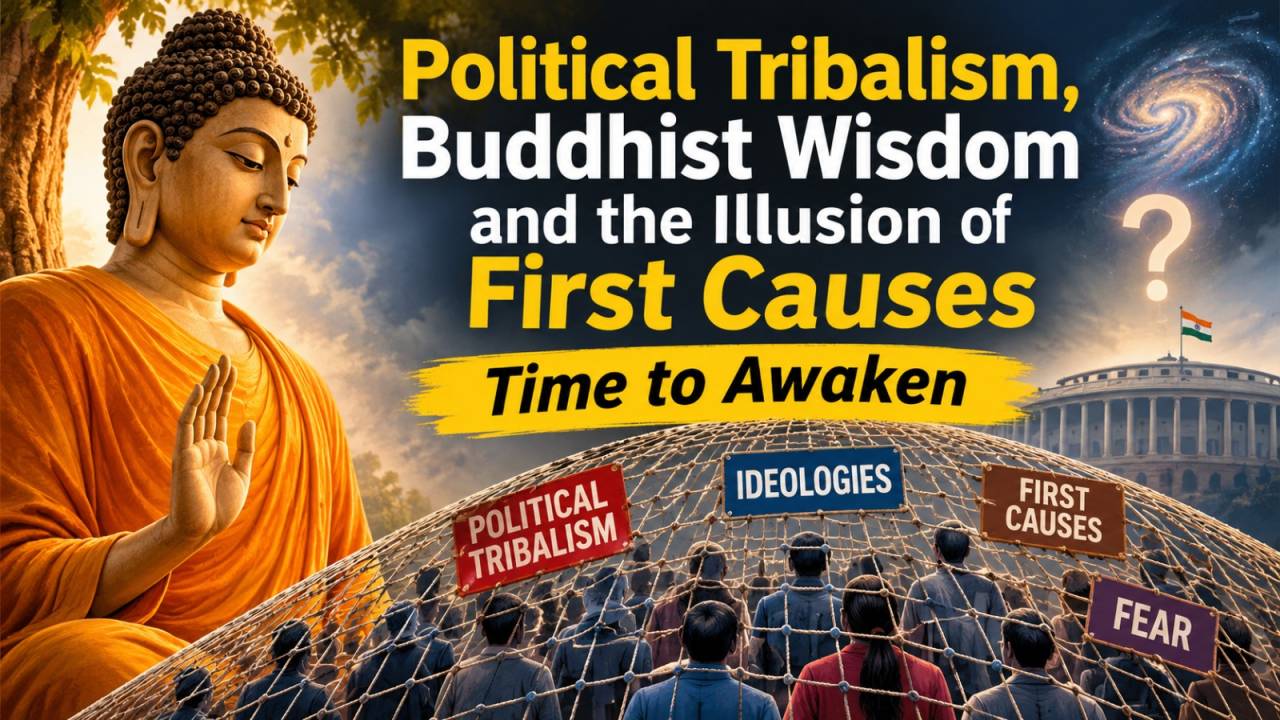
Are we truly thinking freely, or merely swimming inside an invisible net of political beliefs, inherited doctrines and our fear of uncertainty?
At Sāvatthī, standing to one side, a devotee recited this verse in the presence of the Buddha:
“Those who have not penetrated things, Who may be led into others’ doctrines,
Fast asleep, they have not yet awakened: It is time for them to awaken.”
In our previous reflection on the aftermath of elections and the psychological anatomy of partisanship, we confronted an uncomfortable question: when we surrender our critical faculties to a political tribe, what have we actually won? We examined the etymological roots of politics—its historic entanglement with factional maneuver and social leverage—and suggested that the venomous certainty dividing modern culture is less a rational debate over policy than a visceral response to fear. We rush into party ranks not because political dogma resolves our anxieties, but because it promises shelter from groundlessness. We remain fast asleep, allowing ourselves to be led into others’ doctrines simply because we have not yet penetrated the true nature of things. It hands us an off-the-shelf narrative detailing who we are, who our enemies are, and who is responsible for the state of the world.
Yet if political tribalism is a local trench dug against uncertainty, it is merely the symptom of a far deeper slumber in human consciousness. When we trace that anxiety from the micro to the macro—from the ballot box back through the lineage of human culture—we collide with the oldest inquiry of all: the obsession with origins. Where did everything begin? Who set this vast, intimidating cosmos into motion? What was I before I arrived, and what will become of me when the lights go out?
Underneath our ideological feuds lies an unconscious dread of groundlessness. We demand a first cause because ambiguity terrifies us. To quiet that panic, we construct grand cosmologies and wrap them in burrowing doctrines, unaware that these attempts to yoke the ultimate question build even higher barriers to our freedom.
The Fisherman and the Shallows
In the Brahmajāla Sutta, the Discourse on the Supreme Net, the Buddha conducted a radical autopsy on every metaphysical doctrine known to ancient thought. Rather than accepting the truth claims of competing schools, he focused instead on the thinkers themselves—interrogating their epistemic foundations. In this time, philosophers, mystics, and materialists had contrived and debated sixty-two separate views concerning existence, dividing their efforts between speculations about the past (how the cosmos began) and speculations about the future (what survives after death).
The Buddha offered a devastating image to describe the totality of these theories. Imagine a fisherman who casts a finely woven net over a shallow, enclosed pool of water. Inside that pool swim various fish. One fish darts frantically toward the shimmering surface; another dives deep into the cool, dark sediment at the bottom; a third weaves along the perimeter. Each fish might imagine itself free, pursuing an entirely independent, revolutionary direction across the pond. Yet every one of them remains utterly enclosed within the cords of the mesh. Whatever movement it makes, wherever it leaps or plunges, it moves entirely inside the fisherman’s snare.
This is precisely the predicament of modern intellectual life. Whether we are strict materialists insisting that reality is merely an accidental collision of blind atoms destined for oblivion, religious eternalists declaring that a supreme cosmic artisan fashioned our souls, or political determinists preaching that history marches along an inevitable ideological path, we are merely thrashing against different quadrants of the exact same conceptual net.
Because we have not penetrated things to their core, we mistake the boundaries of our cage for the horizon of truth. If you don’t believe me, just pick up any novel, newspaper article or political treatise from the 16th or 17th Century: read it, observe their thoughts, search their longings–and ask yourself if anything has changed…at all?
Why is this?
Because every grand theory about how the world began is built from the same basic psychological ingredients. First, we experience a sensory contact, which triggers an automatic feeling of pleasure, pain, or indifference. Right after, an instinctive craving for certainty rushes in, and the mind quickly hardens that craving into a rigid belief.
We sleepwalk through our own minds, letting external dogmas run our lives. Ultimately, our biggest theories of cosmic origins aren't neutral windows into absolute truth—they are psychological shields born from our deep fear of sitting with uncertainty.
From "Who Exists?" to "What Arises?"
The fatal design flaw common to both political tribalism and cosmological speculation is the implicit assumption of an enduring protagonist. We instinctively begin every inquiry by reifying a central actor: Who am I? Who is to blame? Who created this universe? Who will save us?
The Buddha dismantled this ancient trap not by offering a more convincing creation story, but by throwing out the premise entirely. He replaced the ontological question of "Who exists?" with something more profound: "What arises dependent on what?".
This pivot changes everything. Reality is not a fixed collection of standalone entities bumping into one another like billiard balls, nor is it a drama scripted by a prime mover. To penetrate things as they actually are is to see an intricate, ownerless tapestry of dependent conditions:
- When conditions assemble, experience occurs.
- When conditions disperse, experience ceases.
There is no isolated, sovereign conductor standing behind the orchestra of sensation. Political outrage, patriotic fervor, existential dread, and cosmic theorizing do not belong to an enduring, irreducible core inside the chest; they are emergent psychological weather patterns that blow in whenever specific atmospheric pressures align. Searching for a single, absolute "first cause" of the cosmos is as meaningless as demanding to know which tooth of a revolving gear began the machine's turn. When existence is penetrated, then revealed as an unbroken web of mutually dependent events, the necessity of inventing a fixed origin collapses under its own weight.
The Net Dissolves
Why is this important? Because it gives us new freedoms we’d never perceived before.
When we cease projecting an absolute start or finish onto existence, the illusion of an independent, unchanging self quietly evaporates. And with its departure, the cords of the net fall away.
Metaphysical nets can only capture objects that possess mass, rigidity, and resistance. An entity that insists on its own solid borders will inevitably snag on the threads of dogma. But how can a fisherman catch the flow of the water itself?
Without a reified self, there is no eternal soul to project outward into an imagined future, and there is no solid identity left to be annihilated by the grave. More immediately, there is no sacred personal monument left to defend against our neighbors across the political aisle. The hostility that consumes our public squares, the compulsive need to prove our faction righteous and the other villainous, is fueled by the terrified defense of a manufactured "I"—a mind fast asleep, led along by the doctrines of collective panic.
When we understand that all things arise through conditions—fluid, interdependent, and empty of a permanent core—the compulsion to grasp falls silent. We no longer need to invent an origin story to give ourselves ground, nor do we need a political tribe to give ourselves a face. Having finally penetrated the illusion, we step outside the doctrines that once led us.
It is time to awaken: off the hook, out of the argument, and clean through the mesh of Saṃsāra.
Joe Singleton is an American author, spiritual journalist and practitioner of the Eastern Yogic Wisdom Traditions.



















Leave a Comment