
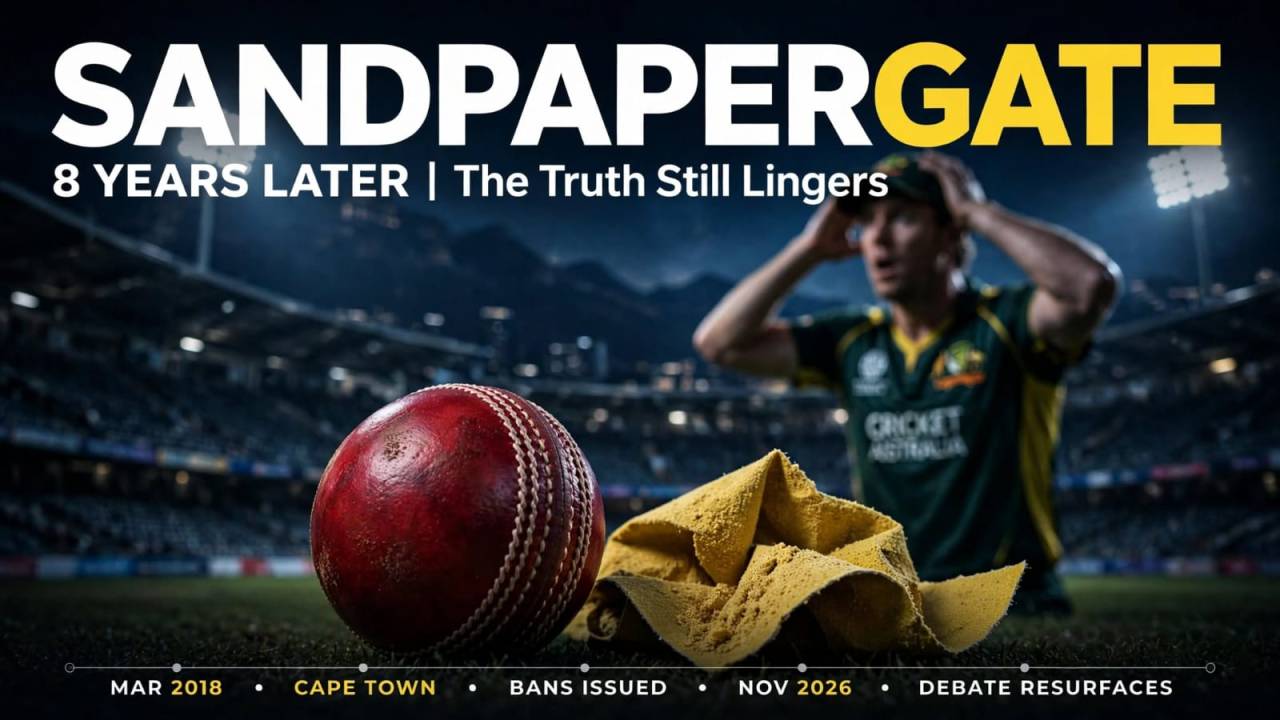
Eight years after Sandpapergate, Khawaja’s memoir challenges Australia’s official narrative and reopens questions about collective responsibility in cricket.
Usman Khawaja’s autobiography Sabr: Finding My Way in Cricket and Life has reopened one of the most controversial chapters in Australian cricket. Eight years after the infamous 2018 ball-tampering scandal in South Africa, the former Australian opener has challenged the official version of events, raising questions about how much the team knew and whether three players were made to bear the consequences of a wider team culture.
Published by Penguin Books Australia on November 10, 2026, the memoir was expected to chronicle Khawaja’s journey as Australia's first Muslim Test cricketer, his struggles with identity and discrimination, and his remarkable return to international cricket. Instead, its account of the Sandpapergate scandal has become the centre of an escalating dispute involving current captain Pat Cummins, former vice-captain David Warner and other members of the Australian cricket establishment.
At the heart of the controversy is a difficult question: Was the 2018 scandal the responsibility of three players, or did a larger group know what was happening?
What Khawaja Revealed in Sabr
The controversy dates back to March 2018, when Australia faced South Africa in the third Test at Newlands, Cape Town. Television cameras caught Australian opener Cameron Bancroft attempting to alter the condition of the cricket ball using sandpaper.
The incident triggered an international outcry. An investigation by Cricket Australia resulted in one-year bans for captain Steve Smith and vice-captain David Warner, while Bancroft received a nine-month suspension. The investigation concluded that the plan involved these three players, while other members of the team and coaching staff were not implicated in the scheme.
Khawaja's account in Sabr challenges that understanding.
He writes that knowledge of ball tampering extended beyond the three players who were punished. According to his recollection, the practice of using sandpaper to help generate reverse swing had already been discussed and attempted during the second Test in Port Elizabeth, now known as Gqeberha.
Khawaja describes how sandpaper was used to roughen one side of the ball, making it easier for the bowlers to generate reverse swing. He also recounts that the activity was not necessarily hidden from everyone in the dressing room.
One of his most significant statements is that the team was collectively involved in the practice of trying to make the ball reverse swing.
He also describes how he believed the entire team should accept responsibility after the incident came to light. However, his suggestion did not receive unanimous support during an internal team discussion.
Khawaja's argument is that the consequences should not have fallen so heavily on three individuals if responsibility extended beyond them.
Importantly, his account is a personal recollection, not a new independent investigation establishing the involvement of every player.
Pat Cummins Rejects Khawaja's Account
Khawaja's revelations have drawn a strong response from Australia's current Test captain, Pat Cummins, who was part of the bowling attack during the 2018 South Africa tour.
Cummins rejected the suggestion that the wider team knew about the use of sandpaper, describing Khawaja's claims as "complete and utter nonsense" and "100 per cent wrong".
He acknowledged his friendship with Khawaja but questioned why his former teammate had waited until retirement to make such claims. Cummins also expressed concern about the impact of the allegations on the reputations of players who have consistently denied knowing about the ball-tampering plan.
The disagreement is significant because it involves two prominent figures who shared the Australian dressing room for years.
Cummins has maintained that he had no knowledge of the sandpaper plan. His response reflects the position of several members of the bowling group who have rejected suggestions that they were involved.
David Warner Backs Khawaja, Criticises Cummins
The controversy took another turn when David Warner publicly supported Khawaja's account.
Warner, who served a 12-month suspension following the 2018 scandal, described Khawaja's version as "100 per cent accurate". His intervention has brought renewed attention to the circumstances surrounding the original investigation.
Warner also criticised Cummins for publicly challenging Khawaja, accusing the current captain of throwing his former teammate under the bus.
For Warner, the controversy is not simply about revisiting an old cricketing incident. It is also about the personal and professional consequences that he, Smith and Bancroft faced following the scandal.
He has questioned the fairness of the original investigation and suggested that the full story was never brought into the open.
Meanwhile, former Australian fast bowler Chadd Sayers has also backed Khawaja's broader claim, saying he believes knowledge of the practice extended beyond the three players who were punished. Sayers has additionally questioned why he was not interviewed during the original Cricket Australia investigation.
However, other former and current Australian players, including Mitchell Starc, have maintained that they were unaware of the use of sandpaper.
Cricket Australia Refuses to Reopen the Investigation
Despite the renewed controversy, Cricket Australia has indicated that it has no intention of reopening the 2018 investigation.
The governing body continues to stand by the findings of its original inquiry, which identified Smith, Warner and Bancroft as the players responsible for the ball-tampering plan.
This position has created an uncomfortable situation for Australian cricket. A former player has publicly questioned the completeness of the investigation, another former player has supported his account, and the current captain has strongly rejected the allegations.
The disagreement also raises questions about the culture of accountability within elite sporting teams. When an entire dressing room operates around a common objective, where should individual responsibility end and collective responsibility begin?
Sandpapergate Is Still a Test of Australian Cricket's Credibility
The significance of Sabr goes beyond the revelations of one retired cricketer. It has reopened a debate about transparency, leadership and institutional accountability in professional sport.
Khawaja's account presents a different perspective on an incident that Australian cricket had officially considered settled. Warner's support has added weight to the demand for a wider examination, while Cummins and other players have challenged the credibility of that interpretation.
There is, however, an important distinction between knowing that a team was trying to generate reverse swing and knowing that an illegal method was being used to alter the ball. The extent of individual knowledge and involvement remains disputed.
Cricket Australia may have closed its investigation, but the debate has not ended.

























Leave a Comment