
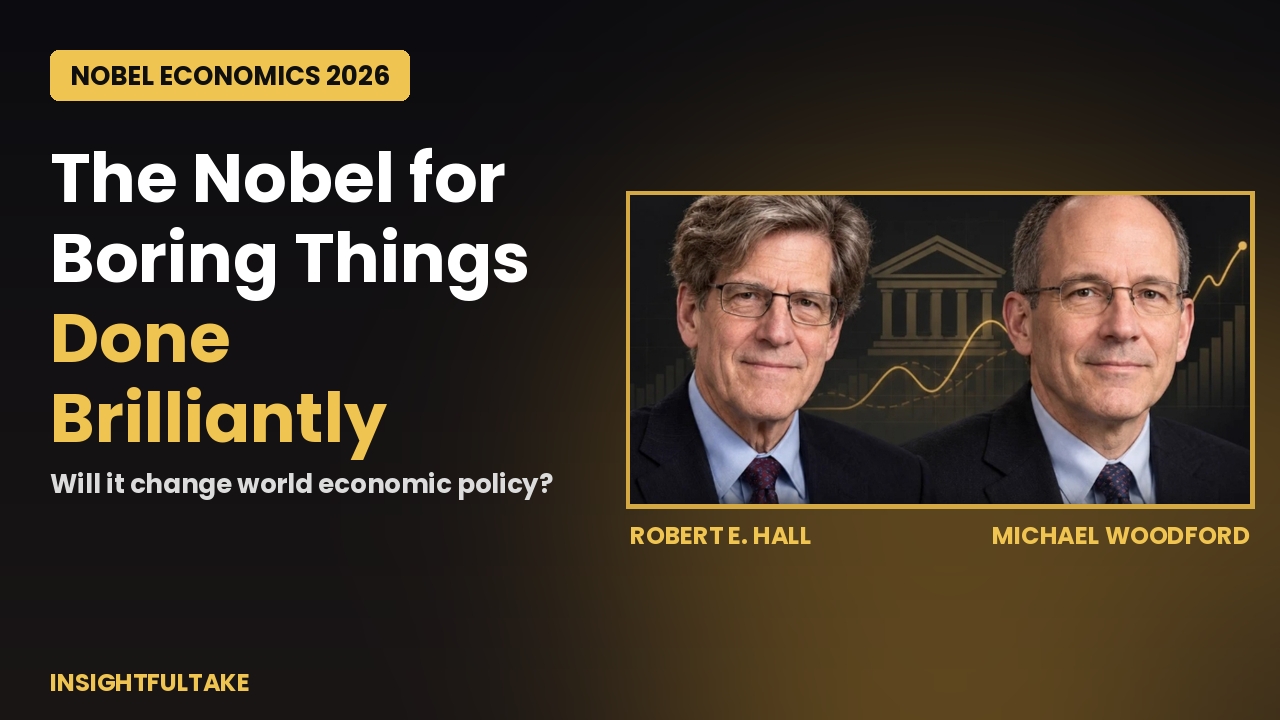
How do decisions by central banks affect your home loan, household budget and job prospects? The 2026 Economics Nobel highlights the role of expectations in economic stability.
The 2026 Nobel Prize in Economic Sciences recognises research on how governments and central banks can keep economies stable during periods of uncertainty. The award has been given to American economists Robert E. Hall and Michael Woodford for their work on the foundations of economic stabilisation.
Their research examines how the decisions of households, businesses and policymakers affect the wider economy. It helps explain why inflation rises, why unemployment persists and how government policies influence economic activity.
The subject may appear distant from everyday life, but its effects are familiar. Interest rates influence home loan payments, inflation affects household budgets, and economic growth determines how many jobs businesses are willing to offer. Understanding these connections is important for governments as well as ordinary citizens.
How Individual Decisions Shape the Economy
Economic policies are often explained in simple terms. A central bank raises interest rates to control inflation, while a government increases spending to support growth and employment. However, the results depend on how people respond to these decisions.
When interest rates rise, families may postpone buying homes or cars because borrowing becomes more expensive. Businesses may delay investment because loans cost more. These decisions can reduce demand and help bring inflation under control, but they can also slow economic growth.
Expectations also matter. If people believe prices will continue to rise, workers may demand higher wages and businesses may increase prices in advance. If companies expect demand to weaken, they may reduce production or postpone hiring.
Hall and Woodford's research helps economists understand these relationships. Their work contributed to the development of the New Keynesian approach, which examines how people's decisions, expectations and pricing behaviour affect the wider economy.
The central idea is that economic policies cannot be judged only by the action taken by a government or central bank. Policymakers must also consider how households and businesses understand and respond to that action.
Robert Hall's Research on Jobs and Unemployment
Robert E. Hall, an economist at Stanford University, has made important contributions to the study of employment, unemployment and economic fluctuations.
During a recession, businesses often reduce production and stop hiring. Some may dismiss workers. Even when economic conditions begin to improve, employment does not always recover immediately.
Finding a job is not simply a matter of matching an unemployed person with a vacant position. Workers and employers need time to find suitable matches. Skills, location, wages and the availability of information can all affect the process.
Hall's research has helped economists study why unemployment rises during economic downturns and why it can remain high even after growth returns.
This work is relevant to governments that must decide how to respond to recessions. Policies aimed at restoring economic activity need to consider not only overall growth but also the time it takes for businesses to resume hiring and for workers to find employment.
Michael Woodford's Work on Central Banks
Michael Woodford of Columbia University is known for his research on monetary policy and economic expectations.
Central banks use interest rates and other measures to influence inflation and economic activity. However, their decisions also affect what people expect to happen in the future.
For example, if a central bank credibly signals that it will work to bring inflation down, businesses and households may adjust their pricing and spending decisions. These changes can influence inflation even before the full effects of an interest-rate decision are felt.
This explains why communication has become an important part of monetary policy. Many central banks now explain their decisions and indicate how they may respond to changing economic conditions. This practice is known as forward guidance.
Clear communication does not guarantee that a policy will succeed. Its effectiveness depends on whether people trust the institution and whether economic conditions support its plans.
What Does the Nobel Mean for Economic Policy?
The award does not mean governments will immediately introduce a new set of policies. Instead, it recognises research that has helped shape the economic models used by policymakers.
Its importance lies in three areas.
First, it highlights the role of communication. Central banks need to explain their decisions clearly because expectations influence economic behaviour. Confusing or inconsistent statements can weaken public confidence.
Second, it underlines the importance of coordination between monetary and fiscal policy. Central banks influence borrowing costs and financial conditions, while governments use taxation and public spending to affect demand. Poorly timed measures can work against each other.
Third, it reminds policymakers that economic models have limits. People's behaviour changes with circumstances, and unexpected events can weaken the effect of policies that worked in the past. Models can help governments assess possible outcomes, but they cannot predict every development.
Why the Research Matters for India
The ideas associated with this field of economics have direct relevance to India.
The Reserve Bank of India adopted a flexible inflation-targeting framework in 2016. Under this system, monetary policy focuses on maintaining price stability while keeping economic growth in mind. The framework gives inflation expectations an important place in policy decisions.
When the RBI raises interest rates, banks may increase lending rates, affecting home loans, business borrowing and other forms of credit. Higher rates can reduce demand and help control inflation, but they may also make investment more expensive.
When the RBI cuts rates, borrowing can become cheaper, potentially encouraging spending and investment. However, the final effect depends on whether banks pass on the reduction and whether households and businesses are willing to borrow.
These decisions affect people differently. A family with a floating-rate home loan may feel the impact of an interest-rate change directly. A small business may reconsider expansion plans because of borrowing costs. A person looking for work may be affected by whether companies are confident enough to hire.
Inflation is equally important. Rising food prices reduce the purchasing power of households, particularly those that spend a large share of their income on essentials. Economic policy must therefore consider both price stability and the need to support employment and growth.
The Limits of Economic Models
The approach associated with New Keynesian economics has also faced criticism. Some economists argue that existing models did not adequately anticipate the 2008 financial crisis or fully explain the inflation surge that followed the COVID-19 pandemic.
Others question whether economic models accurately represent how people make decisions. Households and businesses do not always have complete information, and their choices can be influenced by fear, rumours and sudden changes in confidence.
These concerns are important because policies based on incorrect assumptions can produce disappointing results. Economists and policymakers must continue testing their models against actual events and changing economic conditions.
The research recognised by the 2026 Nobel Prize offers useful tools for understanding economic stability, but it does not remove the uncertainty involved in managing an economy.
For India, as for other countries, the practical challenge is to combine sound economic analysis with reliable data, clear communication and policies that respond to people's needs. Stable prices, stronger employment and sustainable growth depend on several factors working together.
The value of Hall and Woodford's work lies in explaining how these factors interact. Their research helps policymakers understand why economic decisions have consequences beyond the immediate change in interest rates or government spending. This understanding is essential when the aim is to protect household purchasing power, support jobs and keep the economy on a stable path.
The 2026 Nobel Prize in Economic Sciences recognises research on how governments and central banks can keep economies stable during periods of uncertainty. The award has been given to American economists Robert E. Hall and Michael Woodford for their work on the foundations of economic stabilisation.
Their research examines how the decisions of households, businesses and policymakers affect the wider economy. It helps explain why inflation rises, why unemployment persists and how government policies influence economic activity.
The subject may appear distant from everyday life, but its effects are familiar. Interest rates influence home loan payments, inflation affects household budgets, and economic growth determines how many jobs businesses are willing to offer. Understanding these connections is important for governments as well as ordinary citizens.
How Individual Decisions Shape the Economy
Economic policies are often explained in simple terms. A central bank raises interest rates to control inflation, while a government increases spending to support growth and employment. However, the results depend on how people respond to these decisions.
When interest rates rise, families may postpone buying homes or cars because borrowing becomes more expensive. Businesses may delay investment because loans cost more. These decisions can reduce demand and help bring inflation under control, but they can also slow economic growth.
Expectations also matter. If people believe prices will continue to rise, workers may demand higher wages and businesses may increase prices in advance. If companies expect demand to weaken, they may reduce production or postpone hiring.
Hall and Woodford's research helps economists understand these relationships. Their work contributed to the development of the New Keynesian approach, which examines how people's decisions, expectations and pricing behaviour affect the wider economy.
The central idea is that economic policies cannot be judged only by the action taken by a government or central bank. Policymakers must also consider how households and businesses understand and respond to that action.
Robert Hall's Research on Jobs and Unemployment
Robert E. Hall, an economist at Stanford University, has made important contributions to the study of employment, unemployment and economic fluctuations.
During a recession, businesses often reduce production and stop hiring. Some may dismiss workers. Even when economic conditions begin to improve, employment does not always recover immediately.
Finding a job is not simply a matter of matching an unemployed person with a vacant position. Workers and employers need time to find suitable matches. Skills, location, wages and the availability of information can all affect the process.
Hall's research has helped economists study why unemployment rises during economic downturns and why it can remain high even after growth returns.
This work is relevant to governments that must decide how to respond to recessions. Policies aimed at restoring economic activity need to consider not only overall growth but also the time it takes for businesses to resume hiring and for workers to find employment.
Michael Woodford's Work on Central Banks
Michael Woodford of Columbia University is known for his research on monetary policy and economic expectations.
Central banks use interest rates and other measures to influence inflation and economic activity. However, their decisions also affect what people expect to happen in the future.
For example, if a central bank credibly signals that it will work to bring inflation down, businesses and households may adjust their pricing and spending decisions. These changes can influence inflation even before the full effects of an interest-rate decision are felt.
This explains why communication has become an important part of monetary policy. Many central banks now explain their decisions and indicate how they may respond to changing economic conditions. This practice is known as forward guidance.
Clear communication does not guarantee that a policy will succeed. Its effectiveness depends on whether people trust the institution and whether economic conditions support its plans.
What Does the Nobel Mean for Economic Policy?
The award does not mean governments will immediately introduce a new set of policies. Instead, it recognises research that has helped shape the economic models used by policymakers.
Its importance lies in three areas.
First, it highlights the role of communication. Central banks need to explain their decisions clearly because expectations influence economic behaviour. Confusing or inconsistent statements can weaken public confidence.
Second, it underlines the importance of coordination between monetary and fiscal policy. Central banks influence borrowing costs and financial conditions, while governments use taxation and public spending to affect demand. Poorly timed measures can work against each other.
Third, it reminds policymakers that economic models have limits. People's behaviour changes with circumstances, and unexpected events can weaken the effect of policies that worked in the past. Models can help governments assess possible outcomes, but they cannot predict every development.
Why the Research Matters for India
The ideas associated with this field of economics have direct relevance to India.
The Reserve Bank of India adopted a flexible inflation-targeting framework in 2016. Under this system, monetary policy focuses on maintaining price stability while keeping economic growth in mind. The framework gives inflation expectations an important place in policy decisions.
When the RBI raises interest rates, banks may increase lending rates, affecting home loans, business borrowing and other forms of credit. Higher rates can reduce demand and help control inflation, but they may also make investment more expensive.
When the RBI cuts rates, borrowing can become cheaper, potentially encouraging spending and investment. However, the final effect depends on whether banks pass on the reduction and whether households and businesses are willing to borrow.
These decisions affect people differently. A family with a floating-rate home loan may feel the impact of an interest-rate change directly. A small business may reconsider expansion plans because of borrowing costs. A person looking for work may be affected by whether companies are confident enough to hire.
Inflation is equally important. Rising food prices reduce the purchasing power of households, particularly those that spend a large share of their income on essentials. Economic policy must therefore consider both price stability and the need to support employment and growth.
The Limits of Economic Models
The approach associated with New Keynesian economics has also faced criticism. Some economists argue that existing models did not adequately anticipate the 2008 financial crisis or fully explain the inflation surge that followed the COVID-19 pandemic.
Others question whether economic models accurately represent how people make decisions. Households and businesses do not always have complete information, and their choices can be influenced by fear, rumours and sudden changes in confidence.
These concerns are important because policies based on incorrect assumptions can produce disappointing results. Economists and policymakers must continue testing their models against actual events and changing economic conditions.
The research recognised by the 2026 Nobel Prize offers useful tools for understanding economic stability, but it does not remove the uncertainty involved in managing an economy.
For India, as for other countries, the practical challenge is to combine sound economic analysis with reliable data, clear communication and policies that respond to people's needs. Stable prices, stronger employment and sustainable growth depend on several factors working together.
The value of Hall and Woodford's work lies in explaining how these factors interact. Their research helps policymakers understand why economic decisions have consequences beyond the immediate change in interest rates or government spending. This understanding is essential when the aim is to protect household purchasing power, support jobs and keep the economy on a stable path.























Leave a Comment