
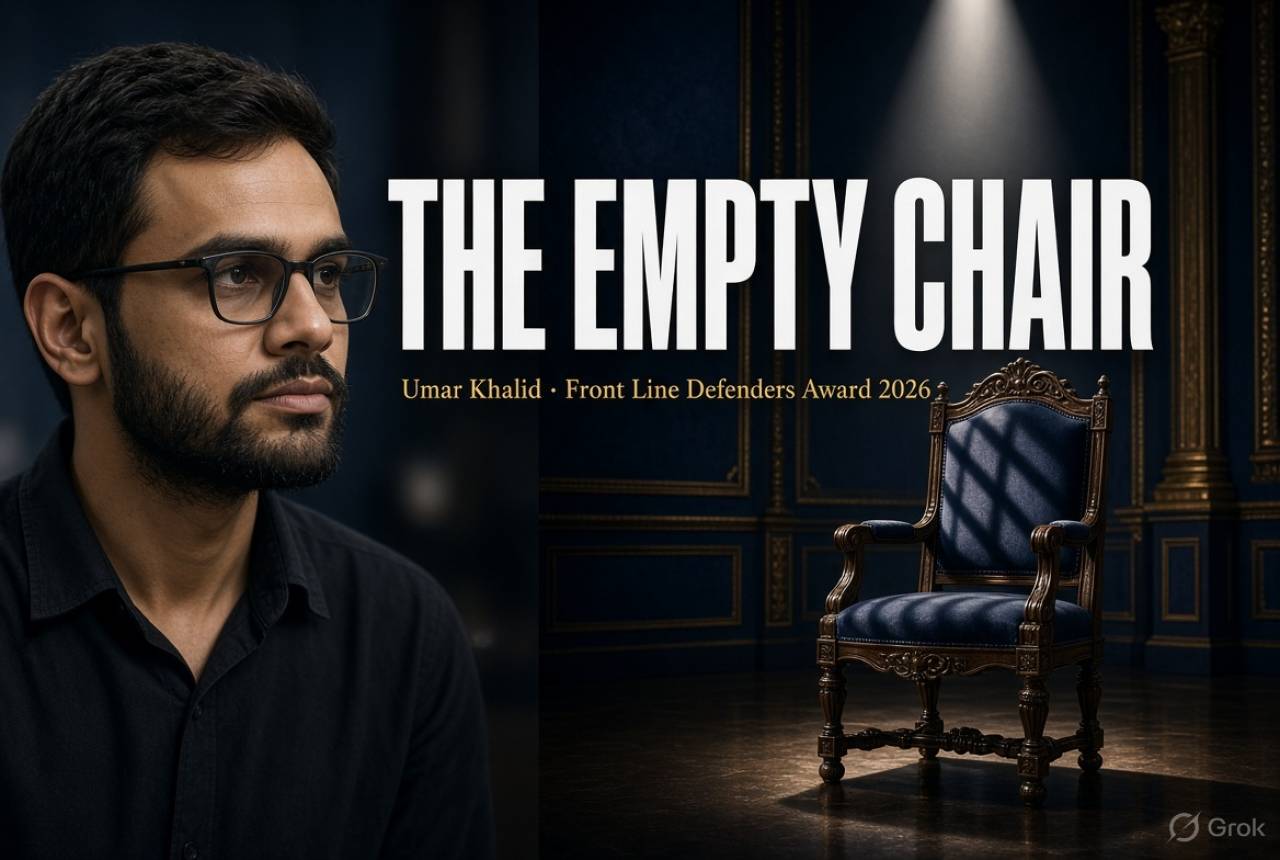
An empty chair in Dublin marked Umar Khalid’s absence. His international recognition has renewed questions about six years in detention without a trial.
On the morning of 8 October 2026, an empty chair stood among the invited guests at Trinity College Dublin. Diplomats, Irish officials and human rights workers had gathered for the announcement of the Front Line Defenders Award for Human Rights Defenders at Risk. Five people from five regions were honoured. For Asia and the Pacific, the award went to Umar Khalid, the former Jawaharlal Nehru University research scholar who has been in jail since September 2020.
His father, Dr S.Q.R. Ilyas, accepted the award on his behalf. Khalid could not attend the ceremony because he remains in Tihar Jail.
The empty chair was more than a reminder of his absence. It drew attention to the circumstances in which an international human rights organisation chose to recognise an activist who has spent six years in detention without his trial beginning.
According to Front Line Defenders, Khalid was recognised for his role in the largely peaceful movement against the Citizenship Amendment Act (CAA) and the proposed National Register of Citizens (NRC). The CAA, passed in 2019, created a route to Indian citizenship for specified non-Muslim migrants from Pakistan, Bangladesh and Afghanistan. Critics argued that the law introduced religion as a criterion for citizenship in a country whose Constitution guarantees equality before the law.
Khalid was among the prominent voices opposing the legislation. During the protests, he spoke about equal citizenship, constitutional values and the risks of turning questions of identity and documentation into instruments of exclusion.
One of his statements from that period continues to be quoted: “We won’t respond to violence with violence. We won’t respond to hate with hate. If they spread hate, we will respond to it with love.”
Six years later, those words carry a different weight. They are being recalled at an international award ceremony while their author remains behind bars, facing charges under the Unlawful Activities (Prevention) Act (UAPA).
From the anti-CAA protests to Tihar Jail
Khalid was arrested in September 2020 in connection with the larger conspiracy case relating to the February 2020 communal violence in northeast Delhi. The riots claimed 53 lives, most of them Muslims.
Delhi Police alleged that speeches delivered by Khalid, including one in Amravati, formed part of a premeditated conspiracy behind the violence. Khalid and the other accused have denied the allegations. The case has involved serious charges, and the prosecution maintains that the accusations warrant judicial proceedings.
However, the prolonged detention of the accused before the start of their trial has raised questions about due process and the relationship between national security laws and personal liberty.
Khalid's bail applications have faced repeated rejection. The Supreme Court's decision in January 2026 was another setback in his efforts to secure release. He remains an undertrial prisoner, and the trial has yet to begin.
The distinction matters. An accusation is not a conviction, and detention before trial does not establish guilt. At the same time, the seriousness of a charge does not remove the need to examine whether a person should remain in custody for years before the evidence is tested in court.
The case has therefore become part of a wider debate over the use of special laws, the right to a fair trial and the consequences of prolonged pre-trial detention.
Why the Dublin award matters
International recognition does not decide a criminal case. Nor does an award establish the innocence or guilt of its recipient. The legal questions surrounding Khalid's case remain for the courts to determine.
The significance of the Dublin ceremony lies elsewhere. Front Line Defenders has chosen to recognise his work as a human rights defender despite the criminal proceedings against him and the years he has spent in prison.
The organisation's recognition places his activism within a broader discussion about freedom of expression, minority rights and the ability of citizens to challenge government policy without fear of reprisal.
Khalid's political activism did not begin with the anti-CAA protests. He studied history at Kirori Mal College before moving to Jawaharlal Nehru University, where he pursued research at the Centre for Historical Studies. His academic work examined Adivasi communities in Jharkhand and was later published as a book. He also participated in campaigns against hate crimes and discrimination before becoming one of the prominent speakers associated with the anti-CAA movement.
For his supporters, his continued detention represents a troubling example of how criminal proceedings can keep a political activist away from public life for an extended period. The prosecution, meanwhile, maintains that the case concerns serious allegations that must be addressed through the judicial process.
These positions do not cancel out the need for a timely trial. The question of individual responsibility for the 2020 violence must be resolved through evidence and legal proceedings, not through public perception or international recognition.
The meaning of an empty chair
The image from Trinity College Dublin is powerful because it captures two different realities.
In one, an international organisation is recognising an individual for his contribution to human rights. In the other, that individual remains in prison, unable to attend the ceremony held in his honour.
The award cannot secure his release, shorten the legal process or determine the outcome of his case. What it can do is keep his name and circumstances in public discussion at a time when prolonged detention risks pushing an individual out of public view.
Six years is a substantial period in any person's life. It is time that might otherwise have been spent working, building relationships, pursuing academic interests and participating in public debate. For a person awaiting trial, the uncertainty can extend well beyond the prison walls, affecting family members and supporters as well.
The empty chair also raises a question that extends beyond Khalid himself. How long should a person accused of a serious offence remain in prison before the trial begins? How should courts balance the demands of national security with the constitutional principles of liberty and a fair hearing? And what safeguards are necessary to ensure that the process of justice does not itself become an enduring punishment?
These are questions for the Indian judicial system, and they deserve answers grounded in law and evidence.
The Dublin ceremony offers no verdict on Khalid's case. Its message is different. It reminds the world that a person facing criminal charges remains entitled to due process and that the work of defending human rights can continue to attract international attention even when the person being honoured cannot be present.
The chair remained empty. The award was accepted in his absence. And Umar Khalid remained in Tihar Jail, awaiting a trial that would allow the allegations against him to be examined in court.
On the morning of 8 October 2026, an empty chair stood among the invited guests at Trinity College Dublin. Diplomats, Irish officials and human rights workers had gathered for the announcement of the Front Line Defenders Award for Human Rights Defenders at Risk. Five people from five regions were honoured. For Asia and the Pacific, the award went to Umar Khalid, the former Jawaharlal Nehru University research scholar who has been in jail since September 2020.
His father, Dr S.Q.R. Ilyas, accepted the award on his behalf. Khalid could not attend the ceremony because he remains in Tihar Jail.
The empty chair was more than a reminder of his absence. It drew attention to the circumstances in which an international human rights organisation chose to recognise an activist who has spent six years in detention without his trial beginning.
According to Front Line Defenders, Khalid was recognised for his role in the largely peaceful movement against the Citizenship Amendment Act (CAA) and the proposed National Register of Citizens (NRC). The CAA, passed in 2019, created a route to Indian citizenship for specified non-Muslim migrants from Pakistan, Bangladesh and Afghanistan. Critics argued that the law introduced religion as a criterion for citizenship in a country whose Constitution guarantees equality before the law.
Khalid was among the prominent voices opposing the legislation. During the protests, he spoke about equal citizenship, constitutional values and the risks of turning questions of identity and documentation into instruments of exclusion.
One of his statements from that period continues to be quoted: “We won’t respond to violence with violence. We won’t respond to hate with hate. If they spread hate, we will respond to it with love.”
Six years later, those words carry a different weight. They are being recalled at an international award ceremony while their author remains behind bars, facing charges under the Unlawful Activities (Prevention) Act (UAPA).
From the anti-CAA protests to Tihar Jail
Khalid was arrested in September 2020 in connection with the larger conspiracy case relating to the February 2020 communal violence in northeast Delhi. The riots claimed 53 lives, most of them Muslims.
Delhi Police alleged that speeches delivered by Khalid, including one in Amravati, formed part of a premeditated conspiracy behind the violence. Khalid and the other accused have denied the allegations. The case has involved serious charges, and the prosecution maintains that the accusations warrant judicial proceedings.
However, the prolonged detention of the accused before the start of their trial has raised questions about due process and the relationship between national security laws and personal liberty.
Khalid's bail applications have faced repeated rejection. The Supreme Court's decision in January 2026 was another setback in his efforts to secure release. He remains an undertrial prisoner, and the trial has yet to begin.
The distinction matters. An accusation is not a conviction, and detention before trial does not establish guilt. At the same time, the seriousness of a charge does not remove the need to examine whether a person should remain in custody for years before the evidence is tested in court.
The case has therefore become part of a wider debate over the use of special laws, the right to a fair trial and the consequences of prolonged pre-trial detention.
Why the Dublin award matters
International recognition does not decide a criminal case. Nor does an award establish the innocence or guilt of its recipient. The legal questions surrounding Khalid's case remain for the courts to determine.
The significance of the Dublin ceremony lies elsewhere. Front Line Defenders has chosen to recognise his work as a human rights defender despite the criminal proceedings against him and the years he has spent in prison.
The organisation's recognition places his activism within a broader discussion about freedom of expression, minority rights and the ability of citizens to challenge government policy without fear of reprisal.
Khalid's political activism did not begin with the anti-CAA protests. He studied history at Kirori Mal College before moving to Jawaharlal Nehru University, where he pursued research at the Centre for Historical Studies. His academic work examined Adivasi communities in Jharkhand and was later published as a book. He also participated in campaigns against hate crimes and discrimination before becoming one of the prominent speakers associated with the anti-CAA movement.
For his supporters, his continued detention represents a troubling example of how criminal proceedings can keep a political activist away from public life for an extended period. The prosecution, meanwhile, maintains that the case concerns serious allegations that must be addressed through the judicial process.
These positions do not cancel out the need for a timely trial. The question of individual responsibility for the 2020 violence must be resolved through evidence and legal proceedings, not through public perception or international recognition.
The meaning of an empty chair
The image from Trinity College Dublin is powerful because it captures two different realities.
In one, an international organisation is recognising an individual for his contribution to human rights. In the other, that individual remains in prison, unable to attend the ceremony held in his honour.
The award cannot secure his release, shorten the legal process or determine the outcome of his case. What it can do is keep his name and circumstances in public discussion at a time when prolonged detention risks pushing an individual out of public view.
Six years is a substantial period in any person's life. It is time that might otherwise have been spent working, building relationships, pursuing academic interests and participating in public debate. For a person awaiting trial, the uncertainty can extend well beyond the prison walls, affecting family members and supporters as well.
The empty chair also raises a question that extends beyond Khalid himself. How long should a person accused of a serious offence remain in prison before the trial begins? How should courts balance the demands of national security with the constitutional principles of liberty and a fair hearing? And what safeguards are necessary to ensure that the process of justice does not itself become an enduring punishment?
These are questions for the Indian judicial system, and they deserve answers grounded in law and evidence.
The Dublin ceremony offers no verdict on Khalid's case. Its message is different. It reminds the world that a person facing criminal charges remains entitled to due process and that the work of defending human rights can continue to attract international attention even when the person being honoured cannot be present.
The chair remained empty. The award was accepted in his absence. And Umar Khalid remained in Tihar Jail, awaiting a trial that would allow the allegations against him to be examined in court.


















Leave a Comment