
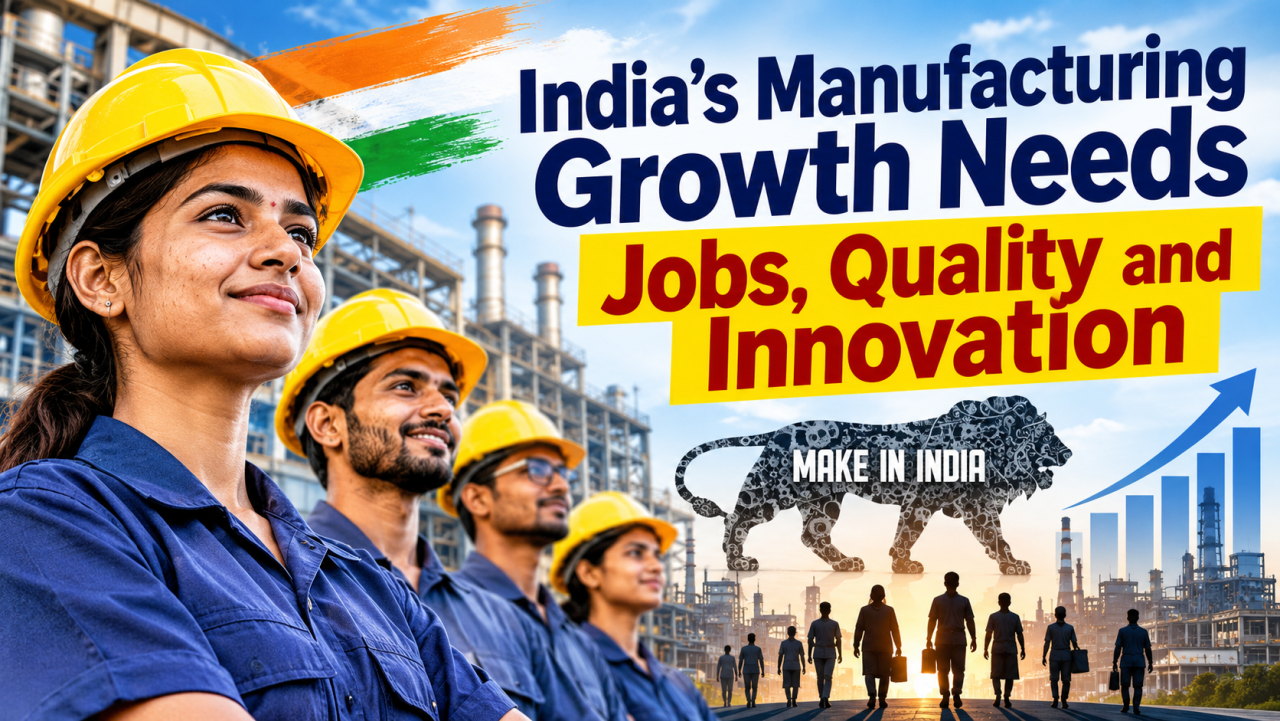
Economic growth will remain incomplete unless Indian industry invests in quality, innovation, skilled employment and the purchasing power of ordinary citizens.
India has spent the better part of the last decade trying to establish itself as a global manufacturing destination. Tax reforms, production incentives, infrastructure expansion and efforts to attract international investment have given domestic industry a more favourable environment. The country has also emerged as an important alternative in global supply chains as businesses reconsider their dependence on a handful of manufacturing centres.
But a competitive manufacturing economy requires more than factories, investment announcements and rising production figures. It requires companies that can produce goods people trust, workers who earn enough to participate in the economy and businesses capable of competing beyond the protection of their domestic market.
Prime Minister Narendra Modi's address at the Federation of Indian Chambers of Commerce and Industry's centenary convention in New Delhi on November 19 brought this larger challenge into focus. His message to industry extended beyond the familiar appeal for investment. He asked business leaders to look beyond their established markets, understand international consumers, improve product quality and make India's national interests the foundation of their long-term investment decisions.
His criticism of corporate reluctance to increase employee salaries and expand workforces was equally significant. It exposed a contradiction in India's growth model. An economy cannot indefinitely celebrate expanding corporate balance sheets while the purchasing power and employment prospects of a substantial section of its population remain under pressure.
The real test of India's industrial ambition is not how much it produces, but how much economic value it creates for the country.
The manufacturing ambition needs a stronger foundation
India's industrial policy has undergone a considerable transformation. The Production Linked Incentive (PLI) programme, introduced across 14 sectors with a combined financial outlay of approximately ₹1.91 lakh crore, was designed to encourage domestic manufacturing, attract investment, reduce import dependence and strengthen India's position in global supply chains.
The programme has produced measurable results. According to the government's latest assessment available for March 2026, PLI schemes attracted cumulative investments of ₹2.40 lakh crore and generated production worth ₹22.66 lakh crore. Employment reached approximately 8.49 lakh under the reported scheme figures. Incentive disbursements stood at ₹35,354 crore.
These figures demonstrate that targeted industrial incentives can help build manufacturing capacity. Electronics, pharmaceuticals, automobiles, solar modules and telecommunications have benefited from the policy framework.
Yet manufacturing capacity and manufacturing competitiveness are not interchangeable. A country may assemble millions of electronic devices without developing the same depth of domestic component manufacturing, research capabilities or technological ownership.
The next phase of industrial development must therefore move beyond production volumes. Indian companies need to invest in research, product engineering, advanced manufacturing, design and quality control. Without these capabilities, India risks becoming an important production location without becoming a decisive centre of industrial innovation.
The Indian consumer deserves better
For too long, sections of Indian industry have treated the domestic market as an assured destination for their products. A large population creates enormous commercial opportunities, but population size alone does not guarantee lasting consumer confidence.
Price-sensitive consumers may initially choose cheaper products, but affordability should never become an excuse for compromised quality, poor after-sales service or inadequate product safety.
Modi's appeal to manufacturers to produce goods that can compete internationally carries an important domestic implication. Products that meet demanding international standards can strengthen the confidence of Indian consumers as well.
The relationship between quality and economic development is particularly important as household consumption becomes a major driver of India's growth ambitions. Consumers need reliable products, transparent pricing and effective grievance redressal. Manufacturers need customers with sufficient purchasing power to sustain demand.
This relationship cannot be built through advertising alone. It requires consistent investment in quality, technology and customer satisfaction.
The domestic market should be a foundation for global ambition, not a substitute for it.
Corporate India must look beyond quarterly returns
The Economic Survey 2024-25 highlighted an imbalance that deserves serious attention. Profits among Nifty 500 companies reached 4.8 per cent of GDP in FY24, the highest level since FY08. Corporate profits increased by 22.3 per cent, while employment grew by only 1.5 per cent, according to the Survey's analysis.
indiabudget.gov.in+1
These figures do not suggest that profitability itself is undesirable. Profitable companies are essential for investment, innovation, exports and economic stability. But the distribution of economic gains matters.
When productivity and corporate earnings improve without corresponding improvements in wages and employment opportunities, the benefits of growth become concentrated. Workers find it difficult to improve their living standards, while businesses eventually encounter limits to domestic demand.
A stronger wage structure is therefore not simply a matter of corporate generosity. It is also an investment in the market that businesses depend upon.
India needs an industrial culture in which companies recognise employees as contributors to productivity and consumers as partners in economic expansion. A business strategy that focuses exclusively on reducing labour costs may improve short-term margins, but it can weaken the wider economic ecosystem over time.
Small businesses cannot remain on the margins
India's manufacturing ambitions will remain incomplete if industrial policy primarily benefits large corporations.
Micro, small and medium enterprises (MSMEs) account for a substantial share of manufacturing activity, exports and employment. They are also important suppliers to larger industrial groups. Yet many struggle with delayed payments, expensive credit, limited access to modern technology and the cost of regulatory compliance.
A large manufacturer may have the financial resources to establish a new production facility, invest in automation and negotiate with global suppliers. A small industrial unit often struggles to finance its next order while waiting for payment from an established customer.
This imbalance restricts the growth of the very businesses that can generate employment across smaller cities and industrial clusters.
The government must strengthen access to affordable credit, enforce timely payments, encourage technology adoption and simplify compliance for smaller enterprises. Large companies receiving public incentives should also be encouraged to develop stronger domestic supplier networks.
An industrial ecosystem becomes resilient when growth extends beyond a handful of corporate headquarters and reaches the smaller businesses that sustain production on the ground.
Automation must not become an excuse for an employment deficit
Technology is changing the nature of manufacturing. Artificial intelligence, robotics, automated assembly lines and digital production systems are improving efficiency and reducing manufacturing costs. Indian industry cannot afford to remain outside this transformation.
However, technological progress must be accompanied by a serious employment strategy.
India has millions of young people entering the labour market every year. Many possess university degrees but lack the technical training and practical experience required by modern industry. The gap between educational qualifications and workplace requirements remains a major obstacle to productive employment.
Businesses must invest in training, apprenticeships and continuous skill development. Industrial expansion should create opportunities for engineers, technicians, machine operators, designers, logistics professionals and skilled production workers.
Automation may reduce demand for certain repetitive tasks, but it also creates opportunities in maintenance, programming, engineering, quality assurance and advanced manufacturing. Preparing workers for these emerging occupations should be a shared responsibility of industry, educational institutions and government.
India's demographic advantage will become meaningful only when its young population can participate in productive economic activity.
Public incentives must produce public value
Government support for industry is not inherently problematic. Every major manufacturing economy has used a combination of infrastructure investment, financial incentives, research support and industrial policy to strengthen domestic enterprises.
The question is whether public support produces lasting economic benefits.
Tax concessions, production incentives and other policy advantages must be evaluated against measurable outcomes. Investment, domestic value addition, technology transfer, employment generation, wage growth and export competitiveness should form part of that assessment.
The latest PLI figures offer a useful starting point. By June 30, 2026, the schemes had reportedly generated more than 14.57 lakh direct and indirect jobs, alongside cumulative production and sales exceeding ₹23.79 lakh crore. These updated figures also demonstrate why policy evaluation must distinguish between direct employment, indirect employment and the wider economic impact of industrial expansion.
Press Information Bureau
The government should publish regular sector-wise assessments showing how incentives translate into actual investment, domestic manufacturing capabilities and employment. Companies receiving substantial public support should be expected to demonstrate progress against their declared commitments.
This is not about discouraging enterprise. It is about ensuring that industrial policy serves both commercial interests and national development.
India's next economic challenge is qualitative growth
India's ambition to become a developed economy by 2047 cannot rest exclusively on headline GDP figures. The quality of growth will matter as much as its pace.
A developed economy needs globally competitive companies, productive workers, strong domestic supply chains, technological independence and consumers who can afford the products and services they help create.
The private sector has a central role in this transformation. Government can build highways, modernise ports, simplify regulations and create investment incentives. It cannot independently create a culture of innovation inside corporate boardrooms or ensure that every company treats quality and workforce development as strategic priorities.
That responsibility belongs to industry.
FICCI's hundred-year journey provides an appropriate moment for Indian business to reassess its larger national role. The next two decades will be shaped by technological competition, changing global supply chains, artificial intelligence and the search for reliable manufacturing partners.
India has an opportunity to become more than an alternative production destination. It can develop into a country that designs, manufactures and exports products trusted across the world.
But that ambition requires a change in corporate thinking. Success cannot be measured only by market capitalisation, quarterly earnings or the number of units leaving factory gates.
It must also be measured by the quality of those products, the opportunities created for young Indians, the wages earned by workers and the strength of the businesses supplying the larger industrial ecosystem.
India's consumers are not merely a market to be captured. Its workers are not simply a cost to be controlled. Both are essential participants in the country's economic future.
The next chapter of Indian industrialisation will be determined by how seriously corporate India recognises this relationship. A manufacturing powerhouse cannot be built by looking only at the balance sheet. It must also look at the people whose labour, purchasing power and aspirations sustain the economy.

























Leave a Comment