
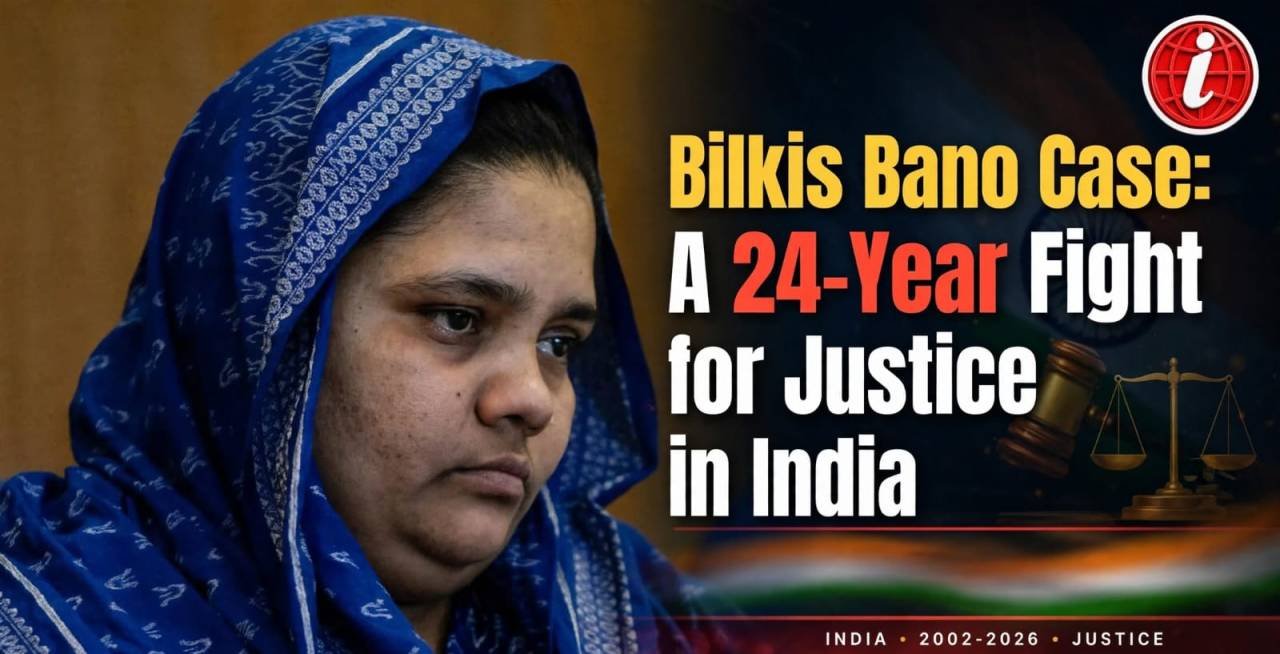
A woman who survived gang rape, lost seven members of her family and challenged a compromised investigation had to fight for more than two decades to protect her right to justice. The latest Supreme Court relief to two convicts has brought the case back in
In India, justice is a constitutional promise. But the experience of obtaining it can depend heavily on who is seeking it. A person with political connections, financial resources and institutional influence often has more ways to defend their interests than someone struggling to make their voice heard. For millions of ordinary citizens, approaching a police station, finding a lawyer or pursuing a case through the courts can become an exhausting battle.
The story of Bilkis Bano represents this difficult reality in one of its most disturbing forms.
More than 24 years after the violence that destroyed her family, Bilkis continues to be associated with a legal battle that has exposed failures in policing, the vulnerability of survivors of sexual violence and the complicated relationship between political power and criminal justice in India.
Her case is not simply about the conviction of 11 men. It is about the extraordinary persistence required from a victim when the institutions expected to protect her initially fail to deliver justice.
A brutal crime during the 2002 Gujarat riots
On March 3, 2002, during the communal violence that followed the Godhra train burning, Bilkis Bano, then 21 years old and five months pregnant, was fleeing with members of her family in Gujarat.
A mob attacked the group in the Dahod district. Bilkis was gang-raped, and seven members of her family, including her three-year-old daughter, were murdered.
The violence left her physically and emotionally devastated. Yet the struggle that followed was almost as difficult as surviving the attack itself.
The initial police response raised serious questions. Her complaint was not properly recorded, and the investigation failed to identify the perpetrators. In November 2002, the police submitted a closure report, describing the case as true but undetected. A subsequent closure request was also accepted in February 2003.
For a survivor who had already lost almost everything, the possibility of justice appeared to be slipping away.
When the survivor had to fight the system
Bilkis refused to accept the closure of her case. She approached the Supreme Court, seeking intervention and an independent investigation.
In December 2003, the Supreme Court ordered a CBI investigation. The agency subsequently uncovered evidence that strengthened the prosecution's case.
The proceedings were transferred from Gujarat to Mumbai in 2004 because of concerns about threats and the possibility of interference with the trial.
On January 21, 2008, a special court in Mumbai convicted 11 men and sentenced them to life imprisonment for their involvement in the rape and murders. The Bombay High Court upheld their convictions in May 2017. It also overturned the acquittal of five police personnel and two doctors, finding them guilty of offences relating to the handling of the investigation and evidence.
The convictions were important not only for Bilkis but also for the principle that public officials cannot escape accountability when they fail in their duties.
In April 2019, the Supreme Court directed the Gujarat government to pay Bilkis compensation of Rs 50 lakh and provide her with a government job and accommodation.
These developments demonstrated that judicial intervention could correct institutional failures. They also exposed how much effort a victim may have to invest before the system begins to respond.
The 2022 release and the Supreme Court's intervention
The case returned to national attention on August 15, 2022, when the Gujarat government released all 11 convicts under its remission policy.
The decision generated widespread criticism because the convicts had been sentenced to life imprisonment for exceptionally serious crimes involving rape and murder.
The release raised questions about the application of remission policies, the treatment of victims and the responsibility of governments in cases involving communal violence and sexual assault.
Bilkis challenged the decision before the Supreme Court.
On January 8, 2024, the Supreme Court struck down the remission orders and directed the 11 men to return to prison.
The court held that Gujarat was not the appropriate government to decide their remission applications because the trial and sentencing had taken place in Maharashtra. It also found that the Gujarat government had acted beyond its authority and that the remission orders were legally invalid.
The judgment was significant because it reinforced an essential constitutional principle: governments cannot exercise legal powers without jurisdiction, even when the beneficiaries are convicted prisoners.
It was also a reminder that the rights of victims cannot be ignored while governments make decisions affecting convicted criminals.
November 2026: Another legal development
The case has entered another phase.
In an order passed on October 28, 2026, and reported publicly in November, the Supreme Court suspended the life sentences of two convicts, Bipinchand Kanaiyalal Joshi and Pradip Ramanlal Modhiya, and granted them bail pending their appeals.
The court took note of their incarceration of more than 17 years and the severe physical disability of one of them. It observed that questions of fact and law remained to be examined in their appeals.
This development needs to be understood correctly. The court has not overturned their convictions through this order. Nor is this a restoration of the remission that was cancelled in January 2024. It is a separate judicial decision concerning suspension of sentences while appeals are pending.
Nevertheless, the development has reopened difficult questions about the emotional and legal burden placed on survivors when cases of such magnitude continue through different stages of litigation.
Bilkis reportedly expressed shock that the latest order had been passed without hearing her. Her response highlights the importance of ensuring that victims are not reduced to passive observers in proceedings that have an enormous impact on their lives.
The larger problem: Justice is harder for those without power
The Bilkis Bano case reflects a wider problem in Indian society. The law may promise equality, but access to justice is not always equal.
For a poor family, pursuing a criminal case can mean travelling long distances, losing daily wages, arranging legal representation and dealing with repeated court appearances. For women facing sexual violence, the difficulties can be even greater because social stigma, threats, financial dependence and pressure from influential people often discourage them from reporting crimes.
The National Legal Services Authority provides legal assistance to eligible sections of society, including women and economically weaker people. Yet the existence of legal aid does not automatically remove the practical barriers that prevent people from obtaining justice.
The problem is not limited to criminal cases. Ordinary citizens also struggle with land disputes, delayed compensation, police inaction, administrative corruption and local political pressure. A person without money or connections may spend years trying to obtain a document, register a complaint or secure action against an influential individual.
This is where the idea of equality before the law faces its real test.
The Constitution guarantees equality under Article 14. Article 21 protects life and personal liberty, while Article 39A directs the state to ensure equal justice and free legal aid. These are not merely legal provisions to be quoted in courtrooms. They represent the responsibility of the state towards citizens who cannot protect their interests through influence or wealth.
The Bilkis Bano case shows why these constitutional commitments require constant scrutiny.
Justice must not depend on the strength of the victim
There is another disturbing aspect of this case. Bilkis had to repeatedly demonstrate courage and determination simply to ensure that the legal process continued. She approached the highest court, challenged the initial investigation, sought a transfer of trial and later challenged the remission of the convicts.
Not every victim has the resources, support or strength to undertake such a journey.
Many people abandon their legal battles not because their grievances are false, but because the cost of pursuing justice becomes unbearable. Some fear retaliation. Others cannot afford lawyers or take time away from work. Many simply lose faith after years of waiting.
A justice system should not require extraordinary courage from ordinary citizens just to perform its basic duty.
The state must protect witnesses, investigate complaints impartially, hold erring officials accountable and ensure that victims have a meaningful opportunity to be heard. Political influence must never become a shield against criminal accountability.
Bilkis Bano's struggle deserves recognition because she refused to allow institutional failure to become the final verdict on her life. Her fight also reminds India that a conviction alone does not complete the responsibility of the justice system. The dignity, safety and rights of the survivor must remain central throughout the process.
The true measure of a democracy is not how effectively it protects the powerful, but how reliably it delivers justice to those who have none.





















Leave a Comment