
Vietnam and Singapore are gaining ground, but growing dependence on Chinese imports raises questions about the sustainability of Southeast Asia's export-led success. India, meanwhile, faces a difficult choice between economic protection and deeper regional
Southeast Asia's economic rise is often presented as a success story of globalisation. Its economies have attracted manufacturing investment, expanded exports and steadily increased their share of global output. But beneath these impressive numbers lies a more complicated picture. ASEAN's growing economic influence comes with internal disparities, a narrowing trade surplus relative to GDP and increasing dependence on China for industrial supplies.
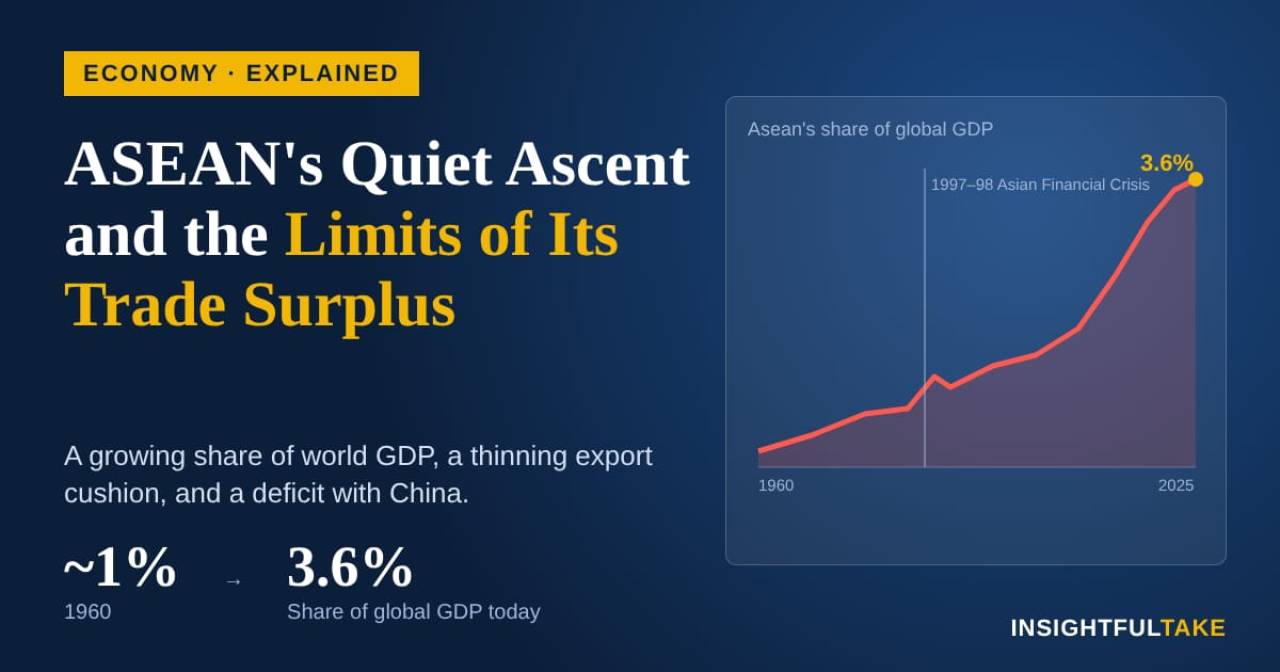
The conclusion of the 40th ASEAN Summit in Manila on November 17 offered an opportunity to look beyond diplomatic statements and examine this changing economic landscape. The bloc, which accounted for barely 1% of global GDP in 1960, now contributes approximately 3.6%. The rise is significant, but an important question remains: how sustainable is this growth, and what kind of economic strength does it represent?
A Long Recovery from the Asian Financial Crisis
ASEAN's economic expansion has not followed a straight line. The Asian Financial Crisis of 1997-98, triggered by sudden capital outflows and aggravated by economic weaknesses, hit Indonesia, Thailand and Malaysia particularly hard.
The region's share of global output declined during the crisis and did not recover to its pre-crisis level until 2006. In effect, Southeast Asia lost years of economic progress before regaining its earlier position.
This history deserves attention when discussing the region's rise. The success of the so-called Asian Tigers was not simply an uninterrupted growth story. It also reflected the ability of several economies to absorb a major financial shock, restructure and rebuild.
Vietnam Rises, but ASEAN's Members Follow Different Paths
ASEAN's overall economic performance hides substantial differences among its members.
Vietnam has emerged as one of the region's most striking success stories. Its share of global GDP increased from 0.03% in 1990 to 0.09% in 2000 and approximately 0.43% in 2025. Its rapid expansion over the past decade and a half reflects its growing importance in global manufacturing and international supply chains.
Singapore, despite its limited land area and lack of natural resources, has also crossed the 0.5% mark. Indonesia remains ASEAN's largest economy by a considerable margin, while Thailand's share of global output has largely stagnated.
The Philippines presents a different picture. It lost economic ground between 1960 and 1990 and, according to the Hindustan Times analysis, has yet to regain its 1960 share of 0.55%.
These contrasting experiences underline an important point: belonging to a fast-growing economic bloc does not automatically guarantee national prosperity. Domestic policy, industrial competitiveness and the ability to attract productive investment continue to determine individual countries' performance.
ASEAN's Trade Surplus Is Losing Its Relative Strength
ASEAN has maintained a trade surplus with the rest of the world every year since 2000. In some years, that surplus has exceeded $100 billion, demonstrating the region's growing importance as an export destination and manufacturing base.
However, measuring the surplus against the size of the economy produces a different picture. Its share of GDP has declined considerably from more than 9% at the beginning of the century.
There are two possible interpretations.
The optimistic view is that ASEAN economies are maturing. Domestic consumption and services are becoming more important, reducing the relative contribution of merchandise exports to economic growth.
The more cautious interpretation is that the region's traditional export advantage is becoming less powerful. A declining surplus-to-GDP ratio does not necessarily indicate economic weakness, but it does raise questions about the changing foundations of ASEAN's external competitiveness.
The China Factor Behind ASEAN's Trade Numbers
Perhaps the most revealing aspect of ASEAN's trade position is its growing economic imbalance with China.
The bloc maintains trade surpluses with the United States and India but runs a deficit with China. This imbalance has deepened since ASEAN became part of the Regional Comprehensive Economic Partnership (RCEP), alongside China, Japan, South Korea, Australia and New Zealand.
The explanation is closely linked to regional manufacturing networks.
Countries such as Vietnam import machinery, components and industrial inputs from China. These materials are then used in manufacturing and assembly operations, with finished products exported to Western markets.
Consequently, part of ASEAN's trade surplus with Western economies is linked to its trade deficit with China.
This complicates the popular idea of China Plus One, under which companies diversify their manufacturing operations beyond China. Moving final assembly to Vietnam or another Southeast Asian country does not necessarily mean reducing dependence on Chinese suppliers.
The production location may change, but the supply chain can remain closely connected to China.
India's Difficult Choice: Protection or Integration?
India's trade relationship with ASEAN presents another important dimension of this economic story.
India's trade deficit with the bloc has also widened in absolute terms, making it one of the markets contributing to ASEAN's export surplus rather than a major beneficiary of the region's manufacturing expansion.
For a country seeking to establish itself as a global manufacturing destination, this presents a challenge.
India's decision to stay out of RCEP was driven by concerns that cheaper imports, particularly from China, could put domestic manufacturers under pressure. Those concerns were not without merit.
However, ASEAN's experience raises another question: did staying outside the regional trade agreement also limit Indian companies' access to the supply chains that helped countries such as Vietnam expand their manufacturing capabilities?
There is no straightforward answer.
Deeper trade integration can expose domestic industries to competition and create dependence on dominant suppliers. ASEAN's growing trade deficit with China illustrates that risk. At the same time, remaining outside major regional production networks can leave domestic companies with fewer opportunities to participate in global value chains.
India must therefore find a balance between protecting its industrial base and making its manufacturing sector competitive enough to benefit from international trade.
The Real Lesson of ASEAN's Economic Rise
ASEAN's economic journey is about more than rising GDP figures and growing export volumes. It demonstrates how developing and middle-income economies can use openness, investment and regional cooperation to strengthen their position in the global economy.
But it also exposes the limitations of that model. Economic growth does not automatically translate into technological independence, stronger domestic supply chains or balanced trade relationships.
For India, the lesson is particularly relevant. Expanding manufacturing capacity must go beyond attracting foreign companies or increasing finished-goods exports. The country needs a stronger domestic ecosystem for components, machinery, industrial inputs and technology.
Without that foundation, India risks becoming a larger consumer market without gaining a proportionate role in global production networks.
ASEAN's rise shows what economic openness can achieve. Its dependence on Chinese industrial supplies also shows what it cannot solve on its own. India's challenge is to learn from both sides of that experience.
Southeast Asia's economic rise is often presented as a success story of globalisation. Its economies have attracted manufacturing investment, expanded exports and steadily increased their share of global output. But beneath these impressive numbers lies a more complicated picture. ASEAN's growing economic influence comes with internal disparities, a narrowing trade surplus relative to GDP and increasing dependence on China for industrial supplies.
The conclusion of the 40th ASEAN Summit in Manila on November 17 offered an opportunity to look beyond diplomatic statements and examine this changing economic landscape. The bloc, which accounted for barely 1% of global GDP in 1960, now contributes approximately 3.6%. The rise is significant, but an important question remains: how sustainable is this growth, and what kind of economic strength does it represent?
A Long Recovery from the Asian Financial Crisis
ASEAN's economic expansion has not followed a straight line. The Asian Financial Crisis of 1997-98, triggered by sudden capital outflows and aggravated by economic weaknesses, hit Indonesia, Thailand and Malaysia particularly hard.
The region's share of global output declined during the crisis and did not recover to its pre-crisis level until 2006. In effect, Southeast Asia lost years of economic progress before regaining its earlier position.
This history deserves attention when discussing the region's rise. The success of the so-called Asian Tigers was not simply an uninterrupted growth story. It also reflected the ability of several economies to absorb a major financial shock, restructure and rebuild.
Vietnam Rises, but ASEAN's Members Follow Different Paths
ASEAN's overall economic performance hides substantial differences among its members.
Vietnam has emerged as one of the region's most striking success stories. Its share of global GDP increased from 0.03% in 1990 to 0.09% in 2000 and approximately 0.43% in 2025. Its rapid expansion over the past decade and a half reflects its growing importance in global manufacturing and international supply chains.
Singapore, despite its limited land area and lack of natural resources, has also crossed the 0.5% mark. Indonesia remains ASEAN's largest economy by a considerable margin, while Thailand's share of global output has largely stagnated.
The Philippines presents a different picture. It lost economic ground between 1960 and 1990 and, according to the Hindustan Times analysis, has yet to regain its 1960 share of 0.55%.
These contrasting experiences underline an important point: belonging to a fast-growing economic bloc does not automatically guarantee national prosperity. Domestic policy, industrial competitiveness and the ability to attract productive investment continue to determine individual countries' performance.
ASEAN's Trade Surplus Is Losing Its Relative Strength
ASEAN has maintained a trade surplus with the rest of the world every year since 2000. In some years, that surplus has exceeded $100 billion, demonstrating the region's growing importance as an export destination and manufacturing base.
However, measuring the surplus against the size of the economy produces a different picture. Its share of GDP has declined considerably from more than 9% at the beginning of the century.
There are two possible interpretations.
The optimistic view is that ASEAN economies are maturing. Domestic consumption and services are becoming more important, reducing the relative contribution of merchandise exports to economic growth.
The more cautious interpretation is that the region's traditional export advantage is becoming less powerful. A declining surplus-to-GDP ratio does not necessarily indicate economic weakness, but it does raise questions about the changing foundations of ASEAN's external competitiveness.
The China Factor Behind ASEAN's Trade Numbers
Perhaps the most revealing aspect of ASEAN's trade position is its growing economic imbalance with China.
The bloc maintains trade surpluses with the United States and India but runs a deficit with China. This imbalance has deepened since ASEAN became part of the Regional Comprehensive Economic Partnership (RCEP), alongside China, Japan, South Korea, Australia and New Zealand.
The explanation is closely linked to regional manufacturing networks.
Countries such as Vietnam import machinery, components and industrial inputs from China. These materials are then used in manufacturing and assembly operations, with finished products exported to Western markets.
Consequently, part of ASEAN's trade surplus with Western economies is linked to its trade deficit with China.
This complicates the popular idea of China Plus One, under which companies diversify their manufacturing operations beyond China. Moving final assembly to Vietnam or another Southeast Asian country does not necessarily mean reducing dependence on Chinese suppliers.
The production location may change, but the supply chain can remain closely connected to China.
India's Difficult Choice: Protection or Integration?
India's trade relationship with ASEAN presents another important dimension of this economic story.
India's trade deficit with the bloc has also widened in absolute terms, making it one of the markets contributing to ASEAN's export surplus rather than a major beneficiary of the region's manufacturing expansion.
For a country seeking to establish itself as a global manufacturing destination, this presents a challenge.
India's decision to stay out of RCEP was driven by concerns that cheaper imports, particularly from China, could put domestic manufacturers under pressure. Those concerns were not without merit.
However, ASEAN's experience raises another question: did staying outside the regional trade agreement also limit Indian companies' access to the supply chains that helped countries such as Vietnam expand their manufacturing capabilities?
There is no straightforward answer.
Deeper trade integration can expose domestic industries to competition and create dependence on dominant suppliers. ASEAN's growing trade deficit with China illustrates that risk. At the same time, remaining outside major regional production networks can leave domestic companies with fewer opportunities to participate in global value chains.
India must therefore find a balance between protecting its industrial base and making its manufacturing sector competitive enough to benefit from international trade.
The Real Lesson of ASEAN's Economic Rise
ASEAN's economic journey is about more than rising GDP figures and growing export volumes. It demonstrates how developing and middle-income economies can use openness, investment and regional cooperation to strengthen their position in the global economy.
But it also exposes the limitations of that model. Economic growth does not automatically translate into technological independence, stronger domestic supply chains or balanced trade relationships.
For India, the lesson is particularly relevant. Expanding manufacturing capacity must go beyond attracting foreign companies or increasing finished-goods exports. The country needs a stronger domestic ecosystem for components, machinery, industrial inputs and technology.
Without that foundation, India risks becoming a larger consumer market without gaining a proportionate role in global production networks.
ASEAN's rise shows what economic openness can achieve. Its dependence on Chinese industrial supplies also shows what it cannot solve on its own. India's challenge is to learn from both sides of that experience.

























Leave a Comment