
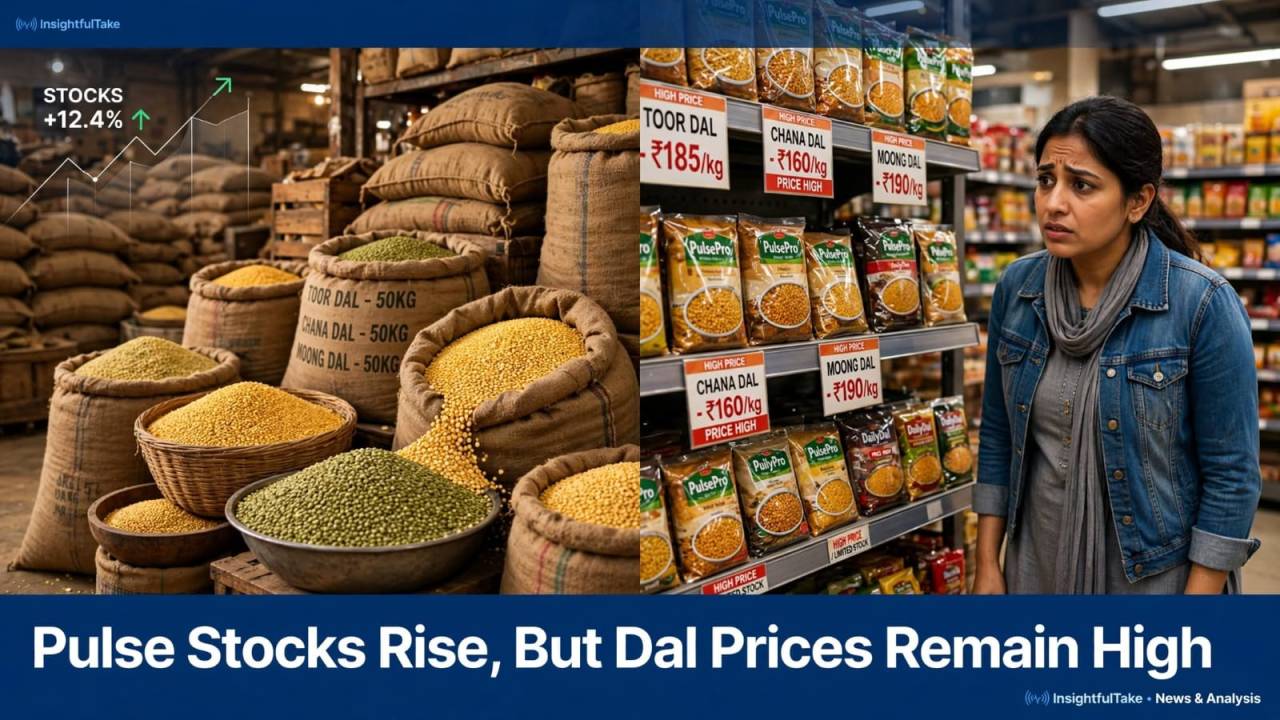
India has 4.5 million tonnes of pulse stocks, but dal remains expensive. Why is the government’s food inflation strategy failing to deliver relief to consumers?
India’s retail inflation climbed to a 23-month high of 5.54% in September 2026, while food inflation surged to 7.74%. Onions led the price rise, jumping more than 108% year-on-year. But the steady increase in pulses is proving harder for households to absorb. Tur dal rose 17.2% year-on-year to ₹131.98 per kg, chana dal climbed 8.66% to ₹92.86, and urad prices increased 10.56%.
The numbers expose a troubling contradiction. The Centre holds a record 4.5 million tonnes of buffer stocks of pulses, yet prices remain stubbornly high. Southern states have sought more than one lakh tonnes of tur dal each to meet their requirements, while consumers continue to pay more for a staple that provides an important source of protein. Tur and chana alone account for a substantial share of India's pulse consumption.
The central question is no longer whether the government has enough stocks. It is whether its policies can translate those stocks into affordable food for households.
A Record Stockpile, but Limited Relief
The government's position is that buffer stocks are intended primarily for market intervention rather than routine distribution through state welfare schemes.
“Our function is not to give states our buffer for their welfare schemes but to intervene in retail markets when necessary,” a government source reportedly told journalists this week.
The 4.5-million-tonne stockpile includes around 1.1 million tonnes of tur and 2.3 million tonnes of chana, alongside masur, moong and urad. The government intends to release these stocks into the open market in a calibrated manner to moderate prices.
There are valid reasons for caution. Uneven rainfall and drought-like conditions in key pulse-growing areas of Maharashtra and Karnataka have raised concerns about the kharif tur crop approaching harvest. Dry soil conditions have also threatened rabi chana sowing. If production falls further, the government may need its reserves to contain a fresh round of price increases.
Releasing too much stock too early could weaken the country's ability to respond to a worsening supply situation. But excessive caution carries its own cost: consumers continue to face high prices even when the government has substantial supplies available.
The challenge is to strike a balance between protecting future availability and providing relief in the present.
Why Lower Wholesale Prices Are Not Reaching Consumers
The disconnect between wholesale and retail prices is central to the problem.
Mandi prices for several pulses have recently traded below their Minimum Support Prices (MSPs), reflecting market arrivals and imports. Retail prices, however, remain elevated. This gap raises questions about how effectively price reductions are travelling through the supply chain.
Pulses pass through several stages before reaching consumers. Farmers sell their produce to traders, which may then move through commission agents, millers, wholesalers and retailers. Processing, transportation, storage and distribution add to the final price. Differences in timing, location and quality can also influence the gap between wholesale and retail rates.
These costs are real, but they do not fully explain why consumers may continue paying high prices when wholesale rates soften. Weak competition, delayed transmission of price changes and distribution inefficiencies can reduce the benefit of lower mandi prices.
The government has several instruments at its disposal. Stockholding limits on tur and urad have been tightened and extended beyond October. Duty-free imports of tur and urad have also been permitted until March 2027.
However, the Centre has resisted calls to reduce the 10% import duty on chana and the 30% duty on yellow peas, even as industry bodies seek relief.
These measures may help improve supply, but their effectiveness depends on timing, market conditions and how quickly the benefits reach retail buyers. A large buffer stock, by itself, cannot guarantee affordable prices.
India's Long-Standing Dependence on Volatile Pulse Production
The current situation reflects a deeper weakness in India's agricultural policy.
Pulses have historically received less investment in irrigation, research and productivity improvements than several major cereal crops. Much of their cultivation remains rain-dependent, leaving farmers vulnerable to erratic monsoons and changing weather patterns.
When rainfall is uneven, production risks rise. Lower yields or reduced acreage can tighten supplies and push prices upwards. A good harvest can reverse the situation, sometimes leaving farmers struggling with falling market prices.
India also depends on imports to meet a portion of its pulse requirements, with the share varying by crop and year. Supplies from Myanmar, African countries, Canada and other markets help bridge domestic production gaps. But imports bring their own uncertainties, including exchange-rate movements, international price fluctuations, geopolitical disruptions and changes in trade policy.
The government's record procurement in previous years has helped build a substantial buffer. Yet the same system faces a recurring challenge: managing the timing and distribution of stocks so that farmers receive reasonable returns without forcing consumers to bear persistently high prices.
This is not simply a question of how much grain is stored. It is a question of how effectively production, procurement, imports and market distribution are coordinated.
Short-Term Fixes Cannot Replace Long-Term Reform
The government's response has relied heavily on temporary interventions: releasing buffer stocks, adjusting import duties, imposing stock limits and selling subsidised chana under the Bharat Dal initiative.
These measures can help during periods of acute price pressure. But repeated reliance on emergency action suggests that the underlying weaknesses remain unresolved.
India needs a stronger long-term strategy to improve pulse productivity and reduce vulnerability to weather shocks. This requires investment in climate-resilient seed varieties, better agricultural research, improved access to quality seeds and targeted irrigation in major pulse-growing regions.
Maharashtra and Karnataka, important producers of tur, need sustained support for water conservation and farming practices suited to uncertain rainfall. Procurement policies should also encourage reliable production and quality, rather than focusing primarily on the volume purchased.
Farmers need greater certainty that higher production will not automatically lead to a collapse in prices. Consumers, meanwhile, need protection from sharp increases in the cost of everyday food.
These objectives are not mutually exclusive. Better storage, more efficient market linkages, predictable import policies and transparent procurement can help reduce volatility for both groups.
A Buffer Stock Must Deliver More Than Security on Paper
The government has reasons to preserve reserves against future shortages. But a stockpile intended to stabilise prices must be judged by its results in the market, not merely by its size.
The Centre and states need a more coordinated approach to pulse distribution. Buffer releases should be timely, transparent and responsive to retail prices, regional shortages and seasonal demand. Temporary reductions in import duties on chana and yellow peas could also be considered if evidence shows that they would improve supplies and reduce consumer prices without causing disproportionate harm to domestic farmers.
Above all, the government needs a clearer mechanism to assess whether its interventions are working. Publishing regular information on stock releases, wholesale prices and retail price movements would help establish whether public resources are delivering the intended relief.
India's 4.5-million-tonne pulse reserve is a significant achievement. But when prices remain high despite such stocks, the achievement is incomplete.
For millions of households, dal is not an optional item in the food basket. It is an essential source of protein. Food security, therefore, cannot be measured only by the quantity stored in government warehouses. It must also be measured by whether families can afford to put nutritious food on their plates.
India's food inflation policy must move beyond accumulating stocks and reacting to price spikes. The real test is whether it can make the journey from government godowns to household kitchens faster, fairer and more effective.



























Leave a Comment