
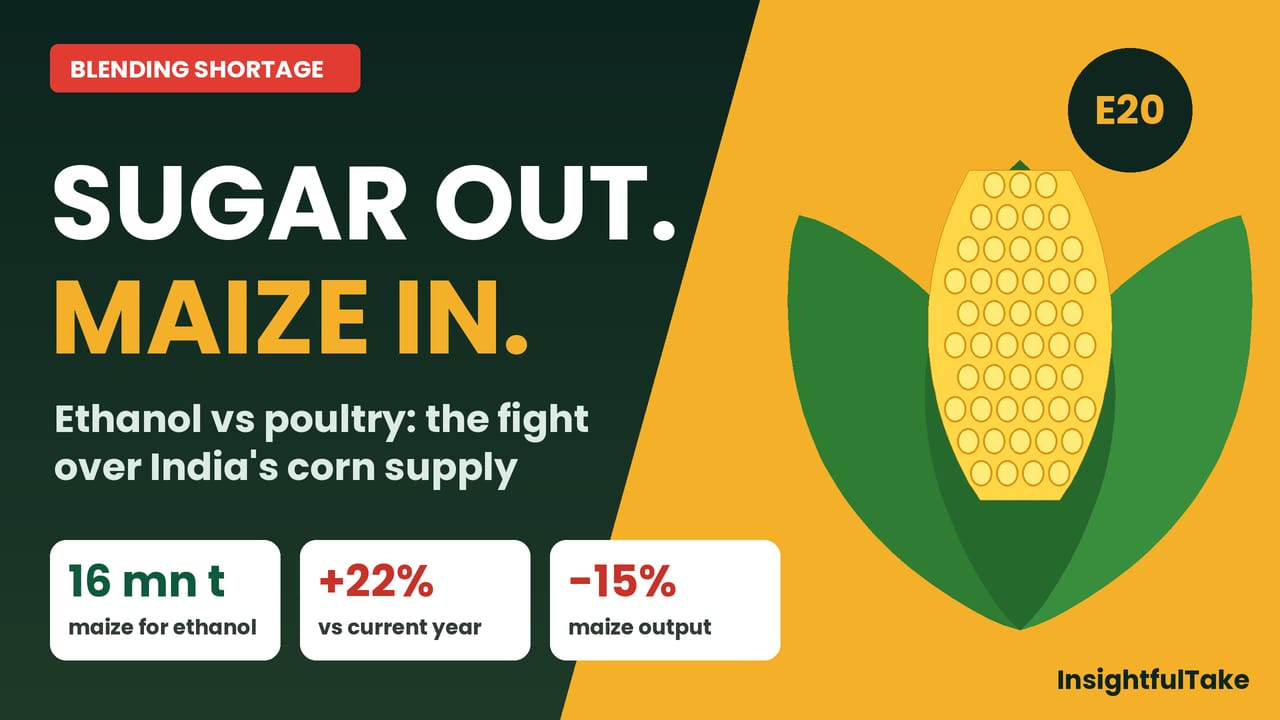
India’s ethanol push is shifting demand to maize just as production falls, raising the risk of a supply crunch for poultry farms, dairies and food industries.
When the government shut the sugar-based route to ethanol this month, it did more than change a fuel policy. It shifted pressure onto maize, a crop that poultry farms, dairies and starch manufacturers also depend on. With maize production already falling, the next ethanol supply year could bring a scramble for grain.
A Sudden Change of Course
On October 16, the government directed oil marketing companies (OMCs) to stop buying ethanol made from sugarcane juice, sugar syrup and B-heavy molasses. The stated reason was to protect domestic sugar supplies. In effect, the diversion of these sugar-based products for ethanol is set to fall to zero in the coming supply cycle.
One sugar-linked feedstock remains eligible. C-heavy molasses, the residue left after most of the sugar has been extracted, can still be used to produce ethanol. However, its low sugar content limits how much it can contribute. B-heavy molasses contains considerably more sucrose, making it a more productive feedstock. Its exclusion therefore leaves a significant gap for the industry to fill.
The Numbers Behind the Gap
On the same day, Bharat Petroleum Corporation Ltd floated the first tender for the November 2026 to October 2027 ethanol supply year, seeking around 11 billion litres. With most sugar-based sources excluded, the sourcing plan relies heavily on grain.
The proposed feedstock mix is as follows:
- Maize: About 6 billion litres
- Surplus rice: About 3.25 billion litres
- Damaged foodgrains: About 1.25 billion litres
- C-heavy molasses: About 0.5 billion litres
Maize alone is expected to account for more than half of the requirement. Industry estimates suggest that producing this volume of ethanol will require roughly 16 million tonnes of maize, around 22% more than the 13 million tonnes used in the current supply year.
This sharp increase in demand comes at a time when the domestic crop is expected to be smaller.
A Shrinking Crop Meets Growing Demand
Maize production is estimated to have fallen by around 15% from last year's 55 million tonnes. If that estimate holds, the harvest would be roughly 47 million tonnes.
Industry estimates suggest that total maize demand in 2027, including animal feed, ethanol production, starch manufacturing and other uses, could reach 55.7 million tonnes. Compared with the projected harvest, this would leave a shortfall of around 9 million tonnes.
These figures are projections and could change with the final harvest estimates, actual consumption and import decisions. Even so, they point to a growing mismatch between the available supply and the demand for maize.
Based on these estimates, ethanol production would account for about 29% of total maize demand in 2027. This would make the fuel industry a major competitor for a crop that is already essential to several other sectors.
Who Feels the Squeeze?
Maize is a key ingredient in poultry feed, while dairy farms use it in cattle feed. Starch manufacturers also depend on it as a primary raw material. All three sectors now face greater competition from ethanol producers for the same grain.
If demand rises faster than supply, maize prices could climb, pushing up input costs for poultry farms, dairy businesses and starch manufacturers. For consumers, the effects could eventually show up in the prices of eggs, poultry meat and milk. The extent of any increase would depend on how prices move and how businesses adjust their procurement and production.
Farmers could benefit from stronger demand and higher prices. However, when the harvest is already under pressure, the gains may not be evenly distributed. Farmers with surplus grain may be in a stronger position than those with smaller marketable quantities. Meanwhile, industries dependent on maize may seek measures to ensure that enough grain remains available for their needs.
The question is no longer just how much ethanol India can produce. It is also how much competition the country's grain supply can withstand.
The Policy Tightrope
The episode highlights a difficult balance in India's ethanol-blending programme. The policy aims to reduce dependence on imported oil, support domestic fuel production and create an additional market for farmers. But every feedstock used for ethanol has other demands on it.
Sugarcane supports the sugar industry, rice is a staple food, and maize is vital to animal feed and industrial production. Diverting any of these resources towards fuel can affect the markets that depend on them.
By restricting sugar-based feedstocks, the government has sought to protect domestic sugar availability. But the decision has shifted more of the burden onto grain, particularly maize.
The next test will come as tenders are finalised and distilleries begin purchasing their feedstock. If maize prices rise sharply, policymakers could face pressure to reconsider the feedstock mix, expand the use of damaged or surplus foodgrains where feasible, or examine imports to ease supply constraints.
Each option has trade-offs. Imports could help bridge a domestic shortage but would introduce new costs and supply considerations. Greater reliance on other grains would also depend on their availability and competing uses.
For now, the central challenge is clear. India's ethanol programme is expanding its demand for maize just as the crop faces a production setback. Unless supply improves or the feedstock mix changes, fuel producers and the industries that depend on maize could find themselves competing for an increasingly scarce resource.





















Leave a Comment