
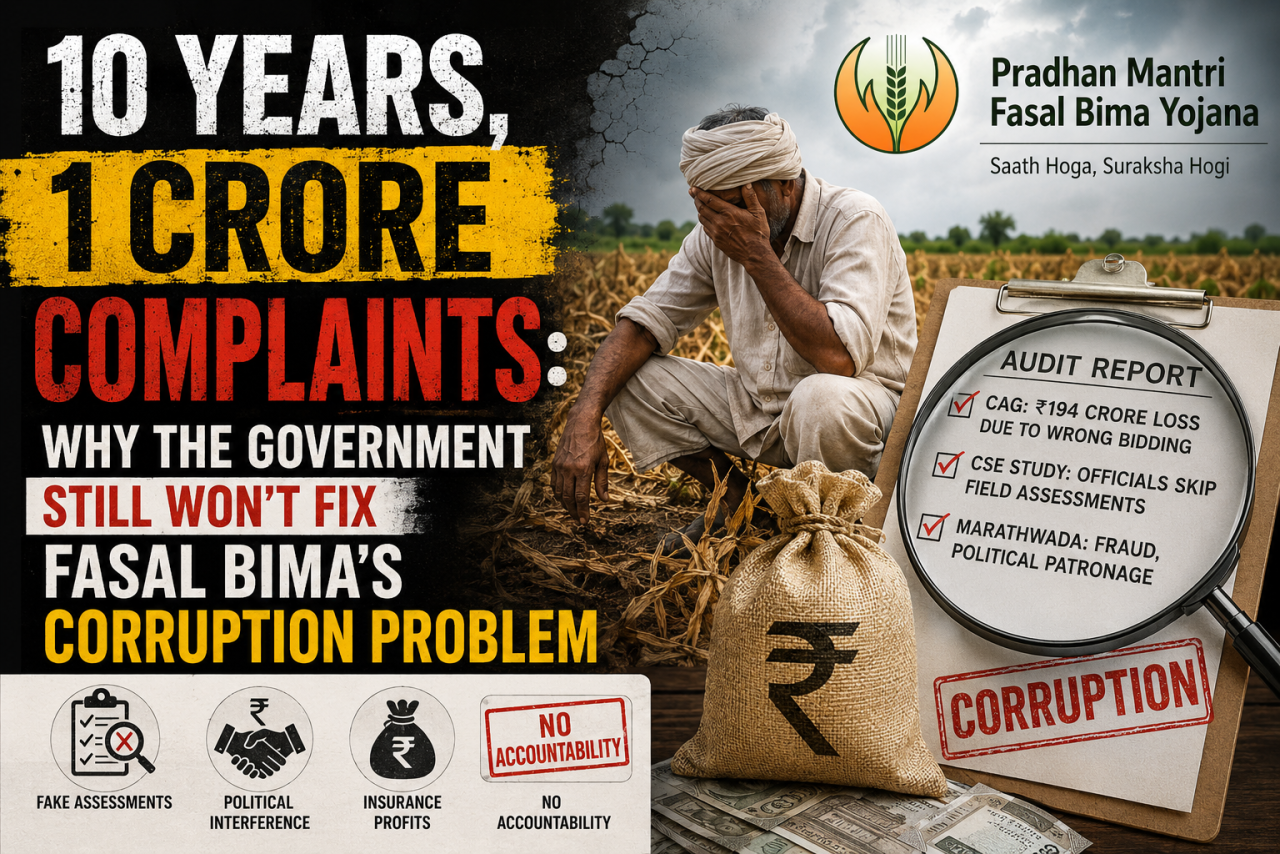
A decade after promising financial security to India's farmers, the Pradhan Mantri Fasal Bima Yojana faces uncomfortable questions. Audit reports, field studies, and fraud investigations suggest that the biggest challenge may not be crop failure, but a per
The Pradhan Mantri Fasal Bima Yojana (PMFBY) was launched in 2016 with a simple promise that it would protect India's farmers from the financial devastation caused by crop failure. A decade later, the scheme has disbursed more than Rs 1.25 lakh crore in insurance claims, a figure the government frequently highlights as evidence of its success.
What receives far less attention is an equally significant record of audit findings, field studies, and state-level fraud investigations that suggest the scheme's implementation has been compromised at multiple levels. Despite repeated warnings, successive governments have responded with incremental reforms instead of systemic accountability.
A Decade of Documented Irregularities
The evidence has existed in official records for years.
A Comptroller and Auditor General (CAG) audit found that Oriental Insurance Company Ltd incurred a loss of Rs 194 crore in a single financial year after failing to correctly determine bidding rates under the scheme's reinsurance treaty. The error ultimately translated into a loss of public money, yet no significant accountability followed.
Field research conducted by the Centre for Science and Environment (CSE) across Haryana, Tamil Nadu, and Uttar Pradesh uncovered another troubling pattern. District and block-level agriculture officials frequently bypassed physical crop-loss assessments while completing the required paperwork as though inspections had taken place.
The study also highlighted a shortage of trained outsourced agencies responsible for conducting assessments. More importantly, it noted that technologies such as smartphones and drones, already available for transparent crop verification, remained largely unused despite repeated recommendations.
When Verification Exists Only on Paper
These are not isolated administrative failures.
They point to a structural weakness where the two most important stakeholders, the farmer reporting crop damage and the taxpayer funding premium subsidies, have no reliable way to verify whether an assessment actually took place.
That absence of transparency creates fertile ground for corruption.
Marathwada Becomes a Case Study
Maharashtra's Marathwada region has emerged as one of the clearest examples of how these weaknesses can be exploited.
Reports from the region have described the scheme increasingly becoming a vehicle for local political patronage, with implementation facing growing political interference alongside major fraud allegations.
The Opposition has capitalised on these developments. Congress General Secretary Jairam Ramesh has described PMFBY as a "complete failure," alleging that it has primarily benefited private insurance companies rather than farmers.
The political rhetoric may be partisan, but the underlying concern is not new. Independent researchers have long questioned a system in which private insurers receive substantial premium income while claim assessments remain opaque and vulnerable to manipulation.
Reforms That Address Symptoms, Not the Disease
The government's response has largely followed a familiar pattern.
Problems are acknowledged just enough to justify announcing new reforms, while the structural causes remain largely untouched.
Earlier this year, Union Agriculture Minister Shivraj Singh Chouhan informed the Lok Sabha that insurance companies would have to pay farmers 12 percent interest if claims were not settled within 21 days. State governments would face the same financial penalty for delays attributable to them.
The government also launched the Krishi Rakshak grievance portal, allowing farmers to register complaints regarding delayed settlements.
Both initiatives are sensible.
Neither, however, addresses the core issue repeatedly identified by field researchers: the unreliable and poorly supervised process of assessing crop losses on the ground.
An interest penalty may discourage delays, but it cannot prevent an official from certifying an assessment that never occurred. Nor does it ensure that bidding rates are calculated correctly or that those responsible for repeated errors face meaningful consequences.
The Accountability Gap Remains
This is where scrutiny becomes essential.
Ten years after the scheme's launch, there is still no publicly available disclosure showing how many block-level crop assessments were independently audited and found fraudulent. There is no comprehensive record of disciplinary action taken against officials implicated in state-level fraud investigations.
Nor has the government established an independent verification mechanism for crop-loss sampling, despite the shortcomings identified by CSE as far back as 2017.
Instead, official communication continues to emphasise one statistic: the total value of claims disbursed.
That number reveals little about whether those claims were based on accurate assessments, whether deserving farmers were excluded, or whether those denied compensation have any effective avenue for justice beyond filing complaints through an online portal.
Reform, Not Abandonment
None of this suggests that PMFBY should be dismantled.
The scheme's expansion to include non-loanee, marginal, and small farmers represents a significant policy achievement. Removing it would leave millions without an important financial safety net against crop failure.
But recognising that achievement should not require ignoring persistent corruption.
A decade of audit reports, independent research, and investigative findings has already identified where the scheme is failing. The Ministry of Agriculture does not lack information.
What has been missing is the political will to ensure that transparency, accountability, and independent verification become as central to PMFBY as the financial support it promises to deliver.
The Pradhan Mantri Fasal Bima Yojana (PMFBY) was launched in 2016 with a simple promise that it would protect India's farmers from the financial devastation caused by crop failure. A decade later, the scheme has disbursed more than Rs 1.25 lakh crore in insurance claims, a figure the government frequently highlights as evidence of its success.
What receives far less attention is an equally significant record of audit findings, field studies, and state-level fraud investigations that suggest the scheme's implementation has been compromised at multiple levels. Despite repeated warnings, successive governments have responded with incremental reforms instead of systemic accountability.
A Decade of Documented Irregularities
The evidence has existed in official records for years.
A Comptroller and Auditor General (CAG) audit found that Oriental Insurance Company Ltd incurred a loss of Rs 194 crore in a single financial year after failing to correctly determine bidding rates under the scheme's reinsurance treaty. The error ultimately translated into a loss of public money, yet no significant accountability followed.
Field research conducted by the Centre for Science and Environment (CSE) across Haryana, Tamil Nadu, and Uttar Pradesh uncovered another troubling pattern. District and block-level agriculture officials frequently bypassed physical crop-loss assessments while completing the required paperwork as though inspections had taken place.
The study also highlighted a shortage of trained outsourced agencies responsible for conducting assessments. More importantly, it noted that technologies such as smartphones and drones, already available for transparent crop verification, remained largely unused despite repeated recommendations.
When Verification Exists Only on Paper
These are not isolated administrative failures.
They point to a structural weakness where the two most important stakeholders, the farmer reporting crop damage and the taxpayer funding premium subsidies, have no reliable way to verify whether an assessment actually took place.
That absence of transparency creates fertile ground for corruption.
Marathwada Becomes a Case Study
Maharashtra's Marathwada region has emerged as one of the clearest examples of how these weaknesses can be exploited.
Reports from the region have described the scheme increasingly becoming a vehicle for local political patronage, with implementation facing growing political interference alongside major fraud allegations.
The Opposition has capitalised on these developments. Congress General Secretary Jairam Ramesh has described PMFBY as a "complete failure," alleging that it has primarily benefited private insurance companies rather than farmers.
The political rhetoric may be partisan, but the underlying concern is not new. Independent researchers have long questioned a system in which private insurers receive substantial premium income while claim assessments remain opaque and vulnerable to manipulation.
Reforms That Address Symptoms, Not the Disease
The government's response has largely followed a familiar pattern.
Problems are acknowledged just enough to justify announcing new reforms, while the structural causes remain largely untouched.
Earlier this year, Union Agriculture Minister Shivraj Singh Chouhan informed the Lok Sabha that insurance companies would have to pay farmers 12 percent interest if claims were not settled within 21 days. State governments would face the same financial penalty for delays attributable to them.
The government also launched the Krishi Rakshak grievance portal, allowing farmers to register complaints regarding delayed settlements.
Both initiatives are sensible.
Neither, however, addresses the core issue repeatedly identified by field researchers: the unreliable and poorly supervised process of assessing crop losses on the ground.
An interest penalty may discourage delays, but it cannot prevent an official from certifying an assessment that never occurred. Nor does it ensure that bidding rates are calculated correctly or that those responsible for repeated errors face meaningful consequences.
The Accountability Gap Remains
This is where scrutiny becomes essential.
Ten years after the scheme's launch, there is still no publicly available disclosure showing how many block-level crop assessments were independently audited and found fraudulent. There is no comprehensive record of disciplinary action taken against officials implicated in state-level fraud investigations.
Nor has the government established an independent verification mechanism for crop-loss sampling, despite the shortcomings identified by CSE as far back as 2017.
Instead, official communication continues to emphasise one statistic: the total value of claims disbursed.
That number reveals little about whether those claims were based on accurate assessments, whether deserving farmers were excluded, or whether those denied compensation have any effective avenue for justice beyond filing complaints through an online portal.
Reform, Not Abandonment
None of this suggests that PMFBY should be dismantled.
The scheme's expansion to include non-loanee, marginal, and small farmers represents a significant policy achievement. Removing it would leave millions without an important financial safety net against crop failure.
But recognising that achievement should not require ignoring persistent corruption.
A decade of audit reports, independent research, and investigative findings has already identified where the scheme is failing. The Ministry of Agriculture does not lack information.
What has been missing is the political will to ensure that transparency, accountability, and independent verification become as central to PMFBY as the financial support it promises to deliver.

























Leave a Comment