
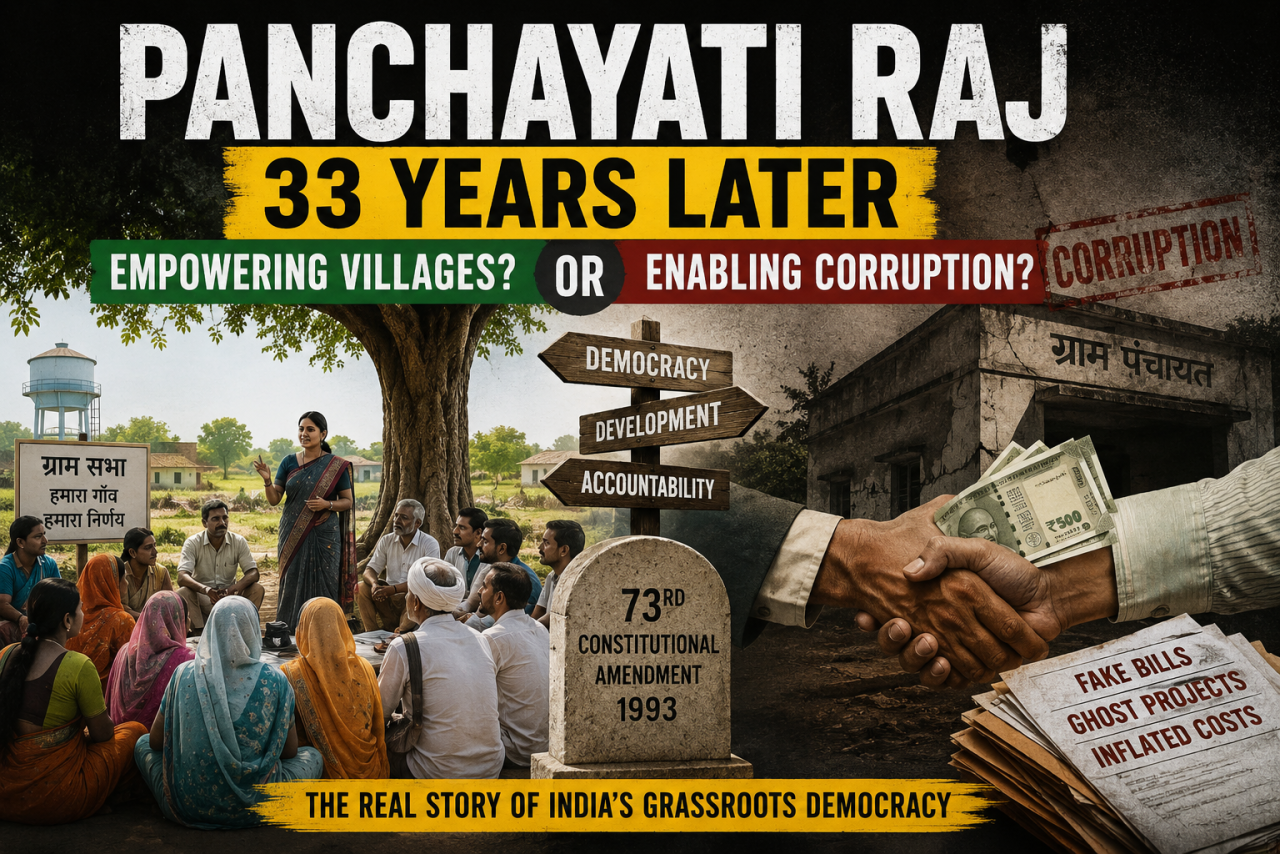
Three decades after empowering India's villages, Panchayati Raj stands at a crossroads. Has it deepened democracy, or simply shifted corruption closer to the people?
Every nation has a place where its democracy is tested. In India, that place is not Parliament. It is the village.
Governments may rise and fall in New Delhi. Chief ministers may promise revolutions from state capitals. Yet the success of the Republic is decided in nearly six lakh villages where a broken hand pump matters more than a televised speech, where a village road carries greater political weight than an expressway hundreds of kilometres away.
India understood this truth long before independence. Mahatma Gandhi imagined the village as the foundation of the Republic. His vision of Gram Swaraj was not merely about local administration. It was about self-rule. Every village, he believed, should govern itself with dignity, responsibility and accountability.
Independent India admired the idea but postponed the action.
For more than four decades, village councils remained weak, irregular and largely dependent on state governments. Elections were often delayed. Funds were scarce. Bureaucrats exercised authority while villagers remained spectators in decisions that affected their daily lives.
Then came the constitutional revolution of 1993.
The 73rd Constitutional Amendment was not greeted with fireworks. There were no victory parades. Yet it quietly altered the architecture of Indian democracy. Panchayati Raj Institutions were given constitutional status. Regular elections became mandatory. Seats were reserved for Scheduled Castes, Scheduled Tribes and women. Powers relating to local development were expected to flow from state capitals to villages.
On paper, it was perhaps the boldest experiment in democratic decentralisation undertaken anywhere in the world.
Three decades later, the verdict remains unfinished.
The numbers are extraordinary.
More than 2.5 lakh Gram Panchayats now govern rural India. Over 30 lakh elected representatives make decisions closer to ordinary citizens than any Member of Parliament or state legislator ever can. Nearly half of these representatives are women, an achievement few democracies can claim.
Political scientists often celebrate Panchayati Raj as India's silent democratic revolution.
They are not entirely wrong.
Millions of women entered public life because constitutional reservations opened doors that social customs had long kept shut. Members of Scheduled Castes and Scheduled Tribes found representation not through charity but through constitutional guarantee. Villages that once waited endlessly for distant officials could now approve local roads, drinking water projects, sanitation works and community infrastructure through elected representatives.
For countless villages, Panchayati Raj changed governance from an occasional visitor into a permanent presence.
But statistics are patient companions of governments. They reveal success while concealing reality.
Travel through rural India and another story begins to emerge.
A village road sanctioned twice but repaired only once.
A pond that exists in government files but has disappeared from the landscape.
Streetlights that glow on expenditure statements but never on village streets.
Community halls that receive maintenance funds without hosting a single community gathering.
These are not isolated scandals. They appear with remarkable familiarity across states, regardless of which political party governs them. Every few months, vigilance departments, auditors or local journalists expose inflated bills, ghost beneficiaries, forged attendance records or development projects that seem more successful on paper than on the ground.
Corruption, it appears, has proved remarkably adaptable.
It survived colonial administration.
It survived economic liberalisation.
It has also survived decentralisation.
Perhaps this should not surprise anyone.
Power alone does not produce honesty. It merely changes the address where dishonesty operates.
The architects of Panchayati Raj believed that bringing government closer to people would naturally improve accountability. In many villages, it certainly did. Citizens could question their elected Sarpanch directly. Gram Sabha meetings gave ordinary residents a voice. Local elections created political competition where none existed before.
Yet democracy demands more than elections.
It demands vigilance.
And vigilance has often been missing.
Gram Sabha meetings are poorly attended in many parts of the country. Financial records remain difficult for ordinary villagers to interpret. Social audits are irregular. Development contracts frequently circulate within small networks of local influence. Transparency portals may publish every expenditure online, but transparency means little when those affected neither possess digital access nor the confidence to challenge authority.
There is another contradiction that rarely finds space in official celebrations.
India proudly points to the remarkable rise of women in Panchayati Raj. The achievement is genuine. Thousands of women Sarpanches have transformed schools, improved sanitation, expanded self-help groups and demonstrated political leadership that challenges generations of social prejudice.
Yet alongside this success survives an uncomfortable reality.
In many villages, elected women continue to govern through their husbands or male relatives. The phrase Sarpanch Pati has entered India's political vocabulary because the practice became too visible to ignore. Reservation created representation, but representation did not always create independence.
Constitutional reform can change institutions.
Changing society requires a longer struggle.
Perhaps the greatest weakness of Panchayati Raj lies elsewhere.
India transferred responsibilities to villages more enthusiastically than it transferred authority.
The Constitution listed subjects ranging from agriculture to education, health and rural development that could be entrusted to Panchayats. But constitutional possibility and political reality are not always companions.
Many state governments continue to retain control over officials, finances and major policy decisions. Panchayats are frequently expected to implement programmes designed elsewhere rather than govern according to local priorities. They distribute schemes but seldom determine them.
The village government often resembles a contractor rather than a government.
This dependence creates another problem.
When money flows primarily from Delhi or state capitals, local accountability weakens. Success becomes measured by grants received rather than revenue generated or institutions strengthened. Panchayats spend money, but they rarely control the system that provides it.
The result is a curious democracy.
Power is decentralised enough to attract blame but not enough to guarantee independence.
And yet, dismissing Panchayati Raj as a failed experiment would be both unfair and historically inaccurate.
No other reform has drawn so many ordinary Indians into public life. No Parliament could have produced millions of first-generation political leaders. No ministry could have engineered such widespread participation of women and historically marginalised communities in governance.
The institution has succeeded where democracy matters most: it has made power visible.
Its failure lies elsewhere.
It has not made power sufficiently answerable.
The real question, therefore, is not whether Panchayati Raj transformed India.
It undoubtedly did.
The better question is whether India transformed Panchayati Raj.
Too often, old habits entered new institutions. Patronage replaced participation. Local elites captured systems meant for local communities. Corruption travelled downward with remarkable efficiency, while accountability struggled to keep pace.
The village republic that Gandhi imagined still exists, but often as an unfinished conversation rather than a completed achievement.
History rarely delivers perfect endings.
Panchayati Raj remains India's greatest democratic gamble because it asks an eternal question: can power belong to ordinary people without eventually being captured by the extraordinary few?
After thirty-three years, the answer remains suspended somewhere between hope and habit. The Constitution opened the village gate. Whether democracy truly entered is a question each village continues to answer for itself.
Every nation has a place where its democracy is tested. In India, that place is not Parliament. It is the village.
Governments may rise and fall in New Delhi. Chief ministers may promise revolutions from state capitals. Yet the success of the Republic is decided in nearly six lakh villages where a broken hand pump matters more than a televised speech, where a village road carries greater political weight than an expressway hundreds of kilometres away.
India understood this truth long before independence. Mahatma Gandhi imagined the village as the foundation of the Republic. His vision of Gram Swaraj was not merely about local administration. It was about self-rule. Every village, he believed, should govern itself with dignity, responsibility and accountability.
Independent India admired the idea but postponed the action.
For more than four decades, village councils remained weak, irregular and largely dependent on state governments. Elections were often delayed. Funds were scarce. Bureaucrats exercised authority while villagers remained spectators in decisions that affected their daily lives.
Then came the constitutional revolution of 1993.
The 73rd Constitutional Amendment was not greeted with fireworks. There were no victory parades. Yet it quietly altered the architecture of Indian democracy. Panchayati Raj Institutions were given constitutional status. Regular elections became mandatory. Seats were reserved for Scheduled Castes, Scheduled Tribes and women. Powers relating to local development were expected to flow from state capitals to villages.
On paper, it was perhaps the boldest experiment in democratic decentralisation undertaken anywhere in the world.
Three decades later, the verdict remains unfinished.
The numbers are extraordinary.
More than 2.5 lakh Gram Panchayats now govern rural India. Over 30 lakh elected representatives make decisions closer to ordinary citizens than any Member of Parliament or state legislator ever can. Nearly half of these representatives are women, an achievement few democracies can claim.
Political scientists often celebrate Panchayati Raj as India's silent democratic revolution.
They are not entirely wrong.
Millions of women entered public life because constitutional reservations opened doors that social customs had long kept shut. Members of Scheduled Castes and Scheduled Tribes found representation not through charity but through constitutional guarantee. Villages that once waited endlessly for distant officials could now approve local roads, drinking water projects, sanitation works and community infrastructure through elected representatives.
For countless villages, Panchayati Raj changed governance from an occasional visitor into a permanent presence.
But statistics are patient companions of governments. They reveal success while concealing reality.
Travel through rural India and another story begins to emerge.
A village road sanctioned twice but repaired only once.
A pond that exists in government files but has disappeared from the landscape.
Streetlights that glow on expenditure statements but never on village streets.
Community halls that receive maintenance funds without hosting a single community gathering.
These are not isolated scandals. They appear with remarkable familiarity across states, regardless of which political party governs them. Every few months, vigilance departments, auditors or local journalists expose inflated bills, ghost beneficiaries, forged attendance records or development projects that seem more successful on paper than on the ground.
Corruption, it appears, has proved remarkably adaptable.
It survived colonial administration.
It survived economic liberalisation.
It has also survived decentralisation.
Perhaps this should not surprise anyone.
Power alone does not produce honesty. It merely changes the address where dishonesty operates.
The architects of Panchayati Raj believed that bringing government closer to people would naturally improve accountability. In many villages, it certainly did. Citizens could question their elected Sarpanch directly. Gram Sabha meetings gave ordinary residents a voice. Local elections created political competition where none existed before.
Yet democracy demands more than elections.
It demands vigilance.
And vigilance has often been missing.
Gram Sabha meetings are poorly attended in many parts of the country. Financial records remain difficult for ordinary villagers to interpret. Social audits are irregular. Development contracts frequently circulate within small networks of local influence. Transparency portals may publish every expenditure online, but transparency means little when those affected neither possess digital access nor the confidence to challenge authority.
There is another contradiction that rarely finds space in official celebrations.
India proudly points to the remarkable rise of women in Panchayati Raj. The achievement is genuine. Thousands of women Sarpanches have transformed schools, improved sanitation, expanded self-help groups and demonstrated political leadership that challenges generations of social prejudice.
Yet alongside this success survives an uncomfortable reality.
In many villages, elected women continue to govern through their husbands or male relatives. The phrase Sarpanch Pati has entered India's political vocabulary because the practice became too visible to ignore. Reservation created representation, but representation did not always create independence.
Constitutional reform can change institutions.
Changing society requires a longer struggle.
Perhaps the greatest weakness of Panchayati Raj lies elsewhere.
India transferred responsibilities to villages more enthusiastically than it transferred authority.
The Constitution listed subjects ranging from agriculture to education, health and rural development that could be entrusted to Panchayats. But constitutional possibility and political reality are not always companions.
Many state governments continue to retain control over officials, finances and major policy decisions. Panchayats are frequently expected to implement programmes designed elsewhere rather than govern according to local priorities. They distribute schemes but seldom determine them.
The village government often resembles a contractor rather than a government.
This dependence creates another problem.
When money flows primarily from Delhi or state capitals, local accountability weakens. Success becomes measured by grants received rather than revenue generated or institutions strengthened. Panchayats spend money, but they rarely control the system that provides it.
The result is a curious democracy.
Power is decentralised enough to attract blame but not enough to guarantee independence.
And yet, dismissing Panchayati Raj as a failed experiment would be both unfair and historically inaccurate.
No other reform has drawn so many ordinary Indians into public life. No Parliament could have produced millions of first-generation political leaders. No ministry could have engineered such widespread participation of women and historically marginalised communities in governance.
The institution has succeeded where democracy matters most: it has made power visible.
Its failure lies elsewhere.
It has not made power sufficiently answerable.
The real question, therefore, is not whether Panchayati Raj transformed India.
It undoubtedly did.
The better question is whether India transformed Panchayati Raj.
Too often, old habits entered new institutions. Patronage replaced participation. Local elites captured systems meant for local communities. Corruption travelled downward with remarkable efficiency, while accountability struggled to keep pace.
The village republic that Gandhi imagined still exists, but often as an unfinished conversation rather than a completed achievement.
History rarely delivers perfect endings.
Panchayati Raj remains India's greatest democratic gamble because it asks an eternal question: can power belong to ordinary people without eventually being captured by the extraordinary few?
After thirty-three years, the answer remains suspended somewhere between hope and habit. The Constitution opened the village gate. Whether democracy truly entered is a question each village continues to answer for itself.


















Leave a Comment