
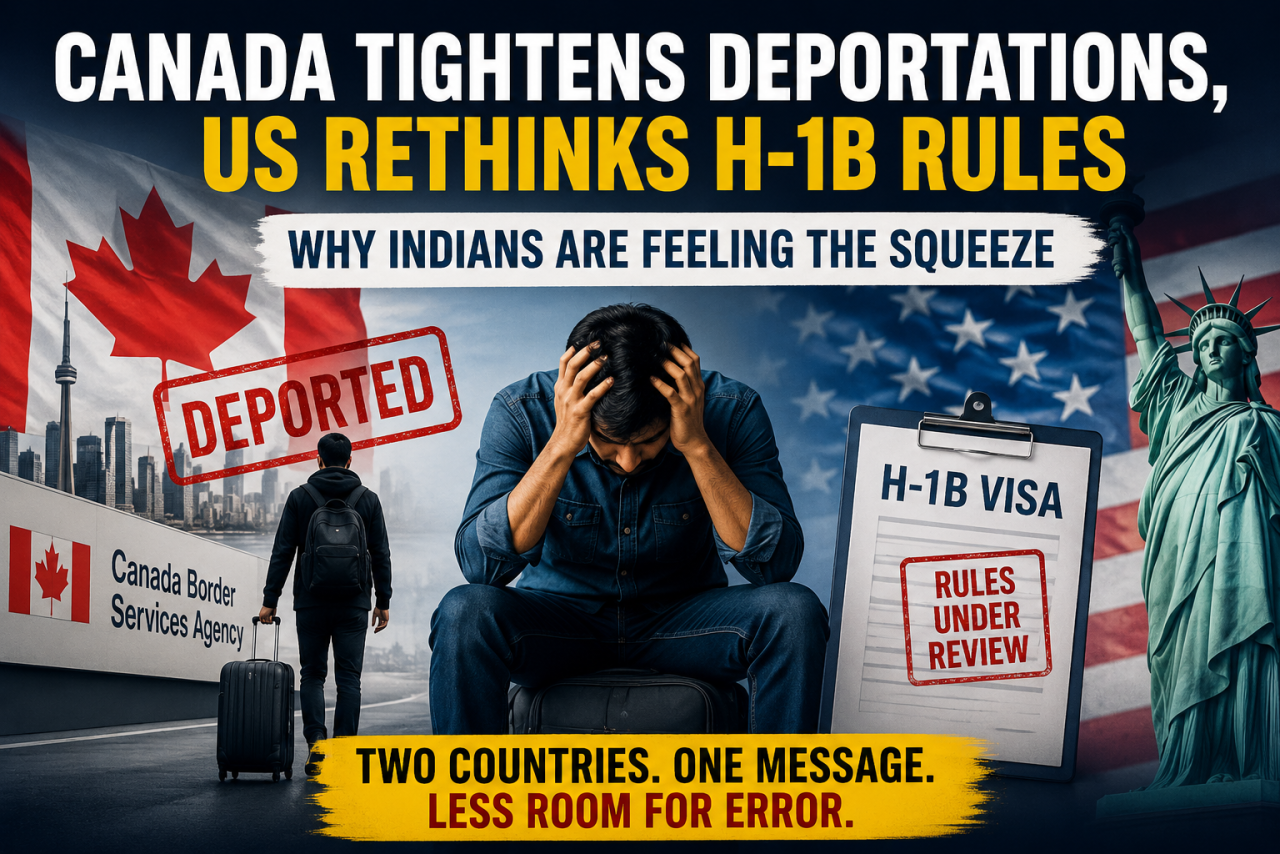
Canada is tightening deportations while the US rethinks H-1B protections. Together, the changes signal a tougher immigration landscape for Indians.
Two immigration stories emerged in the same week, thousands of kilometres apart and seemingly unrelated. But look closer and they reveal a strikingly similar trend.
Canada’s border agency confirmed that the removal of Indian nationals crossed 3,300 in the first half of 2026 alone. The figure has already surpassed the number recorded for the whole of 2020, making Indians the largest nationality among those deported from Canada during the period.
Days later, the US Department of Homeland Security sent a proposal to the White House that could scrap the 60-day grace period currently available to H-1B workers after losing their jobs. The provision, introduced in 2017, has often provided skilled foreign workers with crucial time to find another employer and maintain their legal status.
Viewed separately, both developments could appear to be routine immigration updates. Viewed together, however, they point to a broader shift. Canada and the United States, two of the most important destinations for Indian students, workers and skilled professionals, are becoming less forgiving immigration environments.
Canada’s Deportation Numbers Raise Bigger Questions
The Canadian numbers deserve a closer look before drawing simple conclusions.
Indian nationals removed from Canada during the first six months of 2026 have already overtaken Mexican nationals removed during the same period. The number is also higher than the total number of people the United States deported last year.
That is a significant development for Canada, a country whose international education system has relied heavily on students from India.
The removals cannot, however, be explained simply as a consequence of students overstaying visas or workers losing legal status. Investigations have increasingly highlighted the role of organised networks and intermediaries involved in exploiting Canada's study and work permit pathways.
Some investigations have pointed to foreign nationals linked to Indian criminal networks operating in provinces such as Alberta. Such networks can exploit the immigration system by helping people enter Canada through education or employment routes before leaving them vulnerable when their legal status expires.
That distinction matters.
The problem is not always an individual deliberately breaking immigration rules. In some cases, people may have entered a system marketed to them as a reliable pathway to education, employment and eventually permanent settlement, only to discover that the pathway was far less secure than promised.
It also raises questions about the role of agents, consultants and intermediaries who profit from selling immigration dreams without adequately explaining the risks involved.
America’s H-1B Debate Has a Different Trigger
The US story is different, but the potential consequence is similar.
The 60-day H-1B grace period is more than a bureaucratic provision. For a foreign worker who suddenly loses a job, those two months can mean the difference between finding another employer and having to leave the country.
Indian professionals are particularly exposed because they account for roughly seven in ten successful H-1B applicants in many recent years.
If the grace period is removed, an unexpected layoff could immediately become an immigration crisis. A worker could have little time to secure another sponsor, while the immigration status of accompanying family members could also be affected.
The proposal also comes amid a broader debate in Washington over the future of the H-1B programme.
A federal court has struck down the administration's proposed $100,000 H-1B fee, while legislation has also been introduced in the Senate seeking a three-year pause on new H-1B issuance. Together, these developments reflect a political environment in which skilled-worker immigration is facing greater scrutiny.
For Indian technology professionals, engineers and other highly skilled workers, that uncertainty matters.
The Common Thread Is the Shrinking Safety Net
Canada and the United States are not pursuing identical immigration policies. Their political motivations, legal systems and economic priorities are different.
Yet the two developments expose a common vulnerability.
For years, migrants have often viewed a Canadian study permit, a US work visa or a job offer as the beginning of a relatively secure future. In reality, these pathways have always depended on conditions that can change.
Canada's experience demonstrates what can happen when immigration pathways are exploited by intermediaries and criminal networks. The US debate demonstrates what happens when policymakers reconsider the protections available to people who have entered the country legally but suddenly lose employment.
In both cases, the uncertainty ultimately falls on individuals.
A student who borrowed heavily to study abroad cannot easily reverse that decision. A skilled professional who loses a job cannot always find a new employer within weeks. Families who relocate across continents may find themselves caught between financial commitments at home and changing immigration rules abroad.
The legal cushion may be small, but its value can be enormous.
What This Means for India
For India, the lesson is not simply to criticise Canada or the United States.
It is to reassess how migration opportunities are being sold at home.
Education consultants, coaching centres and recruitment agencies often present overseas study and employment as pathways to better careers and permanent settlement. But families need to understand that these routes carry financial, legal and employment risks.
The Canadian experience should also encourage greater scrutiny of immigration agents and consultants. When intermediaries sell unrealistic promises or facilitate questionable routes, the consequences can ultimately fall on migrants themselves.
For prospective students and professionals, due diligence is becoming more important than ever.
A foreign degree is not automatically a pathway to permanent residency. A work visa is not a guarantee of employment. And a job offer does not necessarily provide long-term immigration security.
Final Take
The Canada and US developments are not the same story. But they are part of the same changing landscape.
The world's two major destinations for Indian students and skilled professionals are signalling that immigration pathways will come with tighter conditions and less room for error.
For Indians planning to study or work abroad, that means the old assumptions need to be reconsidered.
The grace period was never a guarantee.
The visa was never a guarantee.
And increasingly, even the pathway itself may not be a guarantee.
Two immigration stories emerged in the same week, thousands of kilometres apart and seemingly unrelated. But look closer and they reveal a strikingly similar trend.
Canada’s border agency confirmed that the removal of Indian nationals crossed 3,300 in the first half of 2026 alone. The figure has already surpassed the number recorded for the whole of 2020, making Indians the largest nationality among those deported from Canada during the period.
Days later, the US Department of Homeland Security sent a proposal to the White House that could scrap the 60-day grace period currently available to H-1B workers after losing their jobs. The provision, introduced in 2017, has often provided skilled foreign workers with crucial time to find another employer and maintain their legal status.
Viewed separately, both developments could appear to be routine immigration updates. Viewed together, however, they point to a broader shift. Canada and the United States, two of the most important destinations for Indian students, workers and skilled professionals, are becoming less forgiving immigration environments.
Canada’s Deportation Numbers Raise Bigger Questions
The Canadian numbers deserve a closer look before drawing simple conclusions.
Indian nationals removed from Canada during the first six months of 2026 have already overtaken Mexican nationals removed during the same period. The number is also higher than the total number of people the United States deported last year.
That is a significant development for Canada, a country whose international education system has relied heavily on students from India.
The removals cannot, however, be explained simply as a consequence of students overstaying visas or workers losing legal status. Investigations have increasingly highlighted the role of organised networks and intermediaries involved in exploiting Canada's study and work permit pathways.
Some investigations have pointed to foreign nationals linked to Indian criminal networks operating in provinces such as Alberta. Such networks can exploit the immigration system by helping people enter Canada through education or employment routes before leaving them vulnerable when their legal status expires.
That distinction matters.
The problem is not always an individual deliberately breaking immigration rules. In some cases, people may have entered a system marketed to them as a reliable pathway to education, employment and eventually permanent settlement, only to discover that the pathway was far less secure than promised.
It also raises questions about the role of agents, consultants and intermediaries who profit from selling immigration dreams without adequately explaining the risks involved.
America’s H-1B Debate Has a Different Trigger
The US story is different, but the potential consequence is similar.
The 60-day H-1B grace period is more than a bureaucratic provision. For a foreign worker who suddenly loses a job, those two months can mean the difference between finding another employer and having to leave the country.
Indian professionals are particularly exposed because they account for roughly seven in ten successful H-1B applicants in many recent years.
If the grace period is removed, an unexpected layoff could immediately become an immigration crisis. A worker could have little time to secure another sponsor, while the immigration status of accompanying family members could also be affected.
The proposal also comes amid a broader debate in Washington over the future of the H-1B programme.
A federal court has struck down the administration's proposed $100,000 H-1B fee, while legislation has also been introduced in the Senate seeking a three-year pause on new H-1B issuance. Together, these developments reflect a political environment in which skilled-worker immigration is facing greater scrutiny.
For Indian technology professionals, engineers and other highly skilled workers, that uncertainty matters.
The Common Thread Is the Shrinking Safety Net
Canada and the United States are not pursuing identical immigration policies. Their political motivations, legal systems and economic priorities are different.
Yet the two developments expose a common vulnerability.
For years, migrants have often viewed a Canadian study permit, a US work visa or a job offer as the beginning of a relatively secure future. In reality, these pathways have always depended on conditions that can change.
Canada's experience demonstrates what can happen when immigration pathways are exploited by intermediaries and criminal networks. The US debate demonstrates what happens when policymakers reconsider the protections available to people who have entered the country legally but suddenly lose employment.
In both cases, the uncertainty ultimately falls on individuals.
A student who borrowed heavily to study abroad cannot easily reverse that decision. A skilled professional who loses a job cannot always find a new employer within weeks. Families who relocate across continents may find themselves caught between financial commitments at home and changing immigration rules abroad.
The legal cushion may be small, but its value can be enormous.
What This Means for India
For India, the lesson is not simply to criticise Canada or the United States.
It is to reassess how migration opportunities are being sold at home.
Education consultants, coaching centres and recruitment agencies often present overseas study and employment as pathways to better careers and permanent settlement. But families need to understand that these routes carry financial, legal and employment risks.
The Canadian experience should also encourage greater scrutiny of immigration agents and consultants. When intermediaries sell unrealistic promises or facilitate questionable routes, the consequences can ultimately fall on migrants themselves.
For prospective students and professionals, due diligence is becoming more important than ever.
A foreign degree is not automatically a pathway to permanent residency. A work visa is not a guarantee of employment. And a job offer does not necessarily provide long-term immigration security.
Final Take
The Canada and US developments are not the same story. But they are part of the same changing landscape.
The world's two major destinations for Indian students and skilled professionals are signalling that immigration pathways will come with tighter conditions and less room for error.
For Indians planning to study or work abroad, that means the old assumptions need to be reconsidered.
The grace period was never a guarantee.
The visa was never a guarantee.
And increasingly, even the pathway itself may not be a guarantee.

























Leave a Comment