
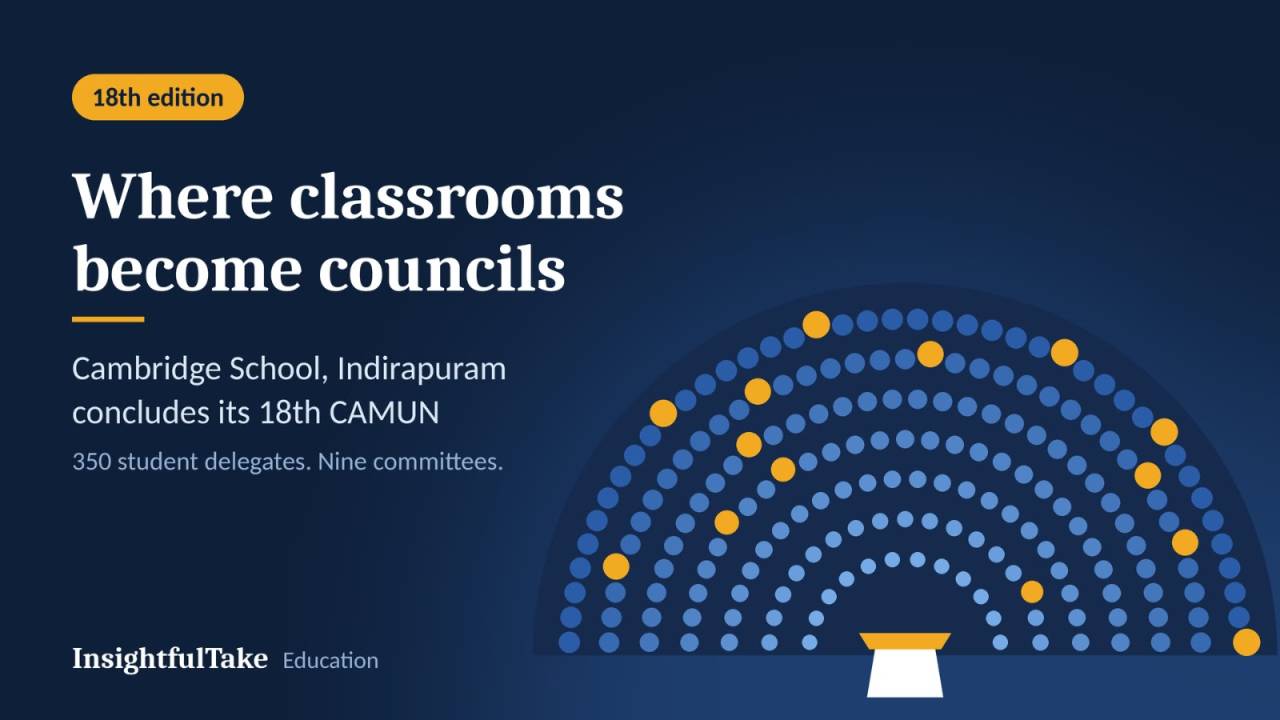
Nearly 350 students stepped into the world of diplomacy, politics and public affairs as Cambridge School Indirapuram hosted the 18th CAMUN.
For two days, nearly 350 students from schools across Delhi-NCR stepped into the roles of diplomats, lawmakers, journalists and policymakers as Cambridge School, Indirapuram hosted the 18th edition of its Cambridge School Model United Nations Conference, or CAMUN.
The conference brought students together to debate issues that extend well beyond the classroom, including global security, artificial intelligence, human rights, healthcare, migration, gender justice and education reforms.
With 18 editions behind it, CAMUN has become a continuing academic activity at the school rather than a one-time event. Each edition gives students an opportunity to engage with international and domestic issues through research, debate and negotiation.
A Serious Agenda, Taken Seriously
This year's conference featured nine committees, each designed around a different area of public affairs and decision-making.
Students represented the UN General Assembly, Security Council, Economic and Social Council, Human Rights Council, World Health Organization and the UN Commission on the Status of Women.
The conference also moved beyond conventional Model UN formats. The All India Political Parties Meet and Joint Parliamentary Committee brought India's political and legislative processes into the discussions, while the International Press committee gave students an opportunity to approach the proceedings from a journalistic perspective.
The subjects under discussion reflected issues that governments and institutions are dealing with today. Delegates examined questions around international security, emerging technologies, healthcare systems, human rights, migration and gender equality.
For the students, this meant more than preparing speeches. They had to understand a position, support it with research and respond to arguments presented by others.
Voices That Set the Tone
The inaugural ceremony featured Dr Yogita Shukla, a multidisciplinary scientist, practitioner and environmental leader with more than 28 years of experience in environment, climate, geospatial sciences and natural resource management.
Her participation added an environmental perspective to a conference largely focused on diplomacy, governance and public policy. Climate and natural resource management remain closely connected with many of the issues being debated internationally, including development, migration, health and security.
The conference concluded with an address by Major General Ashok Kumar, AVSM (Retd.). His career in the Indian Armed Forces has included combat service, operational leadership, infrastructure execution and organisational governance.
He congratulated the young delegates for their performances and encouraged them to contribute to positive change in society.
Students Take Away
The awards at a Model UN may be the most visible outcome, but much of the learning happens during the committee sessions.
Students have to research unfamiliar subjects, understand viewpoints that may differ from their own and present arguments within a limited time. They also learn that debate is not only about speaking. Listening, negotiation and compromise are equally important.
Representing another country, political party or institution can also require students to examine an issue from a perspective they may not personally share. That exercise can help them understand how different interests shape public decisions.
These skills do not always appear in examination results, but they are useful in higher education, professional life and public discussion.
CAMUN also brings together students from different schools and creates an environment where they interact through a common interest in current affairs, diplomacy and debate.
A Tradition That Continues
As schools increasingly look for ways to connect classroom learning with the world outside, Model UN conferences offer one such platform. CAMUN has continued this approach for 18 editions by combining committee-based debates, research and interaction with experienced professionals.
For the students who spent two days discussing international affairs, domestic politics, technology, healthcare and social justice, the conference offered a practical exercise in how public issues are debated and negotiated.
For Cambridge School, Indirapuram, the 18th edition marks another year of a programme that has made discussion, research and public affairs part of its student experience.
For two days, nearly 350 students from schools across Delhi-NCR stepped into the roles of diplomats, lawmakers, journalists and policymakers as Cambridge School, Indirapuram hosted the 18th edition of its Cambridge School Model United Nations Conference, or CAMUN.
The conference brought students together to debate issues that extend well beyond the classroom, including global security, artificial intelligence, human rights, healthcare, migration, gender justice and education reforms.
With 18 editions behind it, CAMUN has become a continuing academic activity at the school rather than a one-time event. Each edition gives students an opportunity to engage with international and domestic issues through research, debate and negotiation.
A Serious Agenda, Taken Seriously
This year's conference featured nine committees, each designed around a different area of public affairs and decision-making.
Students represented the UN General Assembly, Security Council, Economic and Social Council, Human Rights Council, World Health Organization and the UN Commission on the Status of Women.
The conference also moved beyond conventional Model UN formats. The All India Political Parties Meet and Joint Parliamentary Committee brought India's political and legislative processes into the discussions, while the International Press committee gave students an opportunity to approach the proceedings from a journalistic perspective.
The subjects under discussion reflected issues that governments and institutions are dealing with today. Delegates examined questions around international security, emerging technologies, healthcare systems, human rights, migration and gender equality.
For the students, this meant more than preparing speeches. They had to understand a position, support it with research and respond to arguments presented by others.
Voices That Set the Tone
The inaugural ceremony featured Dr Yogita Shukla, a multidisciplinary scientist, practitioner and environmental leader with more than 28 years of experience in environment, climate, geospatial sciences and natural resource management.
Her participation added an environmental perspective to a conference largely focused on diplomacy, governance and public policy. Climate and natural resource management remain closely connected with many of the issues being debated internationally, including development, migration, health and security.
The conference concluded with an address by Major General Ashok Kumar, AVSM (Retd.). His career in the Indian Armed Forces has included combat service, operational leadership, infrastructure execution and organisational governance.
He congratulated the young delegates for their performances and encouraged them to contribute to positive change in society.
Students Take Away
The awards at a Model UN may be the most visible outcome, but much of the learning happens during the committee sessions.
Students have to research unfamiliar subjects, understand viewpoints that may differ from their own and present arguments within a limited time. They also learn that debate is not only about speaking. Listening, negotiation and compromise are equally important.
Representing another country, political party or institution can also require students to examine an issue from a perspective they may not personally share. That exercise can help them understand how different interests shape public decisions.
These skills do not always appear in examination results, but they are useful in higher education, professional life and public discussion.
CAMUN also brings together students from different schools and creates an environment where they interact through a common interest in current affairs, diplomacy and debate.
A Tradition That Continues
As schools increasingly look for ways to connect classroom learning with the world outside, Model UN conferences offer one such platform. CAMUN has continued this approach for 18 editions by combining committee-based debates, research and interaction with experienced professionals.
For the students who spent two days discussing international affairs, domestic politics, technology, healthcare and social justice, the conference offered a practical exercise in how public issues are debated and negotiated.
For Cambridge School, Indirapuram, the 18th edition marks another year of a programme that has made discussion, research and public affairs part of its student experience.













Leave a Comment