
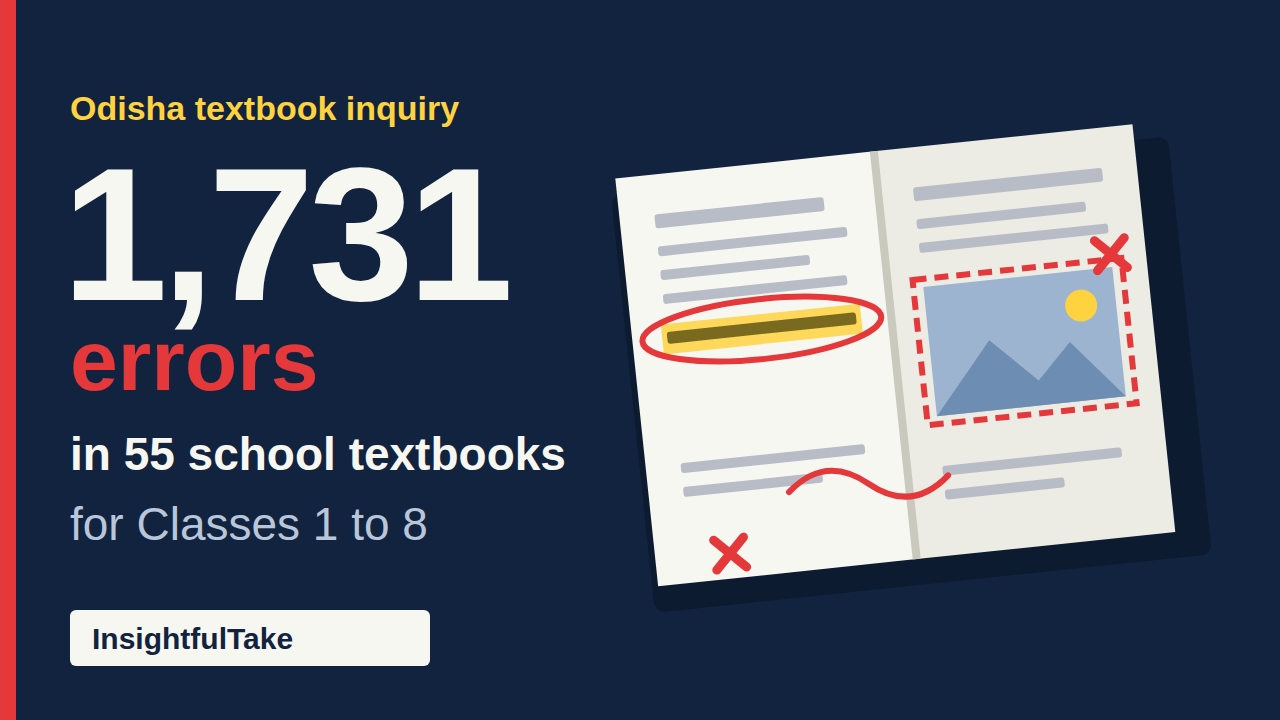
A government inquiry says a rushed four-month timeline and overlapping roles allowed mistakes to slip into books for Classes 1 to 8.
Textbooks are supposed to be the one learning resource a child can trust without question. In Odisha, that trust has been shaken.
A state government inquiry committee has found 1,731 errors in 55 newly developed textbooks for Classes 1 to 8. More troubling than the number of mistakes is what the inquiry says about how they happened.
The report points to a rushed production schedule, inadequate review time and overlapping responsibilities among those involved in writing, reviewing and approving the books.
A Rushed Job
According to the committee's report, the exercise to develop 55 textbooks was completed in roughly four months.
It was a sharp reduction from an earlier textbook development exercise, which had been spread across three academic sessions.
The compressed timeline left subject experts with limited time for the final review process. It is supposed to identify factual, linguistic and other errors before books reach classrooms.
When that final layer of scrutiny is squeezed by deadlines, mistakes can move from a draft document to a printed textbook.
One Person, Many Hats
The report's most concerning finding relates to the way responsibilities were assigned.
The committee found that some individuals served as writers, reviewers, proofreaders and final subject experts. In some instances, the person who prepared the material was also involved in reviewing or approving it.
That weakens the purpose of having separate stages of checking.
A writer reviewing their own work may naturally focus on what they intended to write rather than what actually appears on the page. The committee noted that such overlapping roles increased the possibility of errors going undetected.
Errors That Were Hard to Miss
Some of the reported mistakes were particularly striking.
A Class VII social science textbook reportedly placed Kalahandi, an Odisha district, in Jharkhand.
A Class VIII social science textbook reportedly used a photograph of Karnataka's Vidhana Soudha to represent the Odisha Legislative Assembly.
For students learning about the geography, history and institutions of their own state, such errors are more than minor editorial slips. They can create incorrect information at the very stage when children are building foundational knowledge.
Political Storm and a Criminal Probe
The findings emerged amid political turmoil in the Odisha Assembly.
Proceedings were repeatedly disrupted after the opposition Biju Janata Dal demanded the resignation of School and Mass Education Minister Nityananda Gond over the textbook errors.
Officials of the State Council of Educational Research and Training (SCERT), the agency involved in preparing the textbooks, were suspended earlier this year.
The state's Crime Investigation Department is also investigating the matter. An official said the probe would establish whether any criminal negligence was involved.
The report itself came into the public domain following a Right to Information application filed by activist Pradip Pradhan.
That detail matters. Public scrutiny in this case did not come only from the institutions responsible for education. It also came through a citizen seeking access to information.
The Fix on Paper
The inquiry committee has recommended a four-stage proofing system covering four areas: academic content, facts and images, language, and the printer's final proof.
Each stage would require signed clearance from a designated person.
The committee also identified weaknesses in the final approval process. It noted that a digitally approved PDF is treated as the locked master copy, making the accuracy of that final version especially important.
The proposed system could create clearer accountability, but its effectiveness will ultimately depend on how independently and carefully each stage is carried out.
Why It Matters Beyond Odisha
The Odisha episode raises a larger question about the quality-control systems behind government-prescribed textbooks across India.
For millions of children, particularly those in rural and low-income households, school textbooks remain the primary or even only structured learning resource available to them.
Parents cannot reasonably be expected to fact-check a Class VII geography textbook. Teachers, meanwhile, often work under considerable time and resource constraints.
When incorrect information appears in an officially prescribed textbook, students may learn it, reproduce it in examinations and carry the misconception beyond the classroom.
The Odisha case also exposes a basic weakness in institutional quality control. A checking system is only as strong as its independence, time and accountability.
Having multiple stages of review on paper does little if the same individuals are involved at several stages or if deadlines leave reviewers too little time to examine the material properly.
What to Watch
Several questions now remain.
Will the proposed four-stage proofing system be implemented and enforced? Will the CID investigation establish whether anyone bears individual responsibility for negligence? And will corrected textbooks reach students quickly, accompanied by a transparent record of the errors and corrections?
Parents and teachers can also play a role by reporting mistakes they encounter and asking schools how corrections will be communicated.
A textbook error may be embarrassing for an institution, but for a child it can become a piece of misinformation learned as fact.
When the state puts a textbook in a child's hands, accuracy is not an editorial luxury. It is a responsibility.
Textbooks are supposed to be the one learning resource a child can trust without question. In Odisha, that trust has been shaken.
A state government inquiry committee has found 1,731 errors in 55 newly developed textbooks for Classes 1 to 8. More troubling than the number of mistakes is what the inquiry says about how they happened.
The report points to a rushed production schedule, inadequate review time and overlapping responsibilities among those involved in writing, reviewing and approving the books.
A Rushed Job
According to the committee's report, the exercise to develop 55 textbooks was completed in roughly four months.
It was a sharp reduction from an earlier textbook development exercise, which had been spread across three academic sessions.
The compressed timeline left subject experts with limited time for the final review process. It is supposed to identify factual, linguistic and other errors before books reach classrooms.
When that final layer of scrutiny is squeezed by deadlines, mistakes can move from a draft document to a printed textbook.
One Person, Many Hats
The report's most concerning finding relates to the way responsibilities were assigned.
The committee found that some individuals served as writers, reviewers, proofreaders and final subject experts. In some instances, the person who prepared the material was also involved in reviewing or approving it.
That weakens the purpose of having separate stages of checking.
A writer reviewing their own work may naturally focus on what they intended to write rather than what actually appears on the page. The committee noted that such overlapping roles increased the possibility of errors going undetected.
Errors That Were Hard to Miss
Some of the reported mistakes were particularly striking.
A Class VII social science textbook reportedly placed Kalahandi, an Odisha district, in Jharkhand.
A Class VIII social science textbook reportedly used a photograph of Karnataka's Vidhana Soudha to represent the Odisha Legislative Assembly.
For students learning about the geography, history and institutions of their own state, such errors are more than minor editorial slips. They can create incorrect information at the very stage when children are building foundational knowledge.
Political Storm and a Criminal Probe
The findings emerged amid political turmoil in the Odisha Assembly.
Proceedings were repeatedly disrupted after the opposition Biju Janata Dal demanded the resignation of School and Mass Education Minister Nityananda Gond over the textbook errors.
Officials of the State Council of Educational Research and Training (SCERT), the agency involved in preparing the textbooks, were suspended earlier this year.
The state's Crime Investigation Department is also investigating the matter. An official said the probe would establish whether any criminal negligence was involved.
The report itself came into the public domain following a Right to Information application filed by activist Pradip Pradhan.
That detail matters. Public scrutiny in this case did not come only from the institutions responsible for education. It also came through a citizen seeking access to information.
The Fix on Paper
The inquiry committee has recommended a four-stage proofing system covering four areas: academic content, facts and images, language, and the printer's final proof.
Each stage would require signed clearance from a designated person.
The committee also identified weaknesses in the final approval process. It noted that a digitally approved PDF is treated as the locked master copy, making the accuracy of that final version especially important.
The proposed system could create clearer accountability, but its effectiveness will ultimately depend on how independently and carefully each stage is carried out.
Why It Matters Beyond Odisha
The Odisha episode raises a larger question about the quality-control systems behind government-prescribed textbooks across India.
For millions of children, particularly those in rural and low-income households, school textbooks remain the primary or even only structured learning resource available to them.
Parents cannot reasonably be expected to fact-check a Class VII geography textbook. Teachers, meanwhile, often work under considerable time and resource constraints.
When incorrect information appears in an officially prescribed textbook, students may learn it, reproduce it in examinations and carry the misconception beyond the classroom.
The Odisha case also exposes a basic weakness in institutional quality control. A checking system is only as strong as its independence, time and accountability.
Having multiple stages of review on paper does little if the same individuals are involved at several stages or if deadlines leave reviewers too little time to examine the material properly.
What to Watch
Several questions now remain.
Will the proposed four-stage proofing system be implemented and enforced? Will the CID investigation establish whether anyone bears individual responsibility for negligence? And will corrected textbooks reach students quickly, accompanied by a transparent record of the errors and corrections?
Parents and teachers can also play a role by reporting mistakes they encounter and asking schools how corrections will be communicated.
A textbook error may be embarrassing for an institution, but for a child it can become a piece of misinformation learned as fact.
When the state puts a textbook in a child's hands, accuracy is not an editorial luxury. It is a responsibility.












Leave a Comment