
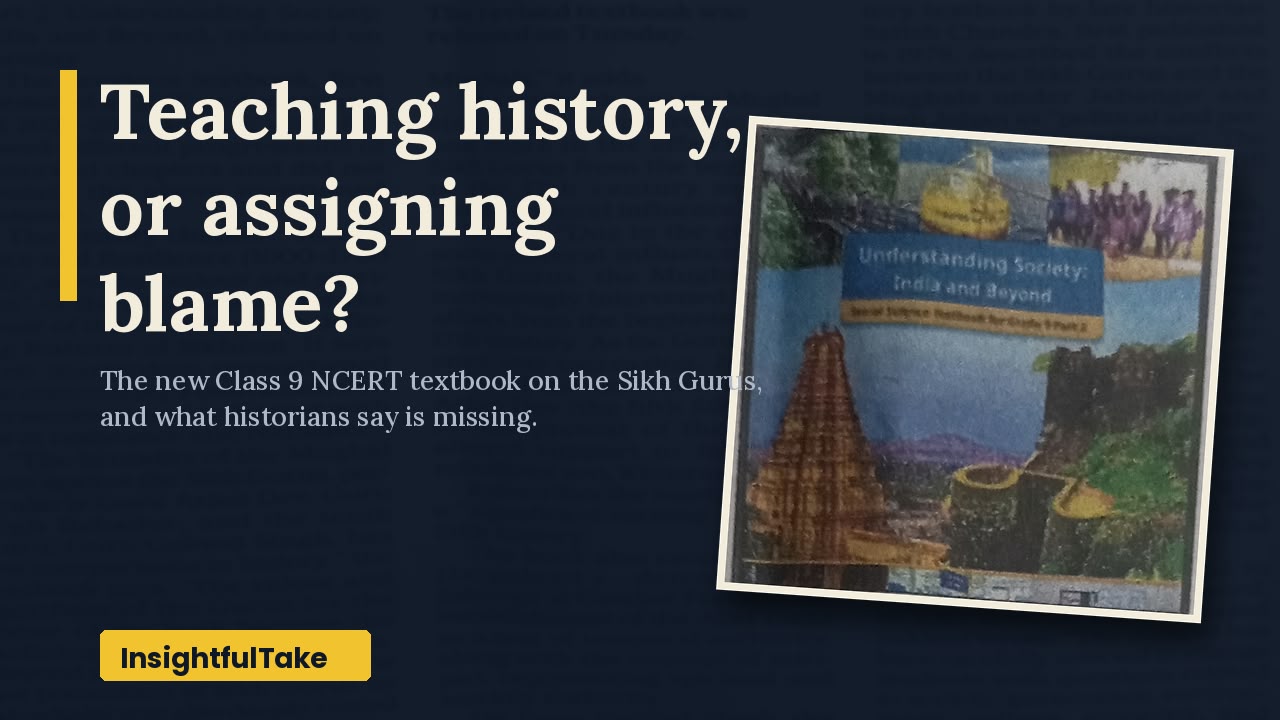
A revised NCERT textbook changes how Class 9 students encounter the Mughal-Sikh conflict, raising a larger question: should contested history be taught as fact or explored through evidence?
The release of NCERT’s revised Class 9 Social Science textbook, Understanding Society: India and Beyond, Part 2, has reopened a difficult question about how medieval history should be taught to school students and where does historical explanation end and present-day political interpretation begin?
What Has Changed
The revised textbook, released on September 29, 2026, includes a chapter titled “Resistance and Resilience (1000–1700 CE)”. Its treatment of the Mughal state’s relationship with the Sikh Gurus uses stronger language than the earlier textbook.
The chapter describes the Mughal state’s conduct towards the Sikh Gurus as brutality with “few comparisons in history.” It says the executions of Guru Arjan Dev and Guru Tegh Bahadur, along with the persecution of Guru Gobind Singh, were deeply rooted in what it calls the “rigid religious and discriminatory practices” of the Mughal state, rather than being explained only through political motivations.
According to media reports, the textbook says Mughal intervention in the affairs of the Gurus increased from the early seventeenth century as their socio-cultural influence expanded. It records that Jahangir ordered Guru Arjan Dev’s execution after accusing him of supporting his rebellious son Khusrau, and describes the martyrdom as a major turning point in Sikh history.
The chapter also discusses Guru Hargobind’s detention at Gwalior Fort, the establishment of the Akal Takht and the concept of miri-piri. It explains the emergence of the Khalsa and the growing connection between spiritual and political identity within the Sikh tradition.
The previous Class 9 textbook, used from 2007 until 2025–26, did not use this framing. The media report also notes that Satish Chandra’s older Class 11 history textbook, first published in 1978, treated Sikh-Mughal conflicts under Jahangir and Shah Jahan primarily through political and personal factors.
NCERT did not respond to the media questions, according to the report. The director’s foreword to the new textbook says its content has been selected to encourage students to engage with questions of society, governance, culture and human relationships.
The Problem With the Framing
There is no dispute that the Sikh Gurus suffered persecution and that their sacrifices are an important part of Indian history. The more difficult question is how a school textbook explains the reasons behind those events.
Historian Ruchika Sharma disputes the religious interpretation and describes the conflict as primarily political. She points to the initially cordial relationship between Jahangir and Guru Arjan Dev and argues that the relationship deteriorated after the Guru’s alleged support for Prince Khusrau, including the reported application of a tilak.
This is fundamentally a question of historical causation. Different historians can examine the same evidence and reach different conclusions about the relative importance of political, personal, religious and social factors.
That is precisely why a school textbook needs to handle such questions carefully.
If one interpretation is presented as settled fact while competing historical interpretations disappear from the discussion, students are not being encouraged to examine evidence. They are being given a conclusion.
For Class 9 students, that distinction matters. At around fourteen years of age, many students are only beginning to learn how historians assess sources, separate evidence from interpretation and understand the motives of rulers within the political conditions of their time.
Medieval states often acted against political rivals, dissenters and competing centres of authority. Religion could be an important factor, but so could succession struggles, territorial control, political loyalty and the consolidation of power.
A textbook should help students examine how these factors interacted rather than encouraging them to reduce a complex historical period to a conflict between religious communities.
History Should Not Become a Grievance Ledger
The larger concern is not whether painful episodes from India's past should be taught. They should.
The concern is what happens when historical suffering is presented primarily through the lens of present-day communal identities.
India's history contains centuries of conflict, persecution and political violence involving rulers and communities of many kinds. There are episodes that remain central to the memory of different religious and social groups. Teaching them honestly is necessary. Turning them into evidence for assigning inherited blame is something else.
A classroom should not ask today's children to carry responsibility for the actions of rulers who lived centuries ago.
India's constitutional framework rests on the principle that citizens are equal before the law regardless of their religious identity. That principle does not require India to forget historical violence. It requires the opposite: that history be studied with enough care to understand the past without turning historical communities into permanent political categories.
The Sikh community's memory of the Gurus and their sacrifices deserves to be taught with seriousness and respect. The question is whether a state textbook should present a single explanation of that history in a way that can be read as assigning collective blame.
What a Better Textbook Would Do
A stronger approach would give students the evidence and explain the areas of historical disagreement.
It could describe the martyrdom of Guru Arjan Dev and Guru Tegh Bahadur in full. It could explain the political circumstances surrounding Jahangir and Shah Jahan. It could examine the evolution of Sikh political and spiritual institutions, including the Akal Takht, miri-piri and the Khalsa.
But it should also distinguish between what historical sources establish and what historians infer from them.
Where historians disagree over motive, students should be told that they disagree.
Where the evidence is strong, the textbook should explain the evidence.
Where interpretations have changed over time, the textbook should explain why.
That would turn the revision itself into a lesson in historical thinking.
It would also allow students to understand why earlier textbooks interpreted the Sikh-Mughal conflicts differently, rather than making the new account appear to have simply replaced an old version with a new one.
The Other Side
Supporters of the revision can make a legitimate argument that earlier textbooks did not give sufficient space to Sikh history and that the persecution and martyrdom of the Gurus should be presented more directly.
They can also argue that historical scholarship evolves and that textbook revisions are a normal part of education. Acknowledging religious persecution in the past does not automatically mean assigning responsibility to people living today.
The Sikh understanding of the Gurus' martyrdom is itself an important part of the historical record and cannot be separated from any serious account of Sikh history.
The real issue, therefore, is not whether these events belong in a Class 9 textbook. They do.
The question is how they are explained.
A history textbook should teach students to ask what happened, what evidence tells us, why historians disagree and how political and religious factors interacted.
It is also the lesson that can help students understand history without turning it into a ledger of inherited grievances.
The release of NCERT’s revised Class 9 Social Science textbook, Understanding Society: India and Beyond, Part 2, has reopened a difficult question about how medieval history should be taught to school students and where does historical explanation end and present-day political interpretation begin?
What Has Changed
The revised textbook, released on September 29, 2026, includes a chapter titled “Resistance and Resilience (1000–1700 CE)”. Its treatment of the Mughal state’s relationship with the Sikh Gurus uses stronger language than the earlier textbook.
The chapter describes the Mughal state’s conduct towards the Sikh Gurus as brutality with “few comparisons in history.” It says the executions of Guru Arjan Dev and Guru Tegh Bahadur, along with the persecution of Guru Gobind Singh, were deeply rooted in what it calls the “rigid religious and discriminatory practices” of the Mughal state, rather than being explained only through political motivations.
According to media reports, the textbook says Mughal intervention in the affairs of the Gurus increased from the early seventeenth century as their socio-cultural influence expanded. It records that Jahangir ordered Guru Arjan Dev’s execution after accusing him of supporting his rebellious son Khusrau, and describes the martyrdom as a major turning point in Sikh history.
The chapter also discusses Guru Hargobind’s detention at Gwalior Fort, the establishment of the Akal Takht and the concept of miri-piri. It explains the emergence of the Khalsa and the growing connection between spiritual and political identity within the Sikh tradition.
The previous Class 9 textbook, used from 2007 until 2025–26, did not use this framing. The media report also notes that Satish Chandra’s older Class 11 history textbook, first published in 1978, treated Sikh-Mughal conflicts under Jahangir and Shah Jahan primarily through political and personal factors.
NCERT did not respond to the media questions, according to the report. The director’s foreword to the new textbook says its content has been selected to encourage students to engage with questions of society, governance, culture and human relationships.
The Problem With the Framing
There is no dispute that the Sikh Gurus suffered persecution and that their sacrifices are an important part of Indian history. The more difficult question is how a school textbook explains the reasons behind those events.
Historian Ruchika Sharma disputes the religious interpretation and describes the conflict as primarily political. She points to the initially cordial relationship between Jahangir and Guru Arjan Dev and argues that the relationship deteriorated after the Guru’s alleged support for Prince Khusrau, including the reported application of a tilak.
This is fundamentally a question of historical causation. Different historians can examine the same evidence and reach different conclusions about the relative importance of political, personal, religious and social factors.
That is precisely why a school textbook needs to handle such questions carefully.
If one interpretation is presented as settled fact while competing historical interpretations disappear from the discussion, students are not being encouraged to examine evidence. They are being given a conclusion.
For Class 9 students, that distinction matters. At around fourteen years of age, many students are only beginning to learn how historians assess sources, separate evidence from interpretation and understand the motives of rulers within the political conditions of their time.
Medieval states often acted against political rivals, dissenters and competing centres of authority. Religion could be an important factor, but so could succession struggles, territorial control, political loyalty and the consolidation of power.
A textbook should help students examine how these factors interacted rather than encouraging them to reduce a complex historical period to a conflict between religious communities.
History Should Not Become a Grievance Ledger
The larger concern is not whether painful episodes from India's past should be taught. They should.
The concern is what happens when historical suffering is presented primarily through the lens of present-day communal identities.
India's history contains centuries of conflict, persecution and political violence involving rulers and communities of many kinds. There are episodes that remain central to the memory of different religious and social groups. Teaching them honestly is necessary. Turning them into evidence for assigning inherited blame is something else.
A classroom should not ask today's children to carry responsibility for the actions of rulers who lived centuries ago.
India's constitutional framework rests on the principle that citizens are equal before the law regardless of their religious identity. That principle does not require India to forget historical violence. It requires the opposite: that history be studied with enough care to understand the past without turning historical communities into permanent political categories.
The Sikh community's memory of the Gurus and their sacrifices deserves to be taught with seriousness and respect. The question is whether a state textbook should present a single explanation of that history in a way that can be read as assigning collective blame.
What a Better Textbook Would Do
A stronger approach would give students the evidence and explain the areas of historical disagreement.
It could describe the martyrdom of Guru Arjan Dev and Guru Tegh Bahadur in full. It could explain the political circumstances surrounding Jahangir and Shah Jahan. It could examine the evolution of Sikh political and spiritual institutions, including the Akal Takht, miri-piri and the Khalsa.
But it should also distinguish between what historical sources establish and what historians infer from them.
Where historians disagree over motive, students should be told that they disagree.
Where the evidence is strong, the textbook should explain the evidence.
Where interpretations have changed over time, the textbook should explain why.
That would turn the revision itself into a lesson in historical thinking.
It would also allow students to understand why earlier textbooks interpreted the Sikh-Mughal conflicts differently, rather than making the new account appear to have simply replaced an old version with a new one.
The Other Side
Supporters of the revision can make a legitimate argument that earlier textbooks did not give sufficient space to Sikh history and that the persecution and martyrdom of the Gurus should be presented more directly.
They can also argue that historical scholarship evolves and that textbook revisions are a normal part of education. Acknowledging religious persecution in the past does not automatically mean assigning responsibility to people living today.
The Sikh understanding of the Gurus' martyrdom is itself an important part of the historical record and cannot be separated from any serious account of Sikh history.
The real issue, therefore, is not whether these events belong in a Class 9 textbook. They do.
The question is how they are explained.
A history textbook should teach students to ask what happened, what evidence tells us, why historians disagree and how political and religious factors interacted.
It is also the lesson that can help students understand history without turning it into a ledger of inherited grievances.























Leave a Comment