
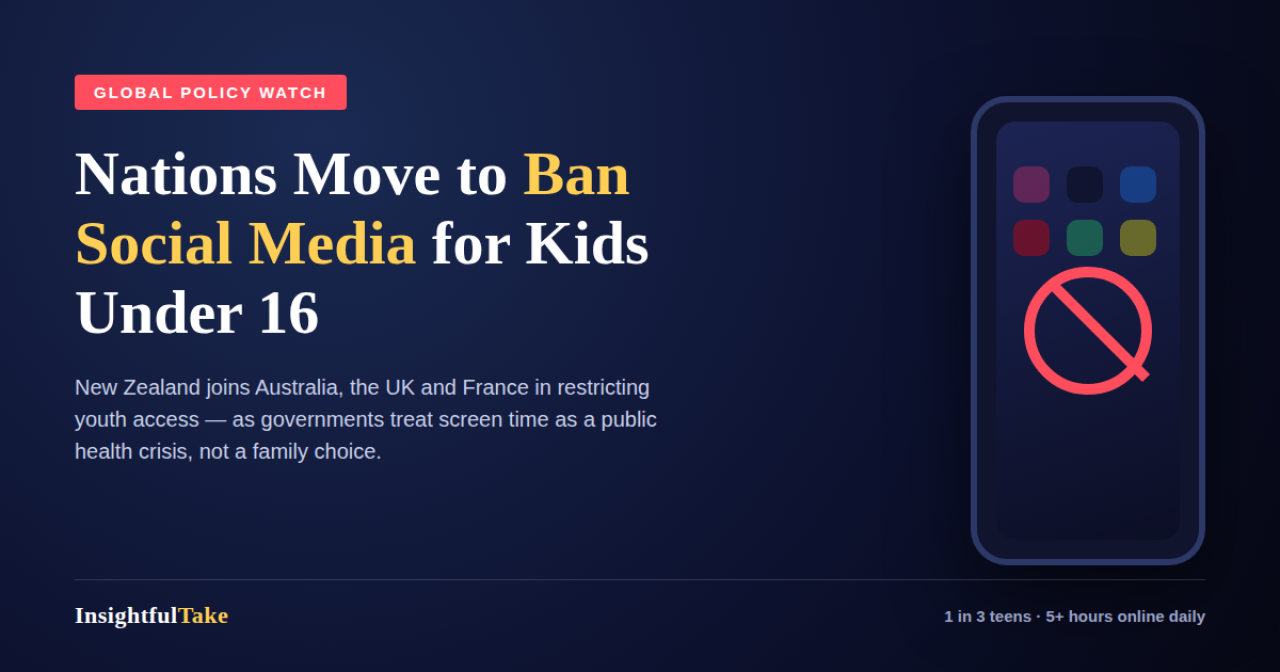
The world is beginning to ask a difficult question: should children be growing up on platforms designed to keep them scrolling?
New Zealand’s proposed under-16 social media ban reflects a growing global shift. Governments are beginning to treat children’s exposure to addictive digital platforms as a public policy and safety issue, not merely a matter for parents.
New Zealand has taken another step towards restricting children’s access to social media. On August 24, the government introduced legislation that would prevent children under 16 from holding accounts on platforms such as Instagram, TikTok, Snapchat and Facebook.
Prime Minister Christopher Luxon has framed the move as a response to the damage social media can cause to an entire generation. Government data shows that one in three children between 13 and 17 now spends at least five hours a day on social media.
That figure captures the scale of the problem. Around the world, governments are no longer debating only whether children should be protected from excessive social media use. The debate is increasingly about how far governments should go to make platforms responsible for protecting young users.
Australia Started the Shift
New Zealand is not acting alone.
Australia passed the first national law of its kind in December 2024, requiring major platforms to prevent under-16s from maintaining accounts or face significant penalties. The United Kingdom, France and several other countries have also indicated that tighter restrictions could follow.
New Zealand’s proposed Online Safety Bill would require platforms to take stronger steps to establish a user’s age. These could include facial age estimation, digital identity checks and analysis of account activity.
Simply asking users to enter their date of birth would no longer be considered sufficient.
That matters because age-gating based on self-declaration has been easy for children to bypass. The new approach attempts to shift the responsibility from children and parents towards the technology companies themselves.
The proposed penalties are equally significant. Companies that fail to comply could face fines of up to 10 percent of their global revenue. For the largest technology companies, that is large enough to turn child safety from a voluntary commitment into a serious financial obligation.
The AI Companion Problem
Perhaps the most interesting part of the proposal is that it goes beyond conventional social media.
The legislation would also extend protections to AI companion applications, including chatbots designed to simulate friendship, emotional support or romantic relationships.
This reflects a broader understanding of the digital risks facing children.
The concern is no longer limited to scrolling through videos or photographs. Artificial intelligence can create software that feels conversational, personal and emotionally responsive. For a young user, distinguishing between genuine human connection and a product deliberately designed to encourage continued engagement may be difficult.
That creates an entirely different regulatory challenge.
The next generation of online safety rules may therefore have to address not only what children see, but also the kinds of relationships technology can simulate for them.
A Ban Is Not the Same as a Wall
New Zealand’s proposal is not without opposition.
Two coalition partners of Luxon’s government have raised concerns about the legislation, including questions about enforcement and parental choice. The main opposition party has offered support, potentially improving the bill’s chances of passing.
Critics also point to Australia’s experience.
Research and early evidence suggest that some teenagers have found ways around age restrictions, including using virtual private networks or providing false information during verification. New Zealand’s own briefing documents acknowledge that no age-verification system will be perfect.
That raises an important question.
If teenagers can bypass a ban, does the ban actually work?
Government officials appear to be answering that question differently. The objective, they argue, is not to construct an impenetrable digital wall. It is to change behaviour and social expectations over time.
The comparison with seatbelt laws is revealing. Seatbelt regulations did not eliminate every instance of dangerous driving, but they changed social behaviour and established a clear expectation that certain safety standards were non-negotiable.
New Zealand appears to be betting that age restrictions could work in a similar way.
Why India Should Pay Attention
For India, the debate is particularly relevant.
India has one of the world’s youngest populations, while smartphone access among school-age children has expanded rapidly. Indian teenagers face many of the same digital pressures being discussed in Australia and New Zealand.
These include disrupted sleep, reduced attention spans, exposure to harmful material and recommendation systems designed primarily to maximise engagement.
The central issue is not simply that children spend too much time online.
It is that many digital platforms are designed around keeping users online for as long as possible.
Endless scrolling, personalised recommendations, notifications and algorithmically selected content can turn ordinary use into a continuous cycle of engagement. For adults, that can already be difficult to manage. For children, whose habits and judgement are still developing, the consequences can be more serious.
India has so far relied largely on existing information-technology rules and platform-level mechanisms for age-related safeguards. Compared with the stronger verification systems now being considered in countries such as New Zealand and Australia, that approach raises questions about how effectively children can actually be protected.
From Parenting Problem to Public Policy
The biggest change may therefore be philosophical rather than technological.
For years, excessive social media use among children was treated primarily as a family problem.
Parents were advised to impose screen-time limits. Schools were encouraged to teach digital literacy. Platforms offered parental controls and safety settings.
But governments are increasingly asking a different question.
What responsibility should belong to the companies that profit from children’s attention?
That question changes the entire debate.
If recommendation algorithms, notifications and infinite feeds are deliberately designed to maximise engagement, then asking parents alone to control their children's behaviour may not be enough.
A parent can tell a child to put the phone away. A technology company can spend millions designing systems that encourage the child to pick it up again.
That imbalance is now becoming a political issue.
Final Take
Whether New Zealand’s bill survives its coalition politics remains uncertain. Whether an under-16 ban can genuinely keep determined teenagers away from social media is equally uncertain.
But the direction of travel is becoming harder to ignore.
A decade after social media became a normal part of childhood, governments in several democracies are beginning to reconsider whether that normalisation happened without enough safeguards.
The argument is no longer simply about screen time.
It is about childhood, corporate responsibility and the design of digital environments.
For parents and educators in India, the lesson is worth considering even before any similar law arrives here.
The question is not whether children will use technology.
They will.
The more important question is whether the technology surrounding them will be designed primarily for their wellbeing, or primarily for keeping them engaged.
New Zealand’s proposed under-16 social media ban reflects a growing global shift. Governments are beginning to treat children’s exposure to addictive digital platforms as a public policy and safety issue, not merely a matter for parents.
New Zealand has taken another step towards restricting children’s access to social media. On August 24, the government introduced legislation that would prevent children under 16 from holding accounts on platforms such as Instagram, TikTok, Snapchat and Facebook.
Prime Minister Christopher Luxon has framed the move as a response to the damage social media can cause to an entire generation. Government data shows that one in three children between 13 and 17 now spends at least five hours a day on social media.
That figure captures the scale of the problem. Around the world, governments are no longer debating only whether children should be protected from excessive social media use. The debate is increasingly about how far governments should go to make platforms responsible for protecting young users.
Australia Started the Shift
New Zealand is not acting alone.
Australia passed the first national law of its kind in December 2024, requiring major platforms to prevent under-16s from maintaining accounts or face significant penalties. The United Kingdom, France and several other countries have also indicated that tighter restrictions could follow.
New Zealand’s proposed Online Safety Bill would require platforms to take stronger steps to establish a user’s age. These could include facial age estimation, digital identity checks and analysis of account activity.
Simply asking users to enter their date of birth would no longer be considered sufficient.
That matters because age-gating based on self-declaration has been easy for children to bypass. The new approach attempts to shift the responsibility from children and parents towards the technology companies themselves.
The proposed penalties are equally significant. Companies that fail to comply could face fines of up to 10 percent of their global revenue. For the largest technology companies, that is large enough to turn child safety from a voluntary commitment into a serious financial obligation.
The AI Companion Problem
Perhaps the most interesting part of the proposal is that it goes beyond conventional social media.
The legislation would also extend protections to AI companion applications, including chatbots designed to simulate friendship, emotional support or romantic relationships.
This reflects a broader understanding of the digital risks facing children.
The concern is no longer limited to scrolling through videos or photographs. Artificial intelligence can create software that feels conversational, personal and emotionally responsive. For a young user, distinguishing between genuine human connection and a product deliberately designed to encourage continued engagement may be difficult.
That creates an entirely different regulatory challenge.
The next generation of online safety rules may therefore have to address not only what children see, but also the kinds of relationships technology can simulate for them.
A Ban Is Not the Same as a Wall
New Zealand’s proposal is not without opposition.
Two coalition partners of Luxon’s government have raised concerns about the legislation, including questions about enforcement and parental choice. The main opposition party has offered support, potentially improving the bill’s chances of passing.
Critics also point to Australia’s experience.
Research and early evidence suggest that some teenagers have found ways around age restrictions, including using virtual private networks or providing false information during verification. New Zealand’s own briefing documents acknowledge that no age-verification system will be perfect.
That raises an important question.
If teenagers can bypass a ban, does the ban actually work?
Government officials appear to be answering that question differently. The objective, they argue, is not to construct an impenetrable digital wall. It is to change behaviour and social expectations over time.
The comparison with seatbelt laws is revealing. Seatbelt regulations did not eliminate every instance of dangerous driving, but they changed social behaviour and established a clear expectation that certain safety standards were non-negotiable.
New Zealand appears to be betting that age restrictions could work in a similar way.
Why India Should Pay Attention
For India, the debate is particularly relevant.
India has one of the world’s youngest populations, while smartphone access among school-age children has expanded rapidly. Indian teenagers face many of the same digital pressures being discussed in Australia and New Zealand.
These include disrupted sleep, reduced attention spans, exposure to harmful material and recommendation systems designed primarily to maximise engagement.
The central issue is not simply that children spend too much time online.
It is that many digital platforms are designed around keeping users online for as long as possible.
Endless scrolling, personalised recommendations, notifications and algorithmically selected content can turn ordinary use into a continuous cycle of engagement. For adults, that can already be difficult to manage. For children, whose habits and judgement are still developing, the consequences can be more serious.
India has so far relied largely on existing information-technology rules and platform-level mechanisms for age-related safeguards. Compared with the stronger verification systems now being considered in countries such as New Zealand and Australia, that approach raises questions about how effectively children can actually be protected.
From Parenting Problem to Public Policy
The biggest change may therefore be philosophical rather than technological.
For years, excessive social media use among children was treated primarily as a family problem.
Parents were advised to impose screen-time limits. Schools were encouraged to teach digital literacy. Platforms offered parental controls and safety settings.
But governments are increasingly asking a different question.
What responsibility should belong to the companies that profit from children’s attention?
That question changes the entire debate.
If recommendation algorithms, notifications and infinite feeds are deliberately designed to maximise engagement, then asking parents alone to control their children's behaviour may not be enough.
A parent can tell a child to put the phone away. A technology company can spend millions designing systems that encourage the child to pick it up again.
That imbalance is now becoming a political issue.
Final Take
Whether New Zealand’s bill survives its coalition politics remains uncertain. Whether an under-16 ban can genuinely keep determined teenagers away from social media is equally uncertain.
But the direction of travel is becoming harder to ignore.
A decade after social media became a normal part of childhood, governments in several democracies are beginning to reconsider whether that normalisation happened without enough safeguards.
The argument is no longer simply about screen time.
It is about childhood, corporate responsibility and the design of digital environments.
For parents and educators in India, the lesson is worth considering even before any similar law arrives here.
The question is not whether children will use technology.
They will.
The more important question is whether the technology surrounding them will be designed primarily for their wellbeing, or primarily for keeping them engaged.






















Leave a Comment