
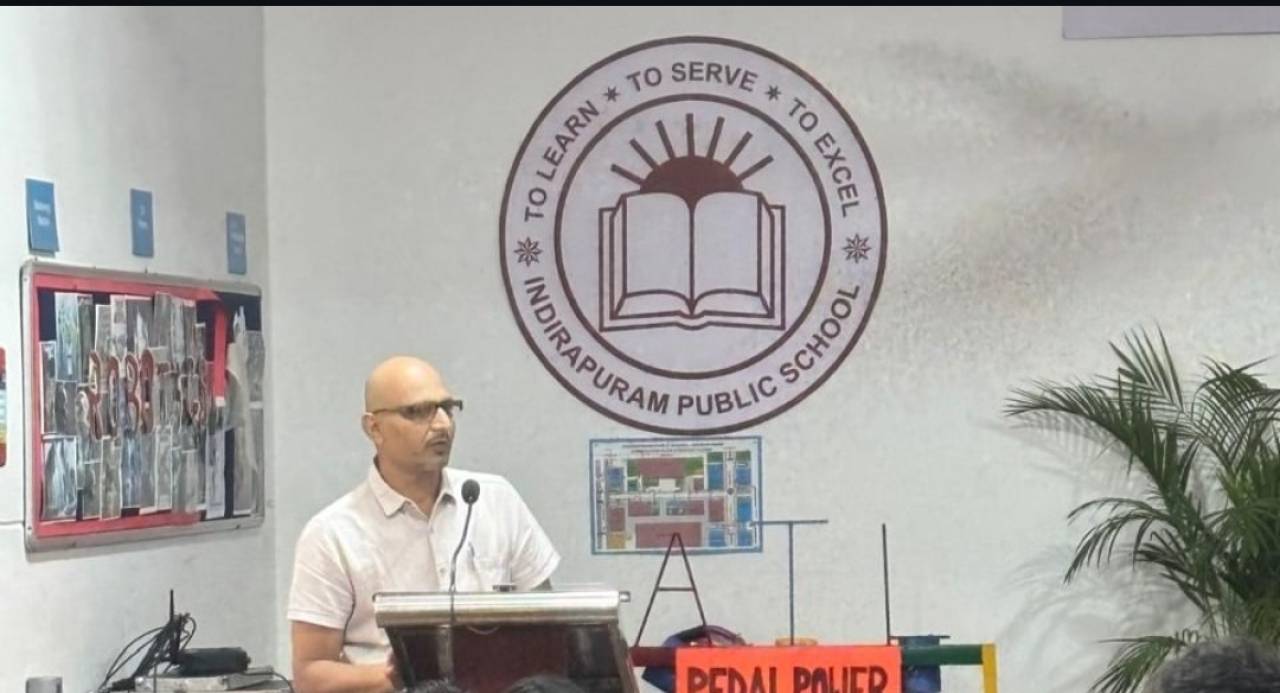
In a world where a viral post can travel faster than the truth, Class 9 students at Indirapuram Public School learned why pausing and checking matters.
A social-media post can take seconds to reach thousands of people. Checking whether that post is true can take much longer. For students growing up in an environment where information, entertainment, advertising and opinion often appear together on the same screen, knowing how to pause and question what they see is becoming an essential life skill.
This was the focus of a special awareness session on “Critical Thinking in the Age of Social Media” conducted by Gautam Kumar Jha, Managing Editor of InsightfulTake, for Class 9 students at Indirapuram Public School.
The session was designed not to make students suspicious of everything they encounter online, but to encourage a more thoughtful habit: pause, question, check and then decide.
The approach is increasingly relevant to education. UNESCO describes media and information literacy as a set of competencies that helps people critically engage with information, media and digital technologies. Its current work also connects these skills with artificial intelligence, digital citizenship and the growing challenge of misinformation and disinformation.
From Scrolling to Thinking
For teenagers, social media is not simply a source of entertainment. It is also a space where they encounter news, opinions, advertisements, short videos, influencers, political arguments, educational material and AI-generated content.
Jha's session began with a simple question: If a message has one million views, does that make it true?
The question helped introduce an important distinction. Popularity is not evidence. A post may receive thousands of likes and shares and still contain incorrect or misleading information.
Students were encouraged to ask three basic questions whenever they encounter a claim online: What exactly is being claimed? How do we know? Who is saying it?
From there, the discussion moved towards evidence, context, source credibility and independent verification.
Learning to Recognise What They Are Seeing
One of the practical elements of the session was helping students distinguish between different kinds of content.
A fact can be checked against evidence. An opinion expresses a person's judgment. An interpretation explains what a fact may mean. An advertisement is designed to persuade or promote. Satire and parody may deliberately use exaggeration or humour.
This distinction matters because digital platforms often place all these forms of content next to one another.
The students were also introduced to the difference between misinformation and disinformation. Misinformation can involve false or misleading information shared without an intention to deceive, while disinformation involves deliberate deception or manipulation.
UNICEF has highlighted the particular challenges children face in evaluating digital information as their cognitive and emotional capacities continue to develop. At the same time, children can also become active participants in challenging misinformation when they have the right skills.
Why We Share Before We Check
The session also explored the psychology behind online sharing.
Anger, fear, excitement and surprise can encourage people to react before verifying information. Confirmation bias can make people more accepting of claims that already fit their beliefs. A large number of likes or shares can create a false sense of credibility.
Urgent messages such as “share before it is deleted” were discussed as another warning sign.
The students were encouraged to recognise that a confident speaker, popular influencer or verified account is not automatically a reliable source. The evidence still matters.
Understanding the Algorithm
Another important part of the discussion focused on social-media recommendation systems.
Rather than turning the subject into a technical lecture, Jha used a simple example. If a student repeatedly watches cricket videos, an app may begin recommending more cricket-related content.
The larger question is what happens when a person repeatedly consumes only one type of opinion or information.
Students were introduced to concepts such as personalised feeds, recommendation systems, filter bubbles and echo chambers. The objective was not to suggest that every student's online experience is manipulated in exactly the same way, but to help them understand that what appears on their screen is shaped partly by digital systems and previous behaviour.
The Pause-and-Check Method
The session gave students a practical framework they could use after leaving the classroom.
Before sharing something important, they were encouraged to check the source, date, context and evidence, and then cross-check the claim independently.
A suspicious viral post, for example, should not be investigated merely by searching for the same post. Students were encouraged to identify the central claim and search for the original source or independent evidence.
For images and videos, they were taught to consider whether the material was old, edited or taken from another event. For statistics, they were encouraged to ask about the source, time period and denominator.
If something cannot be verified, it should not be presented as a fact.
AI Adds a New Layer
The conversation also moved beyond conventional social media to generative artificial intelligence.
AI can produce polished text, images, audio and video that appear convincing. But fluency does not establish truth.
Students were therefore encouraged to apply the same critical-thinking questions to AI-generated answers that they would apply to social-media posts. Where did the information come from? Is the date correct? Can the important claims be independently verified? Has the system produced a source or quotation that does not actually exist?
UNESCO's media and information literacy framework increasingly addresses AI alongside misinformation and digital citizenship, while UNICEF has also highlighted both the opportunities and risks that AI presents for children and young people.
Critical Thinking Also Means Responsible Behaviour
The session did not stop at identifying false information. It also addressed privacy, digital footprints and cyberbullying.
Students were encouraged to think before posting photographs or personal information about themselves or others. They were reminded that screenshots and reposts can preserve content even after the original post disappears.
The discussion also emphasised that disagreement is not the same as harassment. Threats, targeted abuse, impersonation and the deliberate exposure of private information require responsible action, including reporting and seeking help from a trusted adult.
UNICEF India similarly advises young people to think before sending content, respect privacy, avoid spreading rumours and seek help from a trusted adult when they face serious problems online.
Education for a More Thoughtful Digital Generation
The session at Indirapuram Public School reflected a larger challenge facing contemporary education. Students do not only need information. They need the ability to evaluate information.
For Jha, the purpose of critical thinking is not to encourage cynicism or teach students to reject everything they encounter online. It is to develop the confidence to question, investigate and change one's view when stronger evidence becomes available.
The message he left with the students was straightforward:
“You do not need to become suspicious of everything you see online. You need to become curious about it.”
That curiosity may be one of the most valuable habits students can develop in the digital age.
In a world where information can travel faster than verification, the ability to stop, ask questions and check before sharing is no longer merely an academic skill. It is a form of responsible digital citizenship.
For Indirapuram Public School, creating such spaces for discussion can help students connect classroom learning with the realities of the digital world. For Jha and InsightfulTake, the initiative also reflects a broader commitment to promoting informed, responsible and evidence-based engagement with information.
The ultimate lesson was simple enough for every student to remember: Pause. Check. Think. Then Share.
A social-media post can take seconds to reach thousands of people. Checking whether that post is true can take much longer. For students growing up in an environment where information, entertainment, advertising and opinion often appear together on the same screen, knowing how to pause and question what they see is becoming an essential life skill.
This was the focus of a special awareness session on “Critical Thinking in the Age of Social Media” conducted by Gautam Kumar Jha, Managing Editor of InsightfulTake, for Class 9 students at Indirapuram Public School.
The session was designed not to make students suspicious of everything they encounter online, but to encourage a more thoughtful habit: pause, question, check and then decide.
The approach is increasingly relevant to education. UNESCO describes media and information literacy as a set of competencies that helps people critically engage with information, media and digital technologies. Its current work also connects these skills with artificial intelligence, digital citizenship and the growing challenge of misinformation and disinformation.
From Scrolling to Thinking
For teenagers, social media is not simply a source of entertainment. It is also a space where they encounter news, opinions, advertisements, short videos, influencers, political arguments, educational material and AI-generated content.
Jha's session began with a simple question: If a message has one million views, does that make it true?
The question helped introduce an important distinction. Popularity is not evidence. A post may receive thousands of likes and shares and still contain incorrect or misleading information.
Students were encouraged to ask three basic questions whenever they encounter a claim online: What exactly is being claimed? How do we know? Who is saying it?
From there, the discussion moved towards evidence, context, source credibility and independent verification.
Learning to Recognise What They Are Seeing
One of the practical elements of the session was helping students distinguish between different kinds of content.
A fact can be checked against evidence. An opinion expresses a person's judgment. An interpretation explains what a fact may mean. An advertisement is designed to persuade or promote. Satire and parody may deliberately use exaggeration or humour.
This distinction matters because digital platforms often place all these forms of content next to one another.
The students were also introduced to the difference between misinformation and disinformation. Misinformation can involve false or misleading information shared without an intention to deceive, while disinformation involves deliberate deception or manipulation.
UNICEF has highlighted the particular challenges children face in evaluating digital information as their cognitive and emotional capacities continue to develop. At the same time, children can also become active participants in challenging misinformation when they have the right skills.
Why We Share Before We Check
The session also explored the psychology behind online sharing.
Anger, fear, excitement and surprise can encourage people to react before verifying information. Confirmation bias can make people more accepting of claims that already fit their beliefs. A large number of likes or shares can create a false sense of credibility.
Urgent messages such as “share before it is deleted” were discussed as another warning sign.
The students were encouraged to recognise that a confident speaker, popular influencer or verified account is not automatically a reliable source. The evidence still matters.
Understanding the Algorithm
Another important part of the discussion focused on social-media recommendation systems.
Rather than turning the subject into a technical lecture, Jha used a simple example. If a student repeatedly watches cricket videos, an app may begin recommending more cricket-related content.
The larger question is what happens when a person repeatedly consumes only one type of opinion or information.
Students were introduced to concepts such as personalised feeds, recommendation systems, filter bubbles and echo chambers. The objective was not to suggest that every student's online experience is manipulated in exactly the same way, but to help them understand that what appears on their screen is shaped partly by digital systems and previous behaviour.
The Pause-and-Check Method
The session gave students a practical framework they could use after leaving the classroom.
Before sharing something important, they were encouraged to check the source, date, context and evidence, and then cross-check the claim independently.
A suspicious viral post, for example, should not be investigated merely by searching for the same post. Students were encouraged to identify the central claim and search for the original source or independent evidence.
For images and videos, they were taught to consider whether the material was old, edited or taken from another event. For statistics, they were encouraged to ask about the source, time period and denominator.
If something cannot be verified, it should not be presented as a fact.
AI Adds a New Layer
The conversation also moved beyond conventional social media to generative artificial intelligence.
AI can produce polished text, images, audio and video that appear convincing. But fluency does not establish truth.
Students were therefore encouraged to apply the same critical-thinking questions to AI-generated answers that they would apply to social-media posts. Where did the information come from? Is the date correct? Can the important claims be independently verified? Has the system produced a source or quotation that does not actually exist?
UNESCO's media and information literacy framework increasingly addresses AI alongside misinformation and digital citizenship, while UNICEF has also highlighted both the opportunities and risks that AI presents for children and young people.
Critical Thinking Also Means Responsible Behaviour
The session did not stop at identifying false information. It also addressed privacy, digital footprints and cyberbullying.
Students were encouraged to think before posting photographs or personal information about themselves or others. They were reminded that screenshots and reposts can preserve content even after the original post disappears.
The discussion also emphasised that disagreement is not the same as harassment. Threats, targeted abuse, impersonation and the deliberate exposure of private information require responsible action, including reporting and seeking help from a trusted adult.
UNICEF India similarly advises young people to think before sending content, respect privacy, avoid spreading rumours and seek help from a trusted adult when they face serious problems online.
Education for a More Thoughtful Digital Generation
The session at Indirapuram Public School reflected a larger challenge facing contemporary education. Students do not only need information. They need the ability to evaluate information.
For Jha, the purpose of critical thinking is not to encourage cynicism or teach students to reject everything they encounter online. It is to develop the confidence to question, investigate and change one's view when stronger evidence becomes available.
The message he left with the students was straightforward:
“You do not need to become suspicious of everything you see online. You need to become curious about it.”
That curiosity may be one of the most valuable habits students can develop in the digital age.
In a world where information can travel faster than verification, the ability to stop, ask questions and check before sharing is no longer merely an academic skill. It is a form of responsible digital citizenship.
For Indirapuram Public School, creating such spaces for discussion can help students connect classroom learning with the realities of the digital world. For Jha and InsightfulTake, the initiative also reflects a broader commitment to promoting informed, responsible and evidence-based engagement with information.
The ultimate lesson was simple enough for every student to remember: Pause. Check. Think. Then Share.

















Leave a Comment