
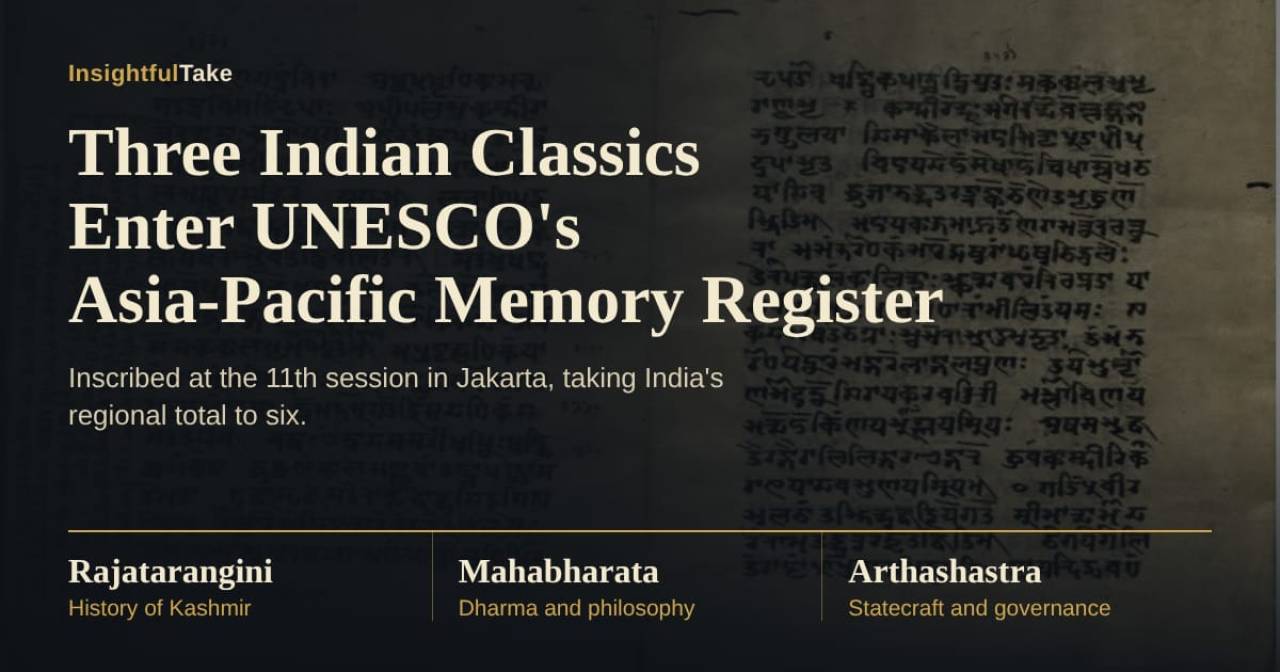
Three landmark Indian works representing literature, governance and historical writing have received international recognition, taking India’s total inscriptions on UNESCO’s regional documentary heritage register to six.
Three of India's most important ancient works, the Mahabharata, Kautilya's Arthashastra and Kalhana's Rajatarangini, have been inscribed on UNESCO's Memory of the World Asia-Pacific Regional Register.
The decision was taken during the 11th session of the register's committee in Jakarta, Indonesia. Union Culture Minister Gajendra Singh Shekhawat announced the recognition on Thursday, November 5.
With these additions, India now has six inscriptions on the regional list. The Ramcharitmanas, the Panchatantra and Sahridayaloka-Locana received recognition in 2024.
The Ministry of Culture described the latest inscriptions as an important acknowledgement of India's literary and intellectual traditions. According to the ministry, the three works reflect the depth of India's historical knowledge, philosophical thinking and understanding of governance. Their continued relevance across centuries also demonstrates the enduring value of these traditions.
What Is UNESCO’s Memory of the World Register?
UNESCO launched the Memory of the World Programme in 1992 to protect documentary heritage of exceptional historical, cultural and intellectual importance and ensure its accessibility for future generations.
The Asia-Pacific Regional Register is maintained by the programme's regional committee and operates alongside UNESCO's international register.
An inscription does not transfer ownership or control of a manuscript. Instead, it recognises the historical and cultural importance of a documentary record and highlights the need to preserve, document and make it accessible to researchers and the public.
Three Ancient Works Representing Different Dimensions of Indian Thought
The three newly recognised works explore different aspects of India's intellectual heritage, from moral philosophy and political administration to historical documentation.
1. Mahabharata: An Epic of Duty, Justice and Moral Conflict
Traditionally attributed to Veda Vyasa, the Mahabharata is among the longest epic poems in the world. Comprising nearly one lakh verses, it explores complex questions of duty, justice, warfare, family loyalty and moral responsibility.
The Bhagavad Gita, one of India's most influential philosophical texts, forms part of the epic.
The manuscript submitted for UNESCO recognition is approximately 400 years old. Written on birch bark in the Sharada script, it is preserved at the Bhandarkar Oriental Research Institute in Pune.
Beyond its literary significance, the Mahabharata has shaped philosophical, religious and cultural traditions across India and several other parts of Asia.
2. Arthashastra: Kautilya’s Treatise on Governance and Statecraft
Attributed to Kautilya, also known as Chanakya, the Arthashastra is one of India's most significant ancient works on political administration and statecraft.
It examines subjects such as economic policy, taxation, law, public administration, diplomacy and military strategy. Its central concern is the organisation and effective functioning of the state.
Scholars continue to debate the precise period in which the text was compiled. However, its importance in the study of political institutions and governance remains widely acknowledged.
Even today, the Arthashastra attracts the attention of historians, political thinkers and students of public administration and international relations.
3. Rajatarangini: Kalhana’s Chronicle of Kashmir’s Kings
Written by Kalhana in the 12th century, the Rajatarangini is a historical chronicle of Kashmir's rulers, composed in Sanskrit verse across eight books.
It is widely regarded as one of the earliest substantial works of historical writing in India.
What distinguishes Kalhana's account is his effort to draw upon earlier chronicles and historical records. He did not merely celebrate the achievements of kings but also examined their failures, weaknesses and political conduct.
This approach gives the Rajatarangini considerable importance as a source for understanding Kashmir's political and cultural history.
Why This Recognition Matters
The three works together represent different dimensions of India's intellectual legacy: history, dharma, philosophy and statecraft.
Their recognition challenges the narrow perception that India's ancient written heritage primarily consists of religious or devotional literature.
The Mahabharata examines the complexities of human conduct and moral choices. The Arthashastra approaches governance as a subject requiring strategic thinking and administrative discipline. The Rajatarangini demonstrates an early effort to document political history through historical accounts and available evidence.
Their influence also extends beyond India's geographical boundaries.
The Mahabharata has travelled across South and Southeast Asia through literature, folklore, theatre and cultural traditions. The Arthashastra continues to feature in discussions on administration, diplomacy and strategic thinking. Meanwhile, the Rajatarangini remains an important historical source for scholars studying Kashmir.
Together, these works demonstrate the breadth of India's contribution to literature, political thought and historical documentation.
The Bigger Challenge: Preserving India’s Manuscript Heritage
UNESCO's recognition is an important milestone, but it also draws attention to a larger responsibility: preserving the original manuscripts and making their contents accessible.
Ancient manuscripts written on birch bark, palm leaves and handmade paper are vulnerable to deterioration caused by age, humidity, temperature variations and inadequate storage.
Many are scattered across libraries, research institutions, temples and private collections. Access also remains limited because relatively few scholars today can read historical scripts such as Sharada.
Conservation and digitisation are therefore essential. International recognition can help generate greater institutional attention and, ideally, resources for preserving these documents and making them available to researchers and ordinary readers without exposing fragile originals to repeated handling.
For India, the six inscriptions on UNESCO's Asia-Pacific Regional Register represent international acknowledgement of a long tradition of recording and transmitting knowledge.
However, recognition is only the beginning. The more important responsibility is to ensure that the manuscripts behind this intellectual legacy remain preserved, readable and accessible to future generations.






















Leave a Comment