
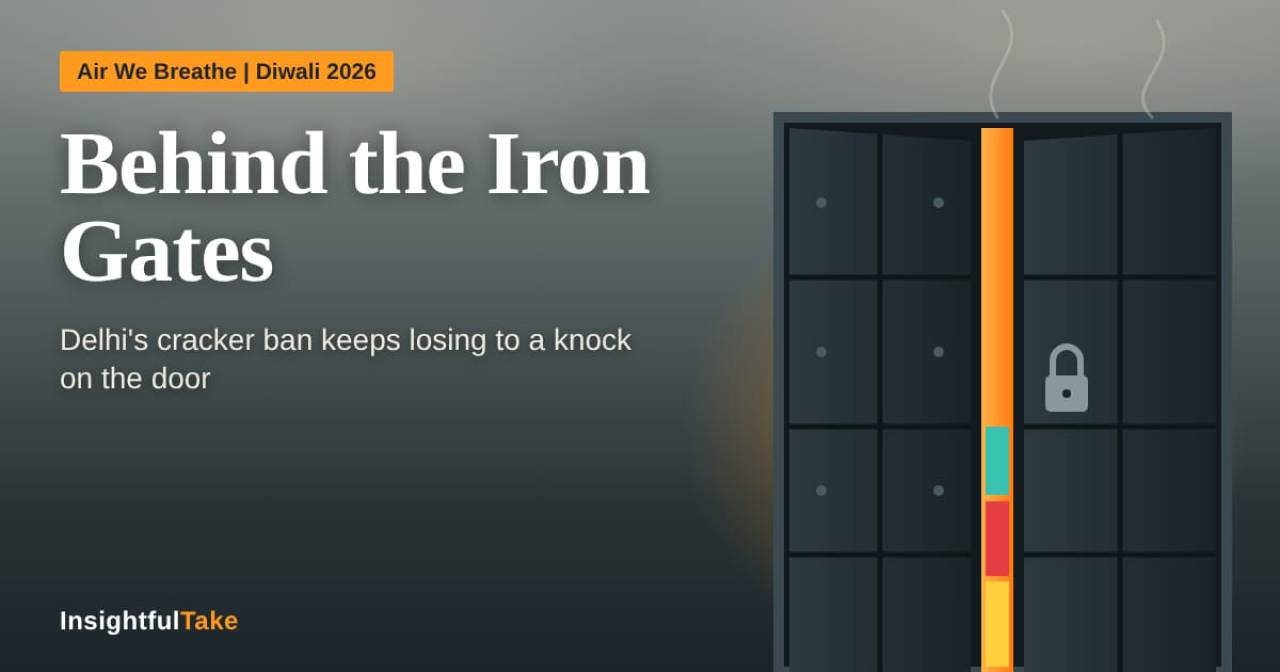
As Diwali approaches, illegal firecrackers continue to reach Delhi's markets through warehouses across the NCR, exposing the limits of a ban that stops at administrative boundaries.
Every year, Delhi's air gets the same ritual treatment. Courts issue orders, officials announce crackdowns, and residents brace for the smog. Then Diwali arrives, and the sky tells us how the exercise has gone.
This year, a Hindustan Times investigation reported that illegal firecrackers are still being sold across the National Capital Region. Its reporters visited six wholesale warehouses in Jhajjar, Pataudi and Bhora Kalan. The gates were shut, but a knock or a phone call was usually enough to open them. In one case, a room stocked with firecrackers was located behind a shop selling religious items.
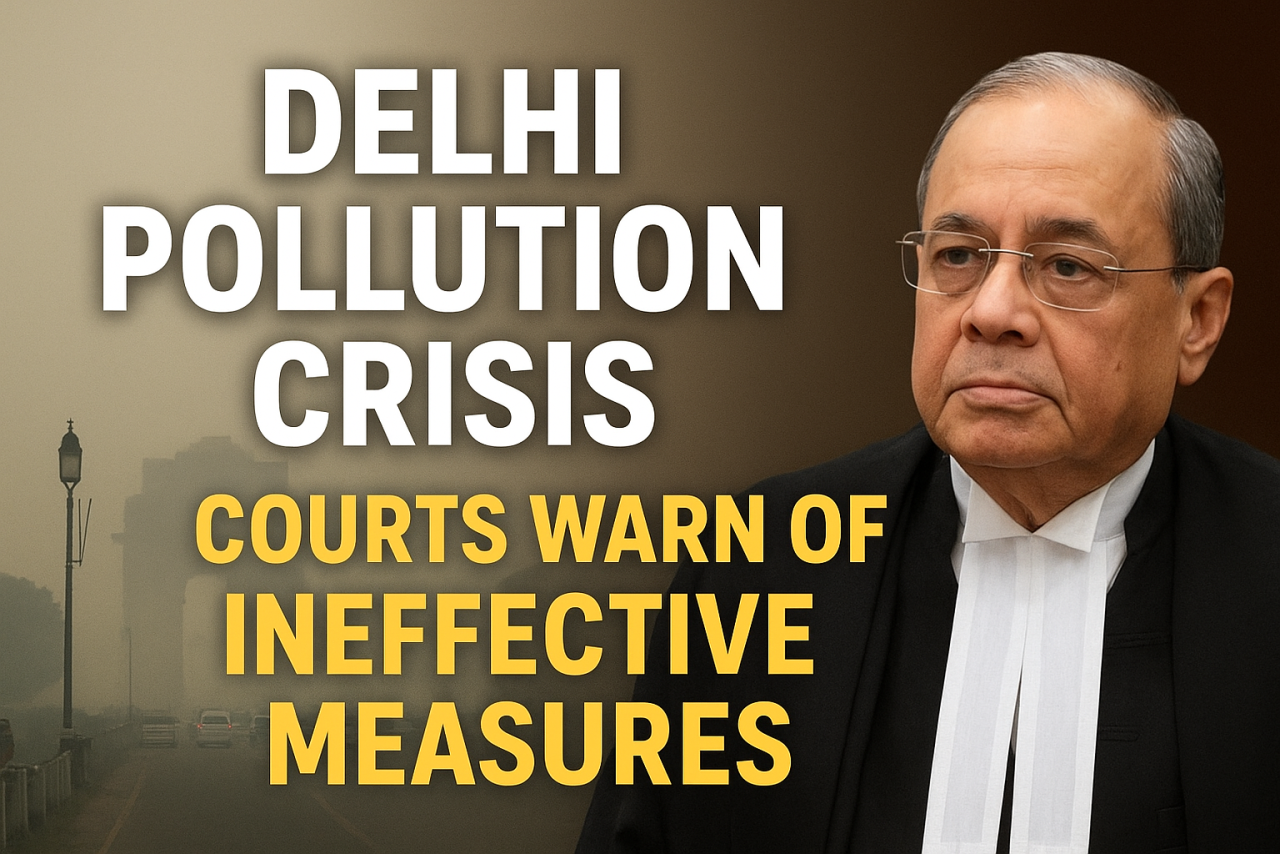
The Supreme Court took note of the report within hours. Yet a follow-up check found conventional crackers still being sold in Chandni Chowk and Sadar Bazaar. The ban is working in the sense that it exists. It is failing in the sense that matters: the air remains polluted.
The Ban Stops at the Border. The Smoke Doesn't.
The most revealing detail in the investigation is not the contraband but the distance buyers are willing to travel. Some travelled 55 km and 78 km to reach these warehouses. One customer reportedly purchased firecrackers worth ₹21,600 for a family wedding and Diwali, attracted by cheaper bulk prices.
These are not necessarily organised offenders. They are ordinary households making a cost-benefit calculation and crossing district and state boundaries to do so. Delhi, Gurugram, Noida and Ghaziabad share one airshed but operate under different police forces and administrative authorities. A restriction enforced in one jurisdiction can simply push the trade into another.
Pollution released in Pataudi does not recognise administrative boundaries. The ban is drawn on government maps, while the problem travels with the wind.
A Rulebook Too Complicated to Follow
The second problem is the rulebook itself. The Supreme Court has allowed only certified green crackers in Delhi-NCR, with sales permitted from November 4 to 6. Bursting is restricted to narrow evening and morning windows on November 7 and 8.
Each condition may be reasonable on its own. Together, they create a framework that is difficult to explain, harder to follow and even harder to enforce. Retailers told reporters that guidelines keep changing, leaving customers uncertain about what is permitted. Such confusion creates room for the grey market.
It also encourages misrepresentation. Spot checks found boxes marked as green crackers without the mandatory QR code, the feature that allows buyers to verify certification. A green sticker without a QR code is little more than a marketing claim. When anyone can print the label, legitimate and illegal products become difficult for ordinary buyers to distinguish.
A regulation that depends on consumer verification must first make that verification simple and reliable.
Enforcement by Scarcity
Then comes the question of enforcement. A senior police official near Jama Masjid admitted to reporters that the force cannot check every shop and is concentrating on major vendors. It is a candid admission, but it also exposes the limitations of the current approach.
Police have reportedly recovered close to 1,300 kg of firecrackers in two weeks. The figure sounds substantial until it is measured against the scale of the festive trade. One cart vendor claimed to earn ₹40,000 a day during the few days available to him. He also said he regularly moves his cart to avoid being caught.
At such margins, an occasional seizure can become just another business expense. When the likelihood of being caught is low and penalties are not sufficiently deterrent, enforcement becomes a manageable risk rather than a reason to stop selling.
The authorities may seize individual consignments, but the business survives as long as supply chains remain intact.
The Cultural Argument We Keep Avoiding
There is another dimension to this problem that enforcement agencies cannot resolve through seizures alone: the cultural attachment to firecrackers.
One buyer told reporters that he had burst crackers since childhood and that nobody spoke about pollution back then. That sentiment is widespread, and dismissing it as simple defiance would be a mistake.
For many families, firecrackers remain part of the familiar experience of Diwali. A ban that offers only prohibition, without an appealing alternative, asks people to give up something emotionally familiar for a benefit that can seem distant and abstract.
Air pollution is a shared public cost. A family lighting a packet of crackers rarely sees the immediate contribution of that single purchase to the city's overall air quality. The enjoyment is personal, while the consequences are distributed across millions of residents.
This gap between individual behaviour and collective harm is precisely why public awareness and credible alternatives must accompany enforcement.
What a More Effective Approach Could Look Like
If the objective is cleaner air rather than stricter announcements, Delhi-NCR needs a different enforcement strategy.
- Regulate the entire airshed, not individual cities. Delhi, Haryana and Uttar Pradesh must coordinate enforcement, share intelligence and monitor the movement of bulk firecracker consignments across their borders.
- Target warehouses and supply chains. Wholesale storage points are fixed, identifiable and easier to monitor than thousands of temporary vendors and roadside carts. Disrupting the supply network can have a greater impact than repeatedly seizing small quantities at retail level.
- Make certification easy to verify. Every certified green cracker should carry a functional QR code that buyers and enforcement personnel can scan instantly. Verification should not require specialist knowledge or complicated procedures.
- Offer alternatives that people want to embrace. Organised community celebrations, laser and light shows, and incentives for neighbourhoods that celebrate without conventional crackers can help make cleaner festivities attractive rather than compulsory.
A ban is more likely to succeed when compliance is practical and the alternative offers something meaningful.
The Real Test Is Enforcement
Delhi will light its lamps this Diwali, and its air quality will be measured within hours. The Supreme Court's intervention is welcome, but a judicial order is only as effective as the enforcement that follows it.
The problem is no longer simply whether Delhi has banned firecrackers. It is whether authorities can prevent their sale, storage and movement across the NCR.
The warehouses in Pataudi and Bhora Kalan may have iron gates, but they open for anyone who knocks. Until enforcement agencies reach these supply points before buyers do, Delhi's firecracker ban will remain stronger on paper than on the ground.
And when the smoke settles, it will be the city's residents, not the warehouses or the authorities, who pay the price.


















Leave a Comment