
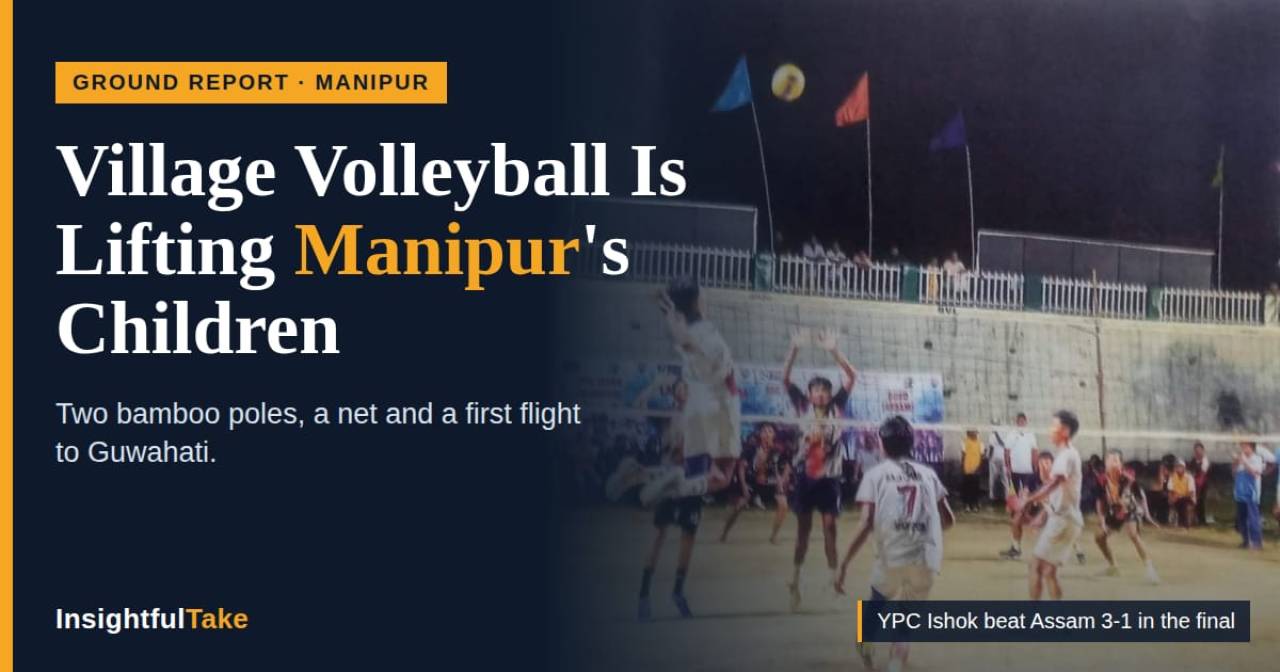
In conflict-hit Manipur, two bamboo poles, a net and a ball are helping village children dream beyond violence and uncertainty.
Most Indian sports stories begin in a stadium. This one begins in a village court, with two bamboo poles, a net and a ball.
Sura and Surjit Singh Rajkumar, 16-year-old twin brothers from Ishok village in Manipur's Bishnupur district, grew up around such a court. They watched older players smash and block, dreaming of wearing India's jersey someday. Last month, they travelled to Guwahati for an interstate tournament. For both, the journey began with another first: their maiden flight.
The reason for flying was not luxury. Road travel through Manipur's highways was considered too risky because of blockades and uncertainty, so the organisers arranged air tickets instead. That single detail says a lot about what it means to be a young athlete in a state that has lived with ethnic violence for more than three years.
The numbers behind that violence are grim. Nearly 60,000 people have been displaced and more than 350 lives lost, according to the media report that inspired this story. Homes have been destroyed, and relationships between communities deeply fractured. Fresh clashes, including in the hill districts, have kept anxiety alive. In such circumstances, parents often hesitate to send teenagers far from home, even for a sporting event.
Yet the boys did go, and they returned as champions.
Representing YPC Ishok Village, the Manipur boys defeated Assam 3-1 in the final of the Brahmaputra Volleyball League Interstate Championship on October 4. The girls' team from another village in Bishnupur district secured third place. For a state that rarely makes national headlines for sporting achievements of this kind, the result deserves attention.
A Game That Begins With Almost Nothing
Why volleyball? Because it is affordable and accessible.
Coach Beda Konsam says most children who take up sports in the region come from economically disadvantaged families. The Brahmaputra Volleyball League, founded in 2020, built its model around this reality. Its grassroots approach requires little more than two bamboo poles, a net and two balls.
The league has gradually expanded its reach, bringing young players into organised volleyball across several states, including Manipur, Jammu and Kashmir, Jharkhand and Odisha.
Indian sports discussions often revolve around the need for a proper system. Big academies, sponsors, professional coaching and television coverage all matter. But a sporting ecosystem does not always begin with expensive infrastructure. Sometimes, it starts with an open field, a coach willing to turn up every evening and a net that villagers can put together themselves.
Volleyball is particularly suited to this model. Unlike sports that demand expensive equipment or specialised facilities, it can be organised in almost any village. That simplicity is its greatest strength, especially in places where uncertainty affects everyday life.
From Village Courts to Bigger Dreams
For many children in Manipur, a government job remains the most familiar career ambition. Joining the Army is another popular aspiration. Volleyball, Konsam believes, can help young people move closer to these goals.
The sport develops discipline, teamwork and physical fitness. The league has also created opportunities for players to participate in recruitment trials and tournaments organised by central forces. Some of its young participants have already represented Manipur at the national level.
Height is often considered an advantage in volleyball. Konsam acknowledges that players from Manipur may face physical disadvantages compared with taller opponents. But he remains confident about their potential.
The players, he says, may not always have the height, but they certainly have big dreams.
It is an attitude that resonates with Indian sports fans, who have repeatedly seen determination and opportunity help athletes overcome limitations in hockey, kabaddi, athletics and cricket.
More Than a Sporting Achievement
Parents naturally worry about their children's education and future. Spending hours on a volleyball court can sometimes appear to compete with academic responsibilities.
But organised sport offers benefits that go beyond the possibility of a professional career. It gives children routine, friendships, confidence and a sense of belonging.
In a region where uncertainty has disrupted normal life, these things matter. A daily practice session offers something increasingly valuable: a fixed time, a familiar place and a shared purpose.
Not every child will become a professional athlete. But participation itself can provide a sense of direction and stability that is difficult to measure through medals or tournament results.
The Challenges Beyond the Court
The journey from a village tournament to national recognition, however, is not easy.
Konsam points out that serious athletes need regular competition to improve. That requires travel, financial support, coaching facilities and opportunities to play against stronger teams.
Conflict has made all these requirements harder to meet. Travel can become uncertain, families remain concerned about safety, and financial constraints limit participation in competitions outside the state.
Without regular exposure to players from other regions, even promising talent can struggle to develop.
This is why interstate tournaments matter beyond the final score. They allow village-level players to test their skills against unfamiliar opponents, understand the standard of competition and return with greater confidence.
For the Rajkumar twins, the Guwahati tournament was not simply another sporting assignment. It was an opportunity to see how far their village-level training could take them.
When Normalcy Becomes a Victory
Photographs from the championship final show a familiar Indian sporting scene: a night match, spectators gathered close to the court and banners decorating the boundary.
It could be a village tournament in almost any part of the country.
And that is precisely what makes the moment special.
For a community that has experienced displacement, violence and prolonged uncertainty, the sight of children competing, families cheering and local teams celebrating is about more than sport. It is a reminder that ordinary life must continue and that young people deserve opportunities beyond the circumstances into which they are born.
The volleyball court cannot resolve Manipur's political and ethnic divisions. Nor can a sporting league replace the need for peace, rehabilitation and accountable governance. But it can create spaces where children learn to work together, compete fairly and imagine a future larger than their immediate surroundings.
India's Sporting Future Begins in Its Villages
India often celebrates a sport when an athlete wins an international medal. The years of practice, local competitions and community support that make such achievements possible receive far less attention.
That needs to change.
If India wants a stronger volleyball ecosystem, it must recognise the importance of village tournaments, local coaches and grassroots organisations. Young players need access to regular competitions, better training facilities and financial support. Equally important, children from conflict-affected regions must have the freedom and opportunity to pursue their sporting ambitions without fear.
The story of Sura and Surjit Singh Rajkumar is a reminder that sporting dreams do not need impressive beginnings.
Sometimes, all they need are two bamboo poles, a net, a ball and someone willing to give a child a chance.
The twins have flown once. They hope to fly again, carrying their experience from Ishok and a bigger dream of representing India.
Back home, another child is probably watching from the sidelines, waiting for a turn on the court.
And that is where India's next sporting story may begin.

















Leave a Comment