
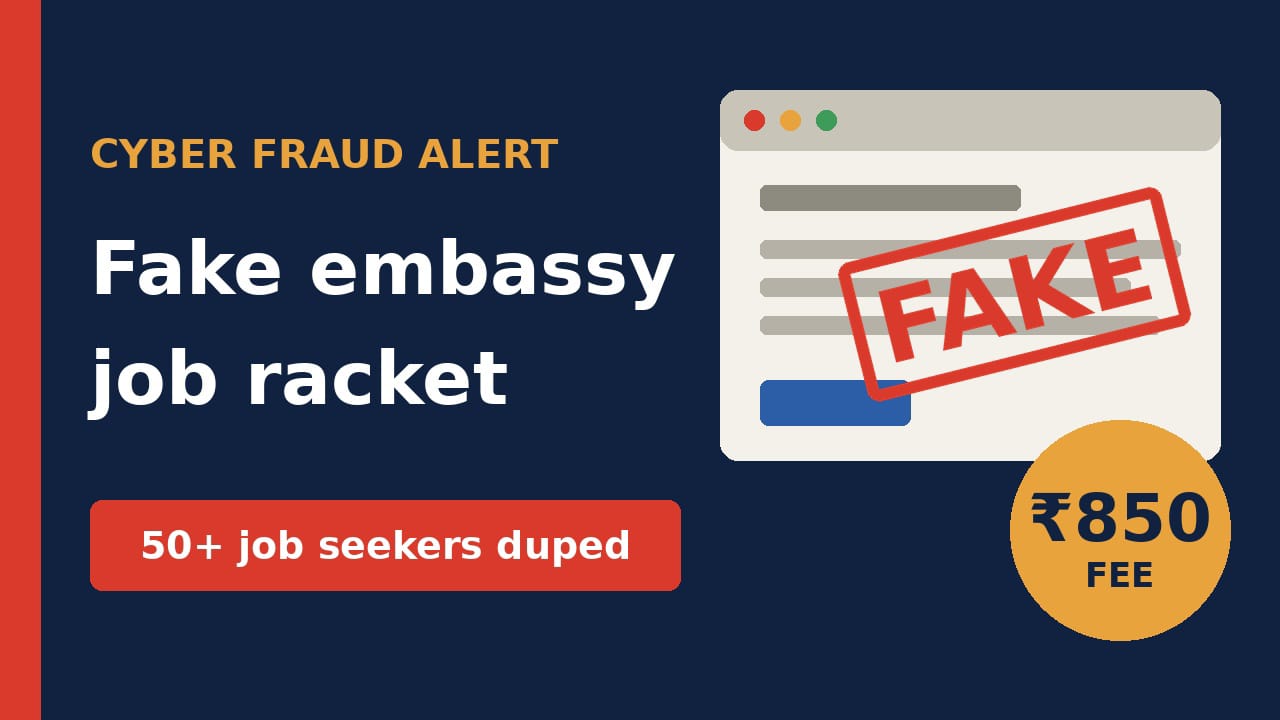
A fake website, 147 embassy vacancies and an ₹850 registration fee. How a Bihar man allegedly duped over 50 Indians chasing overseas jobs.
Delhi Police arrested a 25-year-old Bihar native, employed in the UK, for allegedly collecting registration fees through a fake recruitment website advertising 147 embassy vacancies.
A promise of employment at Russian embassies abroad has landed more than 50 Indian job seekers in an alleged recruitment scam. Delhi Police have arrested a 25-year-old man from Bihar accused of creating a fake recruitment website and collecting money from applicants under the pretext of conducting online interviews.
The accused, identified as Aman Kumar, works as a stock control analyst in the United Kingdom. Police arrested him in Meerut, Uttar Pradesh, on Monday, a day before he was scheduled to board a flight to the UK from Delhi.
Investigators believe Kumar used the credibility of Russian diplomatic missions to attract applicants looking for overseas employment. The racket allegedly operated for four to five months, collecting around ₹50,000 from unsuspecting candidates.
Fake Recruitment Drive Advertised 147 Embassy Vacancies
According to police, the accused advertised 147 vacancies at Russian embassies across different countries through a popular online job portal.
Applicants responding to the advertisement were redirected to a website resembling an official recruitment and testing platform. The website claimed that candidates would be shortlisted through an online interview process.
However, applicants were required to deposit ₹850 as a registration fee before participating.
The relatively modest amount appears to have helped the accused avoid suspicion. For candidates hoping to secure employment abroad, the fee may have seemed insignificant compared with the prospect of a diplomatic posting.
Police suspect that more than 50 people paid the amount without realising that the recruitment exercise was fraudulent.
Bhopal Web Designer Questioned
The investigation has also led police to a web designer based in Bhopal, Madhya Pradesh, who allegedly developed the recruitment website.
The designer was brought in for questioning on Wednesday. Investigators said he knew Kumar through a mutual acquaintance.
During questioning, the designer reportedly claimed that he had no knowledge of the alleged fraud. He told investigators that Kumar had approached him to develop a platform for conducting mock tests for candidates preparing for embassy-related recruitment.
Police are examining whether the designer was aware of the website's actual purpose or had any involvement beyond its development.
He had not been arrested at the time of reporting.
Russian Embassy Complaints Exposed the Racket
The alleged fraud came to light after 17 Indian citizens approached the Russian Embassy in India, complaining that they had paid registration fees for what they believed were genuine embassy vacancies.
The complaints prompted the embassy to contact Delhi Police.
A case involving cyber cheating, impersonation and forgery was registered in July at the Delhi Cyber Police Station.
Investigators subsequently examined financial transactions linked to the website and traced the payments made by applicants.
Police also scrutinised immigration records, which indicated that the suspect was an Indian national employed in the United Kingdom.
After tracking his movements, officers located Kumar in Meerut and arrested him shortly before his scheduled departure from India.
He was subsequently brought to Delhi for further investigation.
Police Suspect More Victims
Although investigators believe more than 50 candidates were cheated, police have so far traced and recorded statements from three victims.
Officials suspect the actual number could be higher, given that the website remained operational for several months.
The case has been registered under Sections 318, 319 and 340 of the Bharatiya Nyaya Sanhita (BNS), covering offences related to cheating, cheating by impersonation and forged documents or electronic records.
Investigators are now examining the accused's financial transactions and the website's operations to establish the full extent of the alleged fraud.
The Russian Embassy had not responded to a request for comment at the time of reporting.
How Fake Job Offers Exploit Applicants
The case highlights how fraudulent recruitment operations exploit the credibility of established institutions and the aspirations of people seeking employment abroad.
Unlike elaborate financial scams involving substantial investments, such rackets often rely on relatively small payments collected from numerous applicants.
A registration fee of ₹850 may not immediately arouse suspicion. However, when collected from dozens or hundreds of candidates, such payments can generate considerable sums for fraudsters.
The use of a recognised job portal also lends apparent legitimacy to fraudulent advertisements. Applicants may assume that a vacancy appearing on a popular employment platform has already undergone verification.
A professionally designed website can reinforce that impression, particularly when it resembles an official recruitment portal.
However, the appearance of a website or its presence on a job portal does not establish the authenticity of a vacancy.
What Job Seekers Should Check Before Paying
Employment seekers should verify overseas vacancies through the official website or authorised recruitment channels of the organisation concerned.
An embassy's name appearing in an advertisement is not sufficient proof of a genuine recruitment drive.
Applicants should also examine website addresses carefully, particularly when directed to unfamiliar portals requesting payments or personal information.
While some legitimate recruitment processes may involve prescribed application fees, payments demanded through unverified websites or personal accounts warrant particular caution.
Candidates should independently confirm vacancies before submitting registration fees, identity documents or banking details.
Anyone suspecting online recruitment fraud can report the matter through the National Cyber Crime Reporting Portal at cybercrime.gov.in or call the national cybercrime helpline at 1930.
Payment receipts, screenshots, messages and website addresses should be preserved as potential evidence.
Investigation Continues as Police Seek More Complainants
Delhi Police have urged people who paid registration fees through the suspected website to come forward and record their statements.
Their accounts could help investigators determine how many candidates were targeted and whether the alleged racket extended beyond the victims identified so far.
The investigation also raises questions about the screening of recruitment advertisements on employment platforms, particularly those invoking foreign diplomatic missions.
For job seekers, the case illustrates a familiar vulnerability in a different setting. A convincing advertisement, an official-looking website and a small registration fee were apparently enough to turn the promise of overseas employment into an opportunity for fraud.



























Leave a Comment