
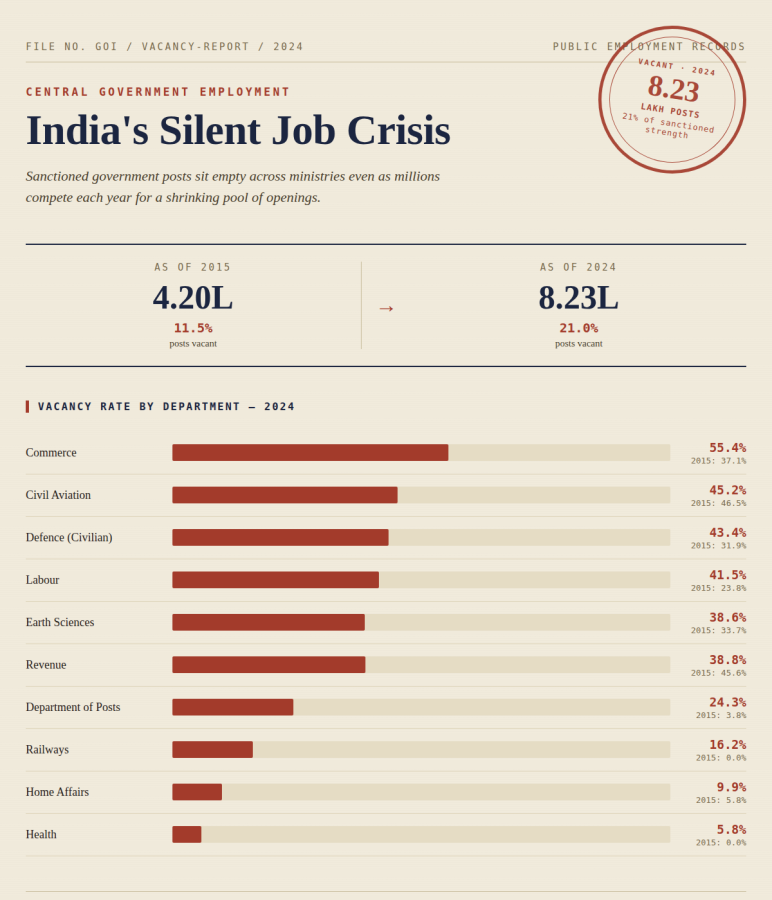
8.23 lakh government posts remain vacant in India. The gap between sanctioned jobs and actual recruitment is raising questions about employment and public services.
More than 8.23 lakh sanctioned posts across central government ministries and departments remained vacant in 2024, according to recent public-sector employment data. The number has nearly doubled from 4.20 lakh in 2015. As a share of total sanctioned posts, vacancies have risen from 11.5% to 21% during the same period.
For a country where government jobs are still seen as the gold standard of employment security, the numbers reveal a troubling gap between the demand for stable employment and the government's ability to fill positions already created.
Where the Gaps Are Widest
The vacancy situation varies across departments, but several major public institutions face substantial shortages.
The civilian wing of the Defence Ministry has the highest vacancy rate among major departments, with 43.4% of sanctioned posts vacant in 2024. About 2.41 lakh posts remained unfilled, compared with a 31.9% vacancy rate in 2015.
Indian Railways, one of India's largest civilian employers, had around 2.40 lakh vacant posts, representing a 16.2% shortfall. The scale of the vacancy is significant because railways directly affects the daily lives of millions of passengers and plays a critical role in freight and national infrastructure.
The Ministry of Home Affairs also had around 1.10 lakh vacant posts, nearly 10% of its sanctioned strength.
Some departments have experienced an even sharper deterioration. The Department of Posts saw its vacancy rate rise from 3.8% in 2015 to 24.3% in 2024. In Commerce, the vacancy rate increased from 37.1% to 55.4%, the steepest rise among the departments highlighted in the data.
The Department of Atomic Energy also saw vacancies increase substantially, from 14.3% to 27.5%.
Not every department has moved in the same direction. Revenue, Housing and Urban Affairs, External Affairs, Water Resources, and Mines have recorded lower vacancy percentages than in 2015. This suggests that recruitment in these areas has kept relatively closer pace with sanctioned strength.
However, these improvements are overshadowed by the scale of vacancies in departments that directly affect millions of citizens, including railways, postal services, defence and health.
Why Government Vacancies Matter
A vacant government post is not simply a missed employment opportunity. It can also affect the delivery of public services.
Fewer railway employees can place additional pressure on maintenance, operations and safety systems. Staffing shortages in departments under Home Affairs can affect administrative and security-related functions. In the health sector, even a comparatively lower vacancy rate of 5.8% can translate into additional pressure on an already stretched public healthcare system.
There is another problem that receives less attention.
When government positions remain vacant for years, the work does not disappear. Existing employees often have to take on additional responsibilities. Over time, this can affect workload, morale, service quality and the ability of departments to plan effectively.
A vacancy that remains unfilled for years therefore becomes more than an administrative statistic. It can become a weakness in the system itself.
The Employment Paradox
India's employment debate usually focuses on private-sector job creation, informal employment and the growing number of young people entering the workforce.
But the government vacancy figures reveal another side of the employment problem.
Government recruitment examinations such as SSC, UPSC and Railway Recruitment Board examinations attract millions of applicants every year. For many young Indians, a government job represents not only a regular income but also job security, social status and long-term financial stability.
Yet thousands of sanctioned positions remain vacant.
This creates a striking paradox: high demand for government employment, large numbers of sanctioned vacancies and slow recruitment.
The reasons are not necessarily the same across all departments. Recruitment procedures can be lengthy, examinations can take years to complete, and administrative or budgetary decisions can delay appointments. Different ministries may also face different institutional constraints.
But whatever the reason, the result is similar for job seekers. A sanctioned post that remains empty does not provide employment to anyone.
A Missed Opportunity
India's working-age population continues to create pressure for more employment opportunities. The government cannot solve the country's employment challenge simply by filling every vacant post, since the public sector is only one part of the economy.
But filling a meaningful share of the 8.23 lakh vacant central government posts could achieve two things at once.
It could provide employment opportunities to a large number of qualified applicants while also strengthening public institutions that millions of citizens depend on every day.
The issue, therefore, is not merely about 8.23 lakh empty chairs in government offices. It is about whether India's public institutions have enough people to perform the work expected of them and whether a generation seeking secure employment is being given a fair opportunity to compete for jobs that already exist on paper.
For India's employment debate, these vacancies deserve to be treated not just as numbers in government records, but as both an employment opportunity and a public-service challenge.
More than 8.23 lakh sanctioned posts across central government ministries and departments remained vacant in 2024, according to recent public-sector employment data. The number has nearly doubled from 4.20 lakh in 2015. As a share of total sanctioned posts, vacancies have risen from 11.5% to 21% during the same period.
For a country where government jobs are still seen as the gold standard of employment security, the numbers reveal a troubling gap between the demand for stable employment and the government's ability to fill positions already created.
Where the Gaps Are Widest
The vacancy situation varies across departments, but several major public institutions face substantial shortages.
The civilian wing of the Defence Ministry has the highest vacancy rate among major departments, with 43.4% of sanctioned posts vacant in 2024. About 2.41 lakh posts remained unfilled, compared with a 31.9% vacancy rate in 2015.
Indian Railways, one of India's largest civilian employers, had around 2.40 lakh vacant posts, representing a 16.2% shortfall. The scale of the vacancy is significant because railways directly affects the daily lives of millions of passengers and plays a critical role in freight and national infrastructure.
The Ministry of Home Affairs also had around 1.10 lakh vacant posts, nearly 10% of its sanctioned strength.
Some departments have experienced an even sharper deterioration. The Department of Posts saw its vacancy rate rise from 3.8% in 2015 to 24.3% in 2024. In Commerce, the vacancy rate increased from 37.1% to 55.4%, the steepest rise among the departments highlighted in the data.
The Department of Atomic Energy also saw vacancies increase substantially, from 14.3% to 27.5%.
Not every department has moved in the same direction. Revenue, Housing and Urban Affairs, External Affairs, Water Resources, and Mines have recorded lower vacancy percentages than in 2015. This suggests that recruitment in these areas has kept relatively closer pace with sanctioned strength.
However, these improvements are overshadowed by the scale of vacancies in departments that directly affect millions of citizens, including railways, postal services, defence and health.
Why Government Vacancies Matter
A vacant government post is not simply a missed employment opportunity. It can also affect the delivery of public services.
Fewer railway employees can place additional pressure on maintenance, operations and safety systems. Staffing shortages in departments under Home Affairs can affect administrative and security-related functions. In the health sector, even a comparatively lower vacancy rate of 5.8% can translate into additional pressure on an already stretched public healthcare system.
There is another problem that receives less attention.
When government positions remain vacant for years, the work does not disappear. Existing employees often have to take on additional responsibilities. Over time, this can affect workload, morale, service quality and the ability of departments to plan effectively.
A vacancy that remains unfilled for years therefore becomes more than an administrative statistic. It can become a weakness in the system itself.
The Employment Paradox
India's employment debate usually focuses on private-sector job creation, informal employment and the growing number of young people entering the workforce.
But the government vacancy figures reveal another side of the employment problem.
Government recruitment examinations such as SSC, UPSC and Railway Recruitment Board examinations attract millions of applicants every year. For many young Indians, a government job represents not only a regular income but also job security, social status and long-term financial stability.
Yet thousands of sanctioned positions remain vacant.
This creates a striking paradox: high demand for government employment, large numbers of sanctioned vacancies and slow recruitment.
The reasons are not necessarily the same across all departments. Recruitment procedures can be lengthy, examinations can take years to complete, and administrative or budgetary decisions can delay appointments. Different ministries may also face different institutional constraints.
But whatever the reason, the result is similar for job seekers. A sanctioned post that remains empty does not provide employment to anyone.
A Missed Opportunity
India's working-age population continues to create pressure for more employment opportunities. The government cannot solve the country's employment challenge simply by filling every vacant post, since the public sector is only one part of the economy.
But filling a meaningful share of the 8.23 lakh vacant central government posts could achieve two things at once.
It could provide employment opportunities to a large number of qualified applicants while also strengthening public institutions that millions of citizens depend on every day.
The issue, therefore, is not merely about 8.23 lakh empty chairs in government offices. It is about whether India's public institutions have enough people to perform the work expected of them and whether a generation seeking secure employment is being given a fair opportunity to compete for jobs that already exist on paper.
For India's employment debate, these vacancies deserve to be treated not just as numbers in government records, but as both an employment opportunity and a public-service challenge.


























Leave a Comment