
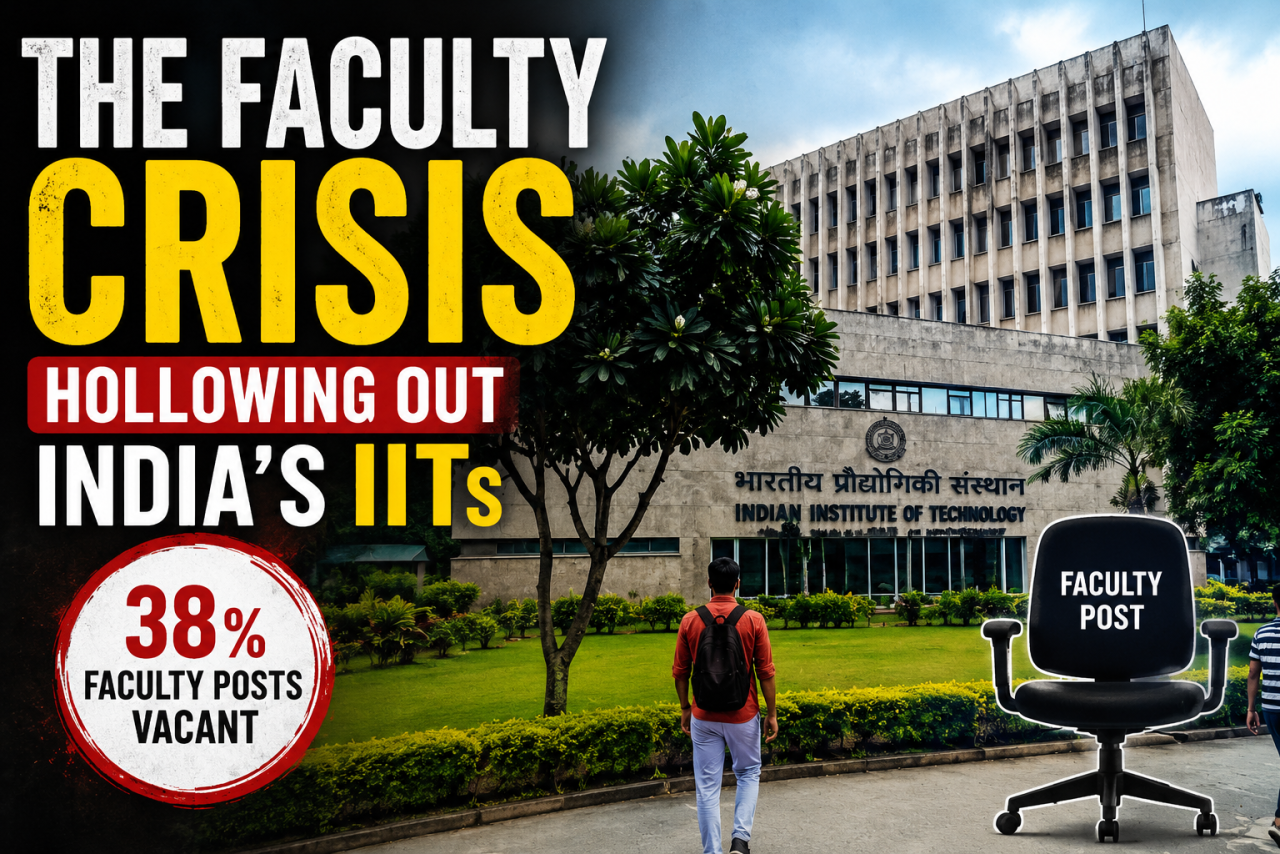
As many as 38.4% of sanctioned faculty posts across India's IITs remain vacant. The shortage is weakening research, stretching classrooms and exposing deeper structural problems in India's higher education system.
India's premier engineering institutions were established to nurture talent and build the country's scientific and technological capability. But a persistent shortage of faculty is steadily weakening that foundation. As of January 30, this year, 4,804 of the 12,498 sanctioned faculty posts across the country's 23 IITs were vacant—38.4% of the total. These are not routine vacancies created by retirements or delayed appointments. Many of these positions have remained unfilled for years despite being sanctioned and funded.
The numbers vary from campus to campus but reveal the same pattern. IIT Patna has more than half of its teaching positions vacant. IIT Kharagpur, one of India's oldest engineering institutions, has a vacancy rate of 51.3%, while IIT (ISM) Dhanbad stands at 48.4%. These are institutions that represent the highest standards of technical education in India. A shortage of faculty on this scale inevitably affects teaching, research and academic leadership.
The problem extends well beyond the IIT system. A Parliamentary Standing Committee reported that 28.56% of sanctioned faculty positions across IITs, NITs, IIMs, IISERs and central universities remain vacant. The situation is even more serious at the professor level, where 56.18% of sanctioned posts are lying vacant. Professors lead research, supervise doctoral scholars and shape academic departments. When more than half of these positions remain unfilled, the impact is felt across the entire higher education system.
IIT directors generally point to one reason: competition for high-quality researchers has become global. Indian institutions are recruiting from the same limited pool of PhD graduates as universities in the United States, Europe and increasingly East and Southeast Asia. Many of India's brightest graduates also choose careers abroad. Around one-third of IIT graduates leave the country every year for higher studies or employment. Studies suggest that nearly 62% of the top 100 JEE rank holders eventually move to the United States or Europe. India spends an estimated ₹50–70 lakh on every IIT B.Tech student over four years, yet a significant share of that publicly funded talent contributes to research and innovation outside the country.
The Director of IIT Kanpur has described the faculty shortage as a long-standing issue rather than a recent development. IITs have maintained strict recruitment standards, preferring to leave positions vacant instead of compromising on quality. That approach protects academic standards, but it also means departments operate with fewer teachers than required. Faculty members supervise larger numbers of students, research responsibilities increase, and emerging disciplines such as artificial intelligence, semiconductor technology and quantum computing struggle to build strong academic teams.
Outside the IIT system, the condition of engineering education is considerably weaker.
India produces nearly 1.5 million engineering graduates every year. Most of them graduate not from IITs or NITs but from thousands of private engineering colleges that expanded rapidly over the last two decades. The quality of these institutions varies widely. Many continue to struggle with inadequate infrastructure, poorly paid faculty and outdated curricula that have failed to keep pace with changes in industry.
The consequences are reflected in employability data. A study by human resources firm SHL found that only 3.8% of Indian engineering graduates possess the skills required for software-related roles in startups. Nasscom has repeatedly highlighted the widening employability gap between graduates and industry requirements. Narayana Murthy has also argued that only about one-fourth of India's engineering graduates meet acceptable quality standards, while nearly 80–85% leave college without the skills expected by employers.
For many private institutions, engineering education has become more of a commercial enterprise than an academic one. Billboards promising guaranteed placements line highways across several states. Families with modest incomes often borrow heavily to finance degrees that offer little return in terms of knowledge or employment. One engineering graduate from Bhopal reportedly spent ₹3.5 lakh on a civil engineering degree but remained unemployed for three years because he lacked basic technical competence. He later enrolled in another postgraduate programme, hoping an additional qualification would improve his prospects.
Such stories are no longer exceptional. They are repeated across private engineering colleges in Bihar, Uttar Pradesh, Madhya Pradesh, Rajasthan and several other states. Students continue to invest large sums in degrees that frequently fail to improve their employment prospects. Institutions collect fees, but employers continue to report shortages of job-ready graduates.
These two problems such as faculty shortages in elite public institutions and declining quality across large sections of private engineering education are closely connected.
When leading public institutions struggle to recruit and retain qualified faculty, the effects spread across the education system. Fewer experienced professors mean fewer doctoral graduates, weaker research output and fewer opportunities for collaboration with industry. Private colleges that depend on academic partnerships receive little support. Meanwhile, the regulators responsible for maintaining standards are themselves facing staffing shortages. The National Council for Teacher Education, which oversees around 16,000 teacher-training institutions, reportedly has between 54% and 89% of its sanctioned posts vacant depending on the level of appointment. Weak regulators are unlikely to enforce quality standards effectively.
The government has responded through year-round recruitment drives, mission-mode hiring and proposals to appoint research chairs and foreign faculty in IITs. These measures may help reduce vacancies, but they do not address the larger issue. India has yet to make academic careers competitive with global opportunities, provide research ecosystems comparable with leading international universities or create enough incentives for highly qualified researchers to build long-term careers at home.
Unless these structural issues are addressed, vacant faculty positions will remain a recurring feature of India's higher education system. The immediate cost will be borne by students, whether they study in an IIT or in a private engineering college, while the long-term cost will be paid by the country's research capacity, innovation ecosystem and economic competitiveness.
India's premier engineering institutions were established to nurture talent and build the country's scientific and technological capability. But a persistent shortage of faculty is steadily weakening that foundation. As of January 30, this year, 4,804 of the 12,498 sanctioned faculty posts across the country's 23 IITs were vacant—38.4% of the total. These are not routine vacancies created by retirements or delayed appointments. Many of these positions have remained unfilled for years despite being sanctioned and funded.
The numbers vary from campus to campus but reveal the same pattern. IIT Patna has more than half of its teaching positions vacant. IIT Kharagpur, one of India's oldest engineering institutions, has a vacancy rate of 51.3%, while IIT (ISM) Dhanbad stands at 48.4%. These are institutions that represent the highest standards of technical education in India. A shortage of faculty on this scale inevitably affects teaching, research and academic leadership.
The problem extends well beyond the IIT system. A Parliamentary Standing Committee reported that 28.56% of sanctioned faculty positions across IITs, NITs, IIMs, IISERs and central universities remain vacant. The situation is even more serious at the professor level, where 56.18% of sanctioned posts are lying vacant. Professors lead research, supervise doctoral scholars and shape academic departments. When more than half of these positions remain unfilled, the impact is felt across the entire higher education system.
IIT directors generally point to one reason: competition for high-quality researchers has become global. Indian institutions are recruiting from the same limited pool of PhD graduates as universities in the United States, Europe and increasingly East and Southeast Asia. Many of India's brightest graduates also choose careers abroad. Around one-third of IIT graduates leave the country every year for higher studies or employment. Studies suggest that nearly 62% of the top 100 JEE rank holders eventually move to the United States or Europe. India spends an estimated ₹50–70 lakh on every IIT B.Tech student over four years, yet a significant share of that publicly funded talent contributes to research and innovation outside the country.
The Director of IIT Kanpur has described the faculty shortage as a long-standing issue rather than a recent development. IITs have maintained strict recruitment standards, preferring to leave positions vacant instead of compromising on quality. That approach protects academic standards, but it also means departments operate with fewer teachers than required. Faculty members supervise larger numbers of students, research responsibilities increase, and emerging disciplines such as artificial intelligence, semiconductor technology and quantum computing struggle to build strong academic teams.
Outside the IIT system, the condition of engineering education is considerably weaker.
India produces nearly 1.5 million engineering graduates every year. Most of them graduate not from IITs or NITs but from thousands of private engineering colleges that expanded rapidly over the last two decades. The quality of these institutions varies widely. Many continue to struggle with inadequate infrastructure, poorly paid faculty and outdated curricula that have failed to keep pace with changes in industry.
The consequences are reflected in employability data. A study by human resources firm SHL found that only 3.8% of Indian engineering graduates possess the skills required for software-related roles in startups. Nasscom has repeatedly highlighted the widening employability gap between graduates and industry requirements. Narayana Murthy has also argued that only about one-fourth of India's engineering graduates meet acceptable quality standards, while nearly 80–85% leave college without the skills expected by employers.
For many private institutions, engineering education has become more of a commercial enterprise than an academic one. Billboards promising guaranteed placements line highways across several states. Families with modest incomes often borrow heavily to finance degrees that offer little return in terms of knowledge or employment. One engineering graduate from Bhopal reportedly spent ₹3.5 lakh on a civil engineering degree but remained unemployed for three years because he lacked basic technical competence. He later enrolled in another postgraduate programme, hoping an additional qualification would improve his prospects.
Such stories are no longer exceptional. They are repeated across private engineering colleges in Bihar, Uttar Pradesh, Madhya Pradesh, Rajasthan and several other states. Students continue to invest large sums in degrees that frequently fail to improve their employment prospects. Institutions collect fees, but employers continue to report shortages of job-ready graduates.
These two problems such as faculty shortages in elite public institutions and declining quality across large sections of private engineering education are closely connected.
When leading public institutions struggle to recruit and retain qualified faculty, the effects spread across the education system. Fewer experienced professors mean fewer doctoral graduates, weaker research output and fewer opportunities for collaboration with industry. Private colleges that depend on academic partnerships receive little support. Meanwhile, the regulators responsible for maintaining standards are themselves facing staffing shortages. The National Council for Teacher Education, which oversees around 16,000 teacher-training institutions, reportedly has between 54% and 89% of its sanctioned posts vacant depending on the level of appointment. Weak regulators are unlikely to enforce quality standards effectively.
The government has responded through year-round recruitment drives, mission-mode hiring and proposals to appoint research chairs and foreign faculty in IITs. These measures may help reduce vacancies, but they do not address the larger issue. India has yet to make academic careers competitive with global opportunities, provide research ecosystems comparable with leading international universities or create enough incentives for highly qualified researchers to build long-term careers at home.
Unless these structural issues are addressed, vacant faculty positions will remain a recurring feature of India's higher education system. The immediate cost will be borne by students, whether they study in an IIT or in a private engineering college, while the long-term cost will be paid by the country's research capacity, innovation ecosystem and economic competitiveness.
























Leave a Comment