
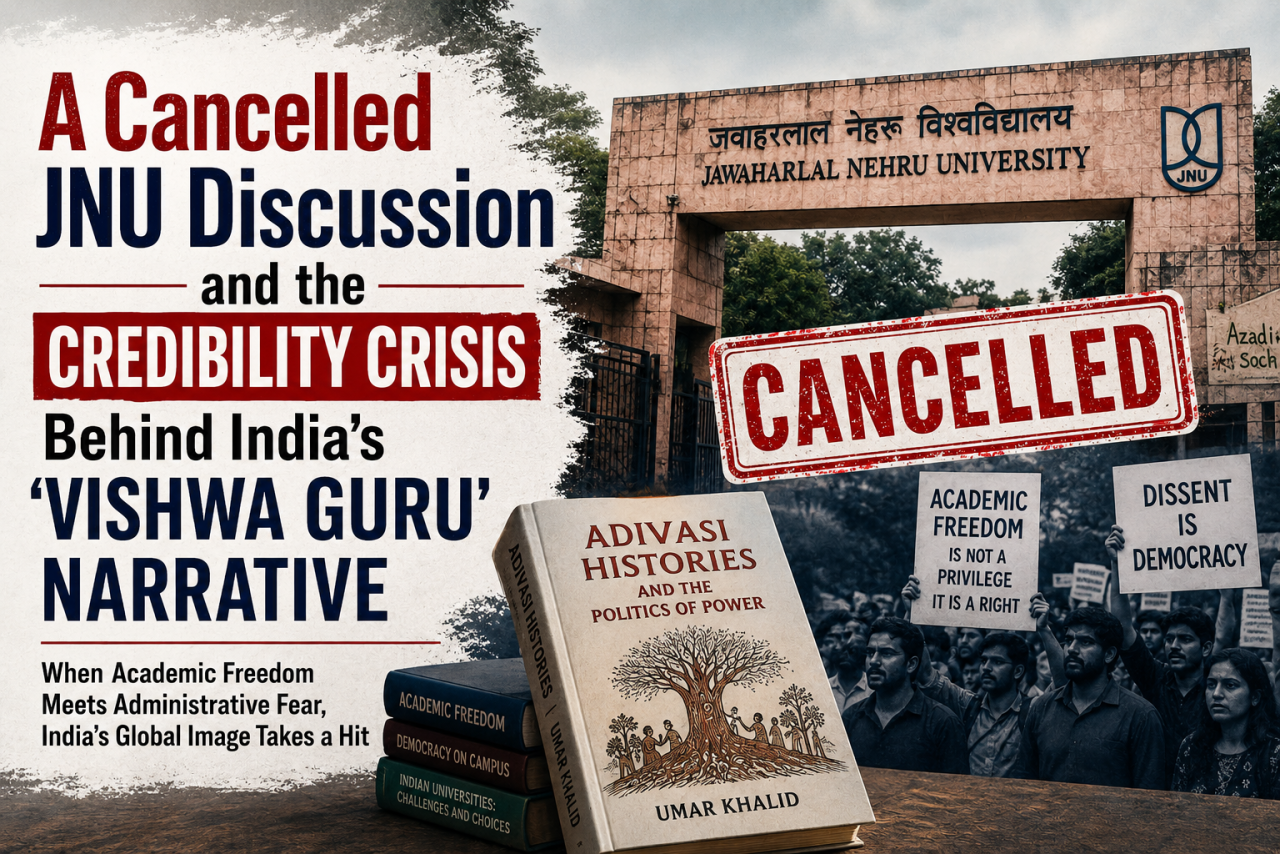
A cancelled JNU discussion over Adivasi history has reopened a bigger question: can India claim the mantle of ‘Vishwa Guru’ while its universities struggle with the boundaries of academic freedom?
On World Adivasi Day, a discussion on a book about Adivasi histories was supposed to take place inside Jawaharlal Nehru University's School of Social Sciences. It did not.
On Sunday, the university withdrew permission for the August 10 event built around Adivasi Histories and the Politics of Power, a book by former JNU student Umar Khalid, citing incomplete disclosure of details about the programme. The JNU Students' Union pushed the discussion outside the building rather than cancelling it altogether.
The episode might have remained a routine campus dispute. Instead, it has become a small but pointed test of a much larger claim India’s government has spent the last decade building: that the country is emerging as a Vishwa Guru, a world teacher whose institutions, ideas and civilisational experience deserve global emulation.
That branding exercise rests heavily on the credibility of Indian universities, publishing and public debate. A government cannot credibly market India abroad as a knowledge hub while a discussion of a scholarly book, however contentious its author, is stopped hours before it is due to begin.
The optics matter because they go directly to the credibility of the Vishwa Guru narrative.
For years, Indian diplomacy has invoked the country's civilisational depth and its status as the world's largest democracy as evidence that India is capable of helping shape global norms rather than merely following them. Episodes like this one complicate that pitch because they invite an obvious question: what kind of intellectual openness should a genuine knowledge leader model?
The University's Defence
To be fair to the university's position, the objection was not framed as ideological censorship.
JNU's statement described the university as a democratic and decentralised institution and said the school's dean, who had originally cleared the booking, later reversed that decision because the organisers had not disclosed the full details of the programme.
The ABVP's campus unit went further, arguing that a university platform should not be used to elevate someone facing prosecution under anti-terror law. The reference was to the Unlawful Activities (Prevention) Act case in which Khalid has been in custody since 2020 in connection with the 2020 Delhi riots.
Framed this way, the cancellation can be read less as outright censorship and more as an institution asserting administrative control over what takes place on its premises while objecting to the public platforming of an undertrial facing serious charges.
Both are defensible institutional positions on their own terms.
A university must have rules governing the use of its spaces. Organisers can reasonably be expected to provide complete information about events. Institutions can also legitimately consider whether their platforms are being used in ways that conflict with established regulations.
But the circumstances of this particular cancellation raise a more difficult question.
Where Administration Meets Academic Freedom
The JNUSU's response points directly towards that question.
The union called the decision arbitrary and authoritarian. What makes the episode resonate beyond campus politics is not simply that permission was withdrawn, but that the reversal reportedly came less than a day before the event, which was centred on a scholarly discussion rather than a political rally.
Adivasi history is not, on its face, an incendiary subject.
If the university's discomfort was primarily with the author rather than the programme's paperwork, that distinction matters. India's global messaging cannot afford to blur the difference between regulating an event and preventing a particular intellectual voice from being heard.
A country cannot simultaneously claim the mantle of intellectual leadership and suggest that an author's identity or legal status alone should determine whether a scholarly discussion can take place.
This does not require overlooking the allegations against Khalid or prejudging the legal case against him. Nor does it require treating an undertrial as though the charges against him do not exist.
It requires recognising an equally important principle: undertrial status is not, in law, equivalent to guilt.
A university's discomfort with a person is also not necessarily the same thing as a university's discomfort with an idea.
That distinction becomes especially important inside institutions whose purpose is to encourage inquiry, debate and the testing of competing arguments.
JNU's Larger Image Problem
This is not the first time JNU has found itself at precisely this intersection.
The university has repeatedly become a site where India's competing self-images collide: the storied public institution that has produced generations of scholars, academics, diplomats and policymakers, and the political flashpoint that recurring controversies have made synonymous with campus protests, sedition debates and government crackdowns.
Both images exist.
The problem is that every time the second one dominates the headlines, it complicates the diplomatic and intellectual capital represented by the first.
For a country trying to establish itself as a global centre of knowledge, education and innovation, universities are not peripheral institutions. They are part of the country's soft power.
India's global influence is built not only through economic growth, diplomatic summits, technological achievements or cultural exports. It is also shaped by what happens inside classrooms, libraries, seminar halls and public universities.
That is why a cancelled discussion over a book can acquire significance beyond the walls of a campus.
Soft power is not manufactured by slogans or summits alone. It is built through institutions that demonstrate confidence in their own intellectual foundations.
The Cost of the Credibility Gap
There is an uncomfortable irony here.
The Vishwa Guru idea is ultimately an argument about India's ability to contribute knowledge, ideas and civilisational perspectives to the world. But intellectual authority cannot be commanded. It has to be earned.
And intellectual authority becomes stronger, not weaker, when institutions are confident enough to allow difficult ideas to be challenged in public.
The question, therefore, is not whether every controversial author deserves an institutional platform without conditions. Universities have rules, and those rules matter.
The more consequential question is whether those rules are applied consistently, transparently and proportionately.
If an event violates administrative requirements, the institution should be able to explain precisely what those requirements were and why the decision was necessary.
If the real concern is the presence of a particular speaker or author, that should not be disguised as a paperwork dispute.
The distinction matters because credibility depends not only on what institutions decide, but also on whether observers believe the stated reasons for those decisions.
India Will Be Judged by Its Contradictions
None of this requires taking a position on Umar Khalid's guilt or innocence.
The legal process will determine that.
The larger issue is about the kind of intellectual environment India wants to project at home while presenting itself abroad as an emerging global knowledge power.
A country aspiring to become a Vishwa Guru will inevitably be judged by the way it handles disagreement.
It will be judged by whether universities can host uncomfortable conversations.
It will be judged by whether controversial ideas can be examined without being automatically treated as threats.
And it will be judged by whether institutions can distinguish between an argument they dislike and an argument they are institutionally required to suppress.
The JNU episode may eventually disappear from the headlines. But the question it raises is unlikely to disappear so easily.
India wants the world to see it not merely as a rising economic and geopolitical power, but as a source of ideas.
That ambition demands more than civilisational rhetoric.
It demands universities confident enough to let ideas compete, institutions transparent enough to explain their decisions and a public culture secure enough to tolerate disagreement.
A nation that wants to teach the world will inevitably be judged by what it allows its own universities to discuss.
That is where the distance between the Vishwa Guru pitch and institutional practice becomes impossible to ignore.
On World Adivasi Day, a discussion on a book about Adivasi histories was supposed to take place inside Jawaharlal Nehru University's School of Social Sciences. It did not.
On Sunday, the university withdrew permission for the August 10 event built around Adivasi Histories and the Politics of Power, a book by former JNU student Umar Khalid, citing incomplete disclosure of details about the programme. The JNU Students' Union pushed the discussion outside the building rather than cancelling it altogether.
The episode might have remained a routine campus dispute. Instead, it has become a small but pointed test of a much larger claim India’s government has spent the last decade building: that the country is emerging as a Vishwa Guru, a world teacher whose institutions, ideas and civilisational experience deserve global emulation.
That branding exercise rests heavily on the credibility of Indian universities, publishing and public debate. A government cannot credibly market India abroad as a knowledge hub while a discussion of a scholarly book, however contentious its author, is stopped hours before it is due to begin.
The optics matter because they go directly to the credibility of the Vishwa Guru narrative.
For years, Indian diplomacy has invoked the country's civilisational depth and its status as the world's largest democracy as evidence that India is capable of helping shape global norms rather than merely following them. Episodes like this one complicate that pitch because they invite an obvious question: what kind of intellectual openness should a genuine knowledge leader model?
The University's Defence
To be fair to the university's position, the objection was not framed as ideological censorship.
JNU's statement described the university as a democratic and decentralised institution and said the school's dean, who had originally cleared the booking, later reversed that decision because the organisers had not disclosed the full details of the programme.
The ABVP's campus unit went further, arguing that a university platform should not be used to elevate someone facing prosecution under anti-terror law. The reference was to the Unlawful Activities (Prevention) Act case in which Khalid has been in custody since 2020 in connection with the 2020 Delhi riots.
Framed this way, the cancellation can be read less as outright censorship and more as an institution asserting administrative control over what takes place on its premises while objecting to the public platforming of an undertrial facing serious charges.
Both are defensible institutional positions on their own terms.
A university must have rules governing the use of its spaces. Organisers can reasonably be expected to provide complete information about events. Institutions can also legitimately consider whether their platforms are being used in ways that conflict with established regulations.
But the circumstances of this particular cancellation raise a more difficult question.
Where Administration Meets Academic Freedom
The JNUSU's response points directly towards that question.
The union called the decision arbitrary and authoritarian. What makes the episode resonate beyond campus politics is not simply that permission was withdrawn, but that the reversal reportedly came less than a day before the event, which was centred on a scholarly discussion rather than a political rally.
Adivasi history is not, on its face, an incendiary subject.
If the university's discomfort was primarily with the author rather than the programme's paperwork, that distinction matters. India's global messaging cannot afford to blur the difference between regulating an event and preventing a particular intellectual voice from being heard.
A country cannot simultaneously claim the mantle of intellectual leadership and suggest that an author's identity or legal status alone should determine whether a scholarly discussion can take place.
This does not require overlooking the allegations against Khalid or prejudging the legal case against him. Nor does it require treating an undertrial as though the charges against him do not exist.
It requires recognising an equally important principle: undertrial status is not, in law, equivalent to guilt.
A university's discomfort with a person is also not necessarily the same thing as a university's discomfort with an idea.
That distinction becomes especially important inside institutions whose purpose is to encourage inquiry, debate and the testing of competing arguments.
JNU's Larger Image Problem
This is not the first time JNU has found itself at precisely this intersection.
The university has repeatedly become a site where India's competing self-images collide: the storied public institution that has produced generations of scholars, academics, diplomats and policymakers, and the political flashpoint that recurring controversies have made synonymous with campus protests, sedition debates and government crackdowns.
Both images exist.
The problem is that every time the second one dominates the headlines, it complicates the diplomatic and intellectual capital represented by the first.
For a country trying to establish itself as a global centre of knowledge, education and innovation, universities are not peripheral institutions. They are part of the country's soft power.
India's global influence is built not only through economic growth, diplomatic summits, technological achievements or cultural exports. It is also shaped by what happens inside classrooms, libraries, seminar halls and public universities.
That is why a cancelled discussion over a book can acquire significance beyond the walls of a campus.
Soft power is not manufactured by slogans or summits alone. It is built through institutions that demonstrate confidence in their own intellectual foundations.
The Cost of the Credibility Gap
There is an uncomfortable irony here.
The Vishwa Guru idea is ultimately an argument about India's ability to contribute knowledge, ideas and civilisational perspectives to the world. But intellectual authority cannot be commanded. It has to be earned.
And intellectual authority becomes stronger, not weaker, when institutions are confident enough to allow difficult ideas to be challenged in public.
The question, therefore, is not whether every controversial author deserves an institutional platform without conditions. Universities have rules, and those rules matter.
The more consequential question is whether those rules are applied consistently, transparently and proportionately.
If an event violates administrative requirements, the institution should be able to explain precisely what those requirements were and why the decision was necessary.
If the real concern is the presence of a particular speaker or author, that should not be disguised as a paperwork dispute.
The distinction matters because credibility depends not only on what institutions decide, but also on whether observers believe the stated reasons for those decisions.
India Will Be Judged by Its Contradictions
None of this requires taking a position on Umar Khalid's guilt or innocence.
The legal process will determine that.
The larger issue is about the kind of intellectual environment India wants to project at home while presenting itself abroad as an emerging global knowledge power.
A country aspiring to become a Vishwa Guru will inevitably be judged by the way it handles disagreement.
It will be judged by whether universities can host uncomfortable conversations.
It will be judged by whether controversial ideas can be examined without being automatically treated as threats.
And it will be judged by whether institutions can distinguish between an argument they dislike and an argument they are institutionally required to suppress.
The JNU episode may eventually disappear from the headlines. But the question it raises is unlikely to disappear so easily.
India wants the world to see it not merely as a rising economic and geopolitical power, but as a source of ideas.
That ambition demands more than civilisational rhetoric.
It demands universities confident enough to let ideas compete, institutions transparent enough to explain their decisions and a public culture secure enough to tolerate disagreement.
A nation that wants to teach the world will inevitably be judged by what it allows its own universities to discuss.
That is where the distance between the Vishwa Guru pitch and institutional practice becomes impossible to ignore.






















Leave a Comment