
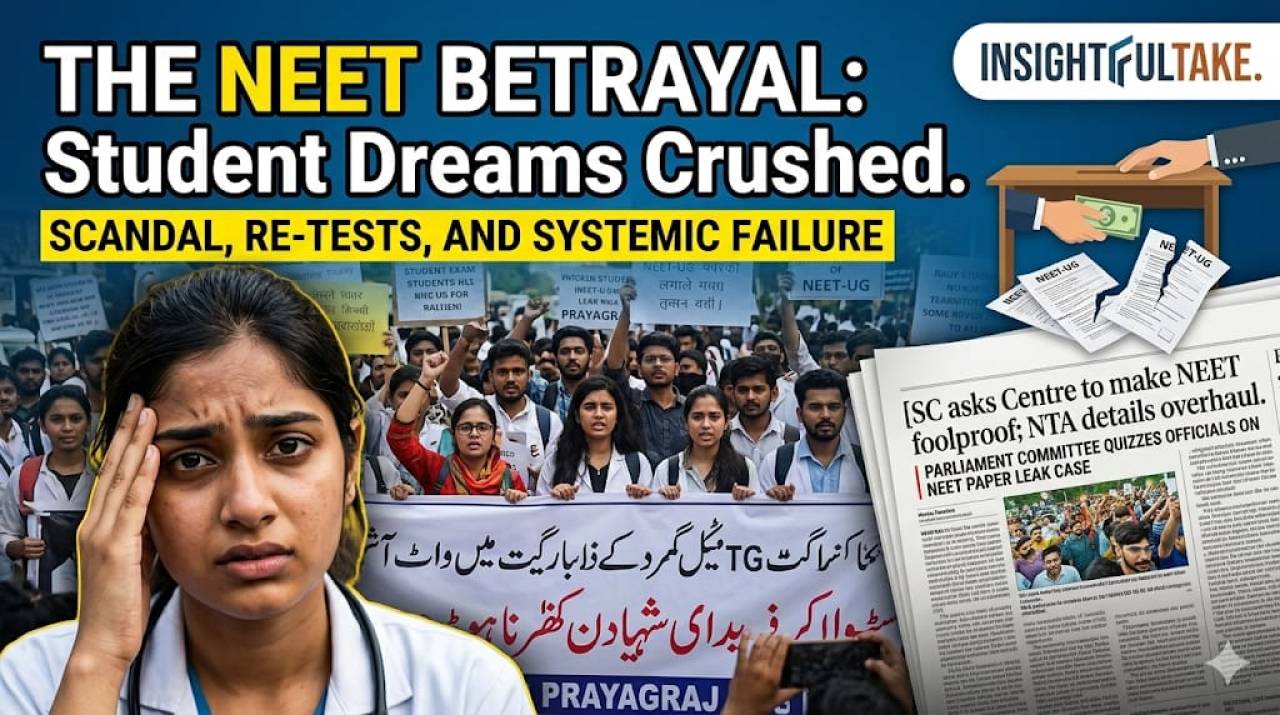
Years of preparation, a single exam—and one system failure that can erase it all. The NEET-UG controversy is forcing India to confront a deeper crisis in its examination framework.
For millions of medical aspirants across India, life narrows down to a single milestone—the NEET-UG examination. Years of adolescence are often spent inside cramped study rooms or high-pressure coaching institutes, where sleep, leisure, and mental peace are quietly sacrificed. Students endure this routine because of a deeply held belief that hard work leads to merit, and merit leads to a secure future.
That belief, however, is now under serious strain. The recent disruptions surrounding exam irregularities, especially allegations of paper leaks, have shaken confidence in the system that was meant to be fair and merit-based. For many students, the promise of equal opportunity now feels increasingly uncertain.
A Crisis That Goes Beyond the Exam Hall
The Supreme Court recently described the NEET-UG paper leak as “very traumatic for students and parents,” a remark that reflects the emotional weight carried by lakhs of families. For students, this is not just an administrative failure—it is a direct blow to years of preparation and personal sacrifice.
Behind every exam cycle lies an exhausting pattern: months of preparation, followed by an examination, and then repeated uncertainty due to reports of irregularities, cancellations, or potential re-tests. Parliamentary committees are currently examining senior officials from the Ministry of Education, testing agencies, and investigative bodies like the CBI over repeated security failures. Yet, for students waiting at the end of this chain, these discussions feel distant and disconnected from reality.
The impact is not only academic but deeply personal. Many candidates travel long distances from rural and semi-urban areas to reach examination centres in cities. For them, the announcement of a compromised exam means not just emotional distress but also wasted resources, disrupted schedules, and renewed uncertainty about the future.
Even when authorities promise compensation or waive re-examination fees, the damage has already been done. The anxiety of preparing again for a high-stakes test, knowing that the system itself may fail once more, is difficult to measure or repair.
The Question of Accountability
At the heart of the crisis lies a more troubling issue: accountability. Institutions responsible for conducting national-level examinations are often seen reacting to failures rather than preventing them. The Supreme Court has pointed to this pattern, suggesting that short-term fixes cannot replace structural reform.
In response to recurring leaks, authorities have proposed several measures, including AI-based surveillance systems, blockchain-secured question papers, and tighter digital controls. There is also ongoing discussion about shifting entirely from pen-and-paper examinations to computer-based testing.
While these technological solutions may improve security to some extent, they do not address the deeper issue. When confidential exam materials are compromised by individuals within the system—whether through negligence or corruption—the problem is not purely technical. It reflects a breakdown of institutional integrity.
Without fixing responsibility at identifiable levels, reforms risk becoming temporary patches rather than lasting solutions.
The Human Cost of a Broken System
What is often overlooked in policy discussions is the psychological impact on students. The pressure of competitive exams is already intense, and uncertainty only adds to the burden. Months of preparation can suddenly feel meaningless when an exam is questioned or rescheduled.
Students are not merely preparing for a test; they are navigating a system that directly shapes their careers, identities, and futures. Each disruption creates a cycle of stress, self-doubt, and emotional exhaustion.
Despite this, student welfare rarely becomes a central focus in reform debates. The conversation tends to revolve around technology, administration, and enforcement, while mental health concerns remain secondary.
A Need for Structural Reform
If India is to restore trust in its examination system, reforms must go beyond surface-level fixes. Strengthening oversight bodies, especially by including independent experts from reputed institutions, could help create a more accountable framework.
However, the most urgent demands from students remain straightforward.
First, transparency must be non-negotiable. Examination systems require clear, consistent protocols that do not change in response to each crisis.
Second, accountability must be strict and visible. Those responsible for breaches—whether individuals or institutions—must face consequences that deter future misconduct.
Finally, the mental health of students must be acknowledged as a serious concern. Counseling support systems and stress-management resources should be integrated into the education framework, especially for high-stakes examinations.
Final Take
Students are not statistics in a results sheet. They are individuals investing years of effort, discipline, and hope into a system they expect to be fair. When that system fails, the impact is not limited to marks or ranks—it affects trust itself.
Restoring that trust will require more than policy announcements. It will require consistent accountability, meaningful reform, and a recognition that at the center of every examination is a human life trying to move forward.
For millions of medical aspirants across India, life narrows down to a single milestone—the NEET-UG examination. Years of adolescence are often spent inside cramped study rooms or high-pressure coaching institutes, where sleep, leisure, and mental peace are quietly sacrificed. Students endure this routine because of a deeply held belief that hard work leads to merit, and merit leads to a secure future.
That belief, however, is now under serious strain. The recent disruptions surrounding exam irregularities, especially allegations of paper leaks, have shaken confidence in the system that was meant to be fair and merit-based. For many students, the promise of equal opportunity now feels increasingly uncertain.
A Crisis That Goes Beyond the Exam Hall
The Supreme Court recently described the NEET-UG paper leak as “very traumatic for students and parents,” a remark that reflects the emotional weight carried by lakhs of families. For students, this is not just an administrative failure—it is a direct blow to years of preparation and personal sacrifice.
Behind every exam cycle lies an exhausting pattern: months of preparation, followed by an examination, and then repeated uncertainty due to reports of irregularities, cancellations, or potential re-tests. Parliamentary committees are currently examining senior officials from the Ministry of Education, testing agencies, and investigative bodies like the CBI over repeated security failures. Yet, for students waiting at the end of this chain, these discussions feel distant and disconnected from reality.
The impact is not only academic but deeply personal. Many candidates travel long distances from rural and semi-urban areas to reach examination centres in cities. For them, the announcement of a compromised exam means not just emotional distress but also wasted resources, disrupted schedules, and renewed uncertainty about the future.
Even when authorities promise compensation or waive re-examination fees, the damage has already been done. The anxiety of preparing again for a high-stakes test, knowing that the system itself may fail once more, is difficult to measure or repair.
The Question of Accountability
At the heart of the crisis lies a more troubling issue: accountability. Institutions responsible for conducting national-level examinations are often seen reacting to failures rather than preventing them. The Supreme Court has pointed to this pattern, suggesting that short-term fixes cannot replace structural reform.
In response to recurring leaks, authorities have proposed several measures, including AI-based surveillance systems, blockchain-secured question papers, and tighter digital controls. There is also ongoing discussion about shifting entirely from pen-and-paper examinations to computer-based testing.
While these technological solutions may improve security to some extent, they do not address the deeper issue. When confidential exam materials are compromised by individuals within the system—whether through negligence or corruption—the problem is not purely technical. It reflects a breakdown of institutional integrity.
Without fixing responsibility at identifiable levels, reforms risk becoming temporary patches rather than lasting solutions.
The Human Cost of a Broken System
What is often overlooked in policy discussions is the psychological impact on students. The pressure of competitive exams is already intense, and uncertainty only adds to the burden. Months of preparation can suddenly feel meaningless when an exam is questioned or rescheduled.
Students are not merely preparing for a test; they are navigating a system that directly shapes their careers, identities, and futures. Each disruption creates a cycle of stress, self-doubt, and emotional exhaustion.
Despite this, student welfare rarely becomes a central focus in reform debates. The conversation tends to revolve around technology, administration, and enforcement, while mental health concerns remain secondary.
A Need for Structural Reform
If India is to restore trust in its examination system, reforms must go beyond surface-level fixes. Strengthening oversight bodies, especially by including independent experts from reputed institutions, could help create a more accountable framework.
However, the most urgent demands from students remain straightforward.
First, transparency must be non-negotiable. Examination systems require clear, consistent protocols that do not change in response to each crisis.
Second, accountability must be strict and visible. Those responsible for breaches—whether individuals or institutions—must face consequences that deter future misconduct.
Finally, the mental health of students must be acknowledged as a serious concern. Counseling support systems and stress-management resources should be integrated into the education framework, especially for high-stakes examinations.
Final Take
Students are not statistics in a results sheet. They are individuals investing years of effort, discipline, and hope into a system they expect to be fair. When that system fails, the impact is not limited to marks or ranks—it affects trust itself.
Restoring that trust will require more than policy announcements. It will require consistent accountability, meaningful reform, and a recognition that at the center of every examination is a human life trying to move forward.



























Leave a Comment