
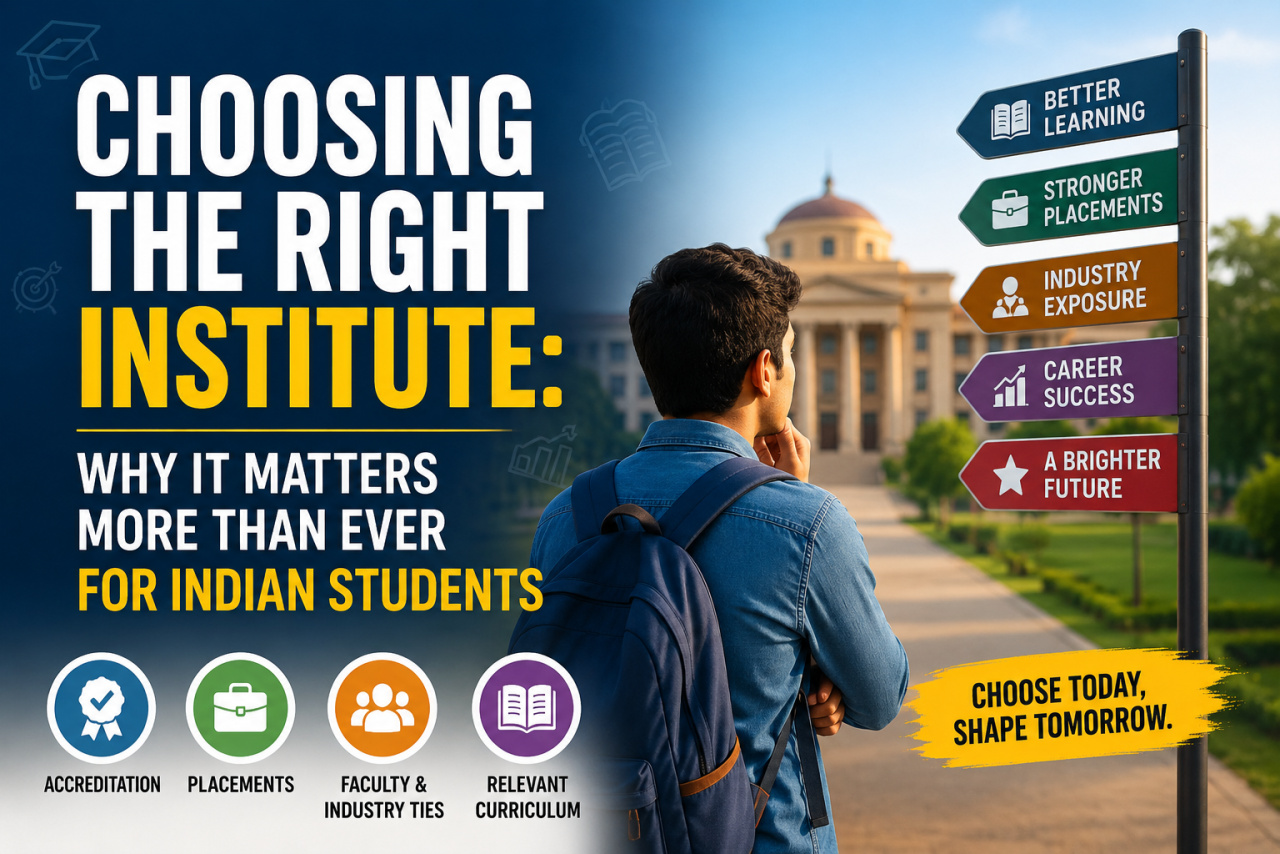
The degree you earn matters. The institute you earn it from may matter even more. As jobs become harder to secure and skills more valuable than credentials alone, choosing the right college has become a critical career decision.
Every year, lakhs of students across India complete their schooling and face one of the most important decisions of their lives: where to pursue higher education. For many families, the focus often remains on securing admission somewhere—anywhere—that offers a degree. But in today's rapidly changing job market, that approach is becoming increasingly risky.
The question is no longer simply "What should I study?" It is "Where should I study, and what outcomes can I realistically expect?"
As industries evolve under the influence of automation, artificial intelligence, and global economic uncertainty, the quality of an educational institution has become as important as the degree itself. Choosing the right institute can significantly influence employability, earning potential, and long-term career growth.
The Myth That Any Degree Guarantees a Job
For decades, a college degree was widely viewed as a reliable pathway to employment. The assumption was straightforward: earn a degree, enter the workforce, and build a stable career.
That formula is no longer guaranteed.
India produces more than a million engineering graduates every year, yet multiple industry reports have consistently highlighted concerns about graduate employability. Employers frequently point to skill gaps, limited practical exposure, and inadequate industry readiness among applicants.
The issue is rarely a lack of intelligence or ambition among students. More often, it stems from institutional factors—outdated curricula, weak industry engagement, insufficient practical training, and limited career support systems.
As a result, students pursuing the same degree can experience vastly different career outcomes depending on where they study.
What Makes an Institute Worth Choosing?
While no institution can guarantee success, certain indicators consistently distinguish institutes that deliver meaningful outcomes from those that merely award degrees.
Accreditation and Recognition
Accreditation should be the first checkpoint. Recognition from regulatory bodies such as the University Grants Commission (UGC), the All India Council for Technical Education (AICTE), or strong National Assessment and Accreditation Council (NAAC) ratings provides an important baseline of credibility.
Accreditation alone does not ensure quality, but it helps students avoid institutions operating without proper oversight or recognition.
Placement Transparency
One of the clearest signs of institutional confidence is transparency.
Reputable institutes typically publish verifiable placement data, including recruiter names, average salary packages, median compensation figures, and placement percentages. Students should be cautious of vague claims such as "100% placement assistance" that reveal little about actual employment outcomes.
A placement promise is not the same as a placement record.
Faculty Quality and Industry Connections
Strong academic programs are built around capable faculty and meaningful industry engagement.
Institutes that maintain active partnerships with companies, facilitate internships, host industry projects, and employ faculty with real-world experience often provide students with a more relevant and practical education. Such exposure helps bridge the gap between classroom learning and workplace expectations.
Curriculum Relevance
The modern economy changes rapidly, and educational programs must keep pace.
Students should examine whether a course curriculum reflects current industry requirements or whether it has remained largely unchanged for years. Subjects related to emerging technologies, digital skills, data analysis, communication, and problem-solving are increasingly valued across sectors.
An outdated syllabus can leave graduates competing in today's job market with yesterday's skills.
Looking Beyond the Marketing
The higher education sector has become intensely competitive, and institutions invest heavily in marketing.
Students and parents encounter sponsored social media campaigns, influencer endorsements, referral incentives, student ambassador programs, and carefully curated success stories. These strategies are not inherently problematic. Many reputable institutions use modern marketing techniques to reach prospective students.
However, effective marketing should never be confused with educational quality.
A polished advertisement cannot reveal what happens inside classrooms. It cannot measure faculty expertise, student satisfaction, or the strength of campus placements.
Before making a decision, students should verify accreditation independently, speak with alumni who were not selected by admissions teams, review independent feedback, and seek honest insights from current students. The goal is to distinguish promotional messaging from measurable outcomes.
Five Questions Every Student Should Ask
Before enrolling in any program, students should seek clear answers to the following questions:
- What percentage of graduates from this specific program secured relevant employment during the past two years?
- Is the institution's accreditation recognized and respected by employers in the chosen field?
- Can alumni be contacted independently for feedback about their experience?
- What is the total cost of education, and how does it compare with realistic entry-level salaries?
- Does the curriculum align with the skills employers are currently seeking?
The quality of the answers often reveals more than the institution's promotional material ever could.
Final Take
India's employment landscape is undergoing significant transformation. Artificial intelligence, automation, changing business models, and global economic fluctuations are reshaping workforce requirements across industries.
In such an environment, the safest investment is not necessarily the most heavily advertised institute or the one with the most recognizable brand. It is the institution that can demonstrate, with evidence, that its graduates are acquiring relevant skills and successfully building careers.
Higher education is one of the largest financial commitments many families will make. Treating the decision as a strategic investment rather than a routine academic step is becoming essential.
Students who conduct thorough research before enrolling are far more likely to avoid disappointment, excessive debt, and underemployment later. In a job market defined by uncertainty, due diligence is no longer optional—it is one of the most valuable skills a student can develop before classes even begin.
Every year, lakhs of students across India complete their schooling and face one of the most important decisions of their lives: where to pursue higher education. For many families, the focus often remains on securing admission somewhere—anywhere—that offers a degree. But in today's rapidly changing job market, that approach is becoming increasingly risky.
The question is no longer simply "What should I study?" It is "Where should I study, and what outcomes can I realistically expect?"
As industries evolve under the influence of automation, artificial intelligence, and global economic uncertainty, the quality of an educational institution has become as important as the degree itself. Choosing the right institute can significantly influence employability, earning potential, and long-term career growth.
The Myth That Any Degree Guarantees a Job
For decades, a college degree was widely viewed as a reliable pathway to employment. The assumption was straightforward: earn a degree, enter the workforce, and build a stable career.
That formula is no longer guaranteed.
India produces more than a million engineering graduates every year, yet multiple industry reports have consistently highlighted concerns about graduate employability. Employers frequently point to skill gaps, limited practical exposure, and inadequate industry readiness among applicants.
The issue is rarely a lack of intelligence or ambition among students. More often, it stems from institutional factors—outdated curricula, weak industry engagement, insufficient practical training, and limited career support systems.
As a result, students pursuing the same degree can experience vastly different career outcomes depending on where they study.
What Makes an Institute Worth Choosing?
While no institution can guarantee success, certain indicators consistently distinguish institutes that deliver meaningful outcomes from those that merely award degrees.
Accreditation and Recognition
Accreditation should be the first checkpoint. Recognition from regulatory bodies such as the University Grants Commission (UGC), the All India Council for Technical Education (AICTE), or strong National Assessment and Accreditation Council (NAAC) ratings provides an important baseline of credibility.
Accreditation alone does not ensure quality, but it helps students avoid institutions operating without proper oversight or recognition.
Placement Transparency
One of the clearest signs of institutional confidence is transparency.
Reputable institutes typically publish verifiable placement data, including recruiter names, average salary packages, median compensation figures, and placement percentages. Students should be cautious of vague claims such as "100% placement assistance" that reveal little about actual employment outcomes.
A placement promise is not the same as a placement record.
Faculty Quality and Industry Connections
Strong academic programs are built around capable faculty and meaningful industry engagement.
Institutes that maintain active partnerships with companies, facilitate internships, host industry projects, and employ faculty with real-world experience often provide students with a more relevant and practical education. Such exposure helps bridge the gap between classroom learning and workplace expectations.
Curriculum Relevance
The modern economy changes rapidly, and educational programs must keep pace.
Students should examine whether a course curriculum reflects current industry requirements or whether it has remained largely unchanged for years. Subjects related to emerging technologies, digital skills, data analysis, communication, and problem-solving are increasingly valued across sectors.
An outdated syllabus can leave graduates competing in today's job market with yesterday's skills.
Looking Beyond the Marketing
The higher education sector has become intensely competitive, and institutions invest heavily in marketing.
Students and parents encounter sponsored social media campaigns, influencer endorsements, referral incentives, student ambassador programs, and carefully curated success stories. These strategies are not inherently problematic. Many reputable institutions use modern marketing techniques to reach prospective students.
However, effective marketing should never be confused with educational quality.
A polished advertisement cannot reveal what happens inside classrooms. It cannot measure faculty expertise, student satisfaction, or the strength of campus placements.
Before making a decision, students should verify accreditation independently, speak with alumni who were not selected by admissions teams, review independent feedback, and seek honest insights from current students. The goal is to distinguish promotional messaging from measurable outcomes.
Five Questions Every Student Should Ask
Before enrolling in any program, students should seek clear answers to the following questions:
- What percentage of graduates from this specific program secured relevant employment during the past two years?
- Is the institution's accreditation recognized and respected by employers in the chosen field?
- Can alumni be contacted independently for feedback about their experience?
- What is the total cost of education, and how does it compare with realistic entry-level salaries?
- Does the curriculum align with the skills employers are currently seeking?
The quality of the answers often reveals more than the institution's promotional material ever could.
Final Take
India's employment landscape is undergoing significant transformation. Artificial intelligence, automation, changing business models, and global economic fluctuations are reshaping workforce requirements across industries.
In such an environment, the safest investment is not necessarily the most heavily advertised institute or the one with the most recognizable brand. It is the institution that can demonstrate, with evidence, that its graduates are acquiring relevant skills and successfully building careers.
Higher education is one of the largest financial commitments many families will make. Treating the decision as a strategic investment rather than a routine academic step is becoming essential.
Students who conduct thorough research before enrolling are far more likely to avoid disappointment, excessive debt, and underemployment later. In a job market defined by uncertainty, due diligence is no longer optional—it is one of the most valuable skills a student can develop before classes even begin.

















Leave a Comment