
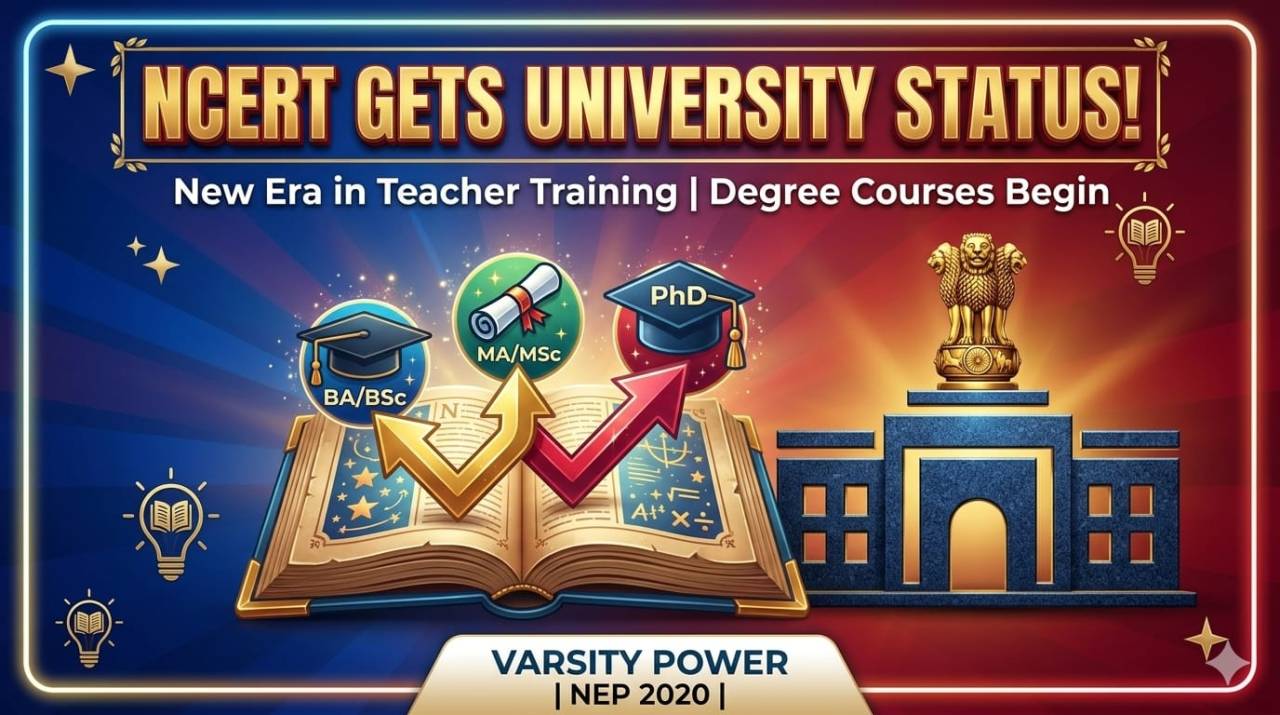
From textbooks to transforming education—NCERT’s new university status could redefine how India learns, teaches, and innovates.
The Indian education system is currently undergoing a massive transformation, and a recent announcement has sent waves of excitement through schools and colleges across the country. The National Council of Educational Research and Training (NCERT), an organization every Indian student is familiar with, has officially been granted the status of a "Deemed to be University" under a "distinct category."
This isn't just a change in title; it is a monumental shift that will redefine how teachers are trained and how research is conducted in our country. For a Class 12 student standing at the crossroads of school and higher education, understanding this development is essential, as it directly impacts the future of learning in India.
What Does "Deemed University" Status Actually Mean?
For decades, NCERT has been the backbone of Indian schooling. It is the body responsible for designing our curriculum and writing the textbooks we use for board exams. However, despite its vast influence, NCERT was primarily an advisory and research body. It could design courses, but it couldn't independently award degrees.
By becoming a Deemed University, NCERT now gains academic autonomy. This means it can now:
- Design its own specialized degree programs.
- Conduct its own examinations.
- Award its own Undergraduate (UG), Postgraduate (PG), and Doctoral (PhD) degrees.
The "distinct category" tag is particularly special. It recognizes that NCERT isn’t just another "conventional" university; it has a unique, specialized role in national education that sets it apart from others.
The Impact on Teacher Education and the NEP 2020
This move is a direct result of the National Education Policy 2020 (NEP 2020), which emphasizes the need for high-quality teacher training. In the past, NCERT’s Regional Institutes of Education (RIEs)—located in places like Ajmer, Bhopal, Bhubaneswar, Mysuru, and Shillong—had to affiliate with local state universities to offer courses. This often led to delays and bureaucratic hurdles when trying to introduce new, innovative programs.
Now, with university status, NCERT can independently launch cutting-edge teacher training programs. This is crucial because the quality of an education system can never exceed the quality of its teachers. By training the "teachers of tomorrow" through its own rigorous and research-based programs, NCERT ensures that the classrooms of the future are led by highly skilled professionals.
Expanding Horizons: Beyond Textbooks
While NCERT will continue its "core role" of developing school curricula, its new status allows it to expand its reach. The notification mentions that NCERT can now establish off-campus and offshore centers. This means that NCERT’s expertise in education could eventually reach students and educators globally, putting India on the map as a hub for educational research and training.
Furthermore, the inclusion of the Pandit Sunderlal Sharma Central Institute of Vocational Education in Bhopal under this status highlights a focus on vocational training. In a world where skills are just as important as degrees, this will help bridge the gap between academic knowledge and practical employment.
Why Should Students Care?
You might wonder, "How does this affect me?" The answer lies in the quality and consistency of education.
- Innovation: NCERT can now experiment with new teaching methods and quickly turn them into degree courses.
- Research-Driven Learning: With more doctoral and research programs, the textbooks and methods we use will be backed by even more robust, local research.
- Integrity: The ministry has clearly stated that NCERT must remain a non-profit entity. This ensures that the focus remains entirely on "educational excellence" rather than commercial gain.
Final Take
The granting of university status to NCERT is a visionary step. It marks the evolution of an institution from a "book-maker" to a "knowledge-creator." For the Indian education system, this means more autonomy, better-trained teachers, and a curriculum that is constantly evolving through high-level research.
As we move toward a future shaped by the NEP 2020, NCERT’s new identity as a varsity will likely be remembered as the moment India’s educational foundation became stronger, more independent, and ready to face global challenges. For every student, teacher, and parent, this is a milestone worth celebrating.

























Leave a Comment