
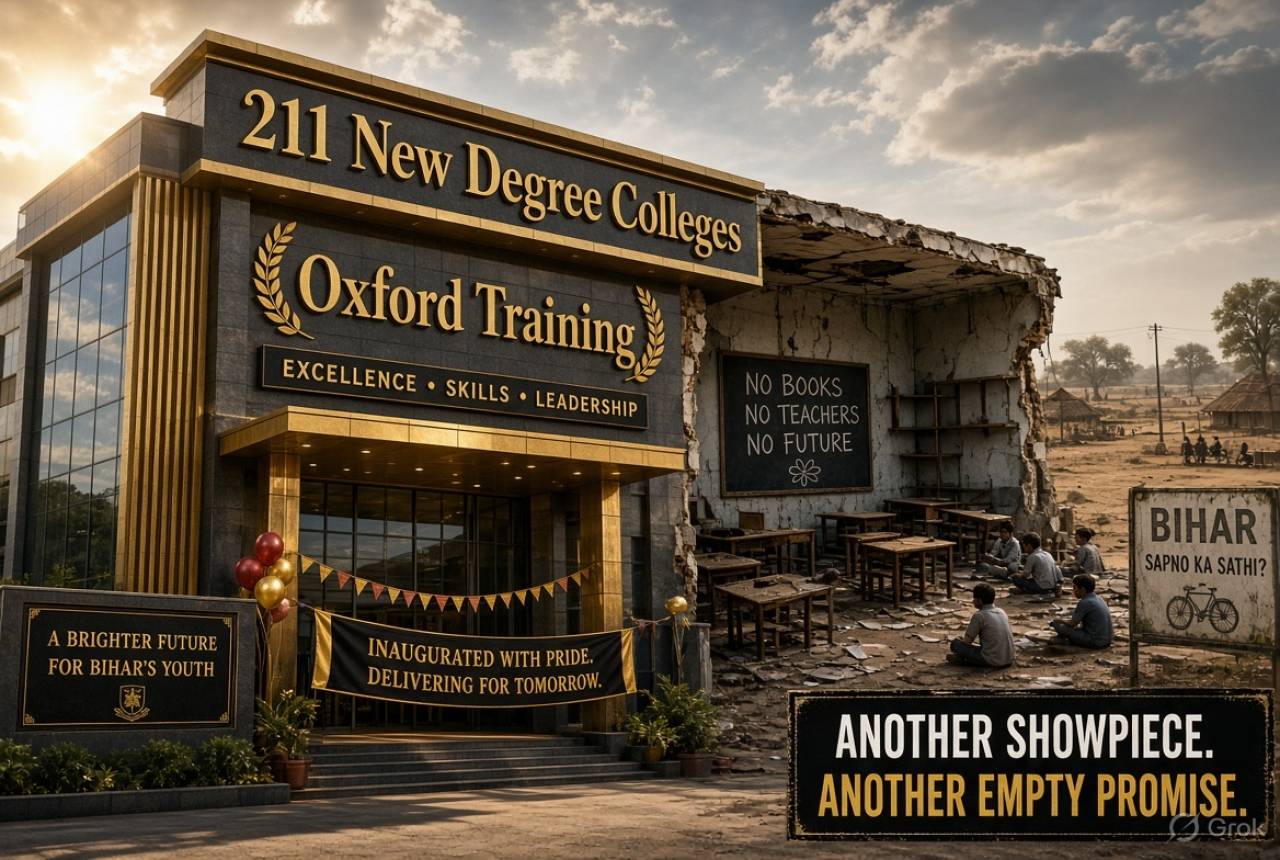
Bihar can open 211 colleges in a day, but building institutions that actually deliver quality education will take far longer.
Bihar has opened 211 government degree colleges in a single day and announced plans to send 100 professors to Oxford and other leading international institutions for training. The scale is impressive. The more important question is whether the state can turn this expansion into functioning institutions that deliver quality higher education.
On July 15, Bihar launched academic operations in 211 new government degree colleges, many of them in blocks that previously did not have a degree college. The government has presented the move as a major step towards taking higher education closer to rural students, particularly women who may otherwise have to travel long distances.
The initiative comes under the “Unnat Shiksha, Ujjwal Bhavishya” component of Saat Nischay-3. The first academic session began with six subjects: Hindi, English, History, Economics, Political Science and Sociology. The government has also appointed 2,451 assistant professors for the new institutions.
In September, Chief Minister Samrat Choudhary announced another ambitious measure. The state plans to identify 100 professors for training and orientation at Oxford and other reputed international institutions. The announcement was made at an orientation programme for the 2,451 newly appointed assistant professors.
Taken together, the announcements create an image of rapid expansion and global ambition.
But higher education cannot be built through numbers and announcements alone.
The First Reality Check Came Quickly
Within days of the July launch, ground reports from Purnia, Muzaffarpur, Saran, Siwan and Gopalganj raised questions about the readiness of several new colleges.
India Today reported that many institutions were operating from temporary premises, including existing schools, intermediate colleges and other government buildings. In some locations, permanent campuses were yet to be developed. Libraries existed without adequate books, while furniture and other basic infrastructure remained incomplete.
That exposes the central contradiction in the entire exercise.
Opening a college is an administrative act. Running a college is an academic responsibility.
A college needs classrooms, libraries, laboratories where required, digital resources, stable faculty, administrative staff and academic leadership. It also needs students who attend regularly and teachers who have the time and institutional support to teach, mentor and conduct research.
Without these elements, a college can exist administratively without functioning as a meaningful centre of higher learning.
The government has itself acknowledged the need for contractual appointments and additional arrangements for the new colleges. Earlier reporting had also identified teacher availability and infrastructure readiness as challenges in meeting the original July 1 target.
Access Is Necessary. But Access Alone Is Not Enough
There is an undeniable value in taking degree education closer to students.
For a student in a rural block, the absence of a nearby college can mean higher travel costs, accommodation expenses and, in many families, a decision to abandon higher education altogether. The expansion of colleges can therefore address a genuine access problem.
That part of the policy deserves attention.
But access and quality are two different questions.
A student may now have a college within a few kilometres of home. The next question is whether that college has enough teachers, books, classrooms and academic resources to provide the education promised by a university degree.
This is where Bihar's expansion needs measurable benchmarks rather than ceremonial milestones.
The number of colleges opened is easy to count. The number of students who actually learn, graduate with useful skills, publish meaningful research or secure better employment is much harder to measure.
That is precisely why it matters more.
Oxford Cannot Substitute for Institutional Reform
The proposed overseas training programme for 100 professors is not inherently problematic. Exposure to international teaching methods, research practices and academic institutions can be useful for faculty members.
But its value will ultimately depend on what happens after those teachers return.
If the selected professors are able to bring new teaching methods into their departments, develop research collaborations, mentor colleagues and improve classroom practices, the programme could have a wider institutional impact.
If it remains limited to a small group of faculty members receiving short-term international exposure, its systemic effect will naturally be limited.
Bihar has more than a thousand degree colleges, according to the government's own account cited in recent reports. Against that scale, a batch of 100 teachers is necessarily small.
The real test, therefore, is whether the government creates a mechanism through which the knowledge gained abroad reaches thousands of teachers and millions of students.
An Oxford visit is an opportunity. It is not an education reform by itself.
The Bigger Problem Is the Academic Ecosystem
Bihar's higher education challenge goes beyond the 211 new colleges.
Universities and colleges need sustained academic leadership, transparent recruitment, regular classes, functioning libraries, research opportunities, updated curricula and credible systems of assessment. Faculty development has to be continuous rather than event-based.
Even the recruitment system is currently under review. The Bihar government has recently constituted a high-level committee to examine the structure and process for recruiting assistant professors in state universities, including questions around eligibility, examinations, interviews and the role of guest lecturers.
That makes the broader issue impossible to ignore.
Teacher recruitment, teacher training, infrastructure and academic accountability are interconnected. Addressing one while leaving the others weak will not transform the system.
The government has also highlighted education as a major budget priority, with the chief minister saying that around 21 per cent of the state budget is allocated to education.
That scale of public spending makes outcome-based evaluation even more important.
What Should Success Look Like?
The success of the 211 colleges should not ultimately be judged by the number of inauguration ceremonies.
It should be judged by whether, over the next few years:
- permanent campuses become operational
- classrooms and libraries are properly equipped
- adequate permanent faculty are available
- students attend classes regularly
- curricula become more relevant and research-oriented
- colleges develop credible academic cultures
- research output improves
- accreditation standards improve
- graduates demonstrate stronger employment and higher-education outcomes
These are slower achievements, but they are the achievements that matter.
Bihar's ancient universities, Nalanda and Vikramshila, are frequently invoked whenever the state speaks about restoring its educational heritage. Their historical importance came from scholarship, debate, knowledge production and intellectual exchange.
That legacy cannot be recreated through the speed of inauguration.
Bihar Needs Colleges That Work, Not Just Colleges That Exist
Opening 211 colleges in one day is a remarkable administrative exercise. Bringing higher education to previously underserved blocks can also address a genuine social need.
But the story should not end with the number 211.
The real story will be written in classrooms, libraries and laboratories over the next several years.
The Oxford proposal can contribute to that transformation if it becomes part of a wider faculty-development and research strategy. The new colleges can expand opportunity if temporary arrangements evolve into permanent, well-equipped institutions.
Bihar therefore faces a simple but demanding test: can it convert expansion into educational quality?
Quantity can be announced in a day. Quality takes years of investment, accountability and sustained academic work.
For Bihar's students, especially those in rural areas, the difference between the two is everything.
Bihar has opened 211 government degree colleges in a single day and announced plans to send 100 professors to Oxford and other leading international institutions for training. The scale is impressive. The more important question is whether the state can turn this expansion into functioning institutions that deliver quality higher education.
On July 15, Bihar launched academic operations in 211 new government degree colleges, many of them in blocks that previously did not have a degree college. The government has presented the move as a major step towards taking higher education closer to rural students, particularly women who may otherwise have to travel long distances.
The initiative comes under the “Unnat Shiksha, Ujjwal Bhavishya” component of Saat Nischay-3. The first academic session began with six subjects: Hindi, English, History, Economics, Political Science and Sociology. The government has also appointed 2,451 assistant professors for the new institutions.
In September, Chief Minister Samrat Choudhary announced another ambitious measure. The state plans to identify 100 professors for training and orientation at Oxford and other reputed international institutions. The announcement was made at an orientation programme for the 2,451 newly appointed assistant professors.
Taken together, the announcements create an image of rapid expansion and global ambition.
But higher education cannot be built through numbers and announcements alone.
The First Reality Check Came Quickly
Within days of the July launch, ground reports from Purnia, Muzaffarpur, Saran, Siwan and Gopalganj raised questions about the readiness of several new colleges.
India Today reported that many institutions were operating from temporary premises, including existing schools, intermediate colleges and other government buildings. In some locations, permanent campuses were yet to be developed. Libraries existed without adequate books, while furniture and other basic infrastructure remained incomplete.
That exposes the central contradiction in the entire exercise.
Opening a college is an administrative act. Running a college is an academic responsibility.
A college needs classrooms, libraries, laboratories where required, digital resources, stable faculty, administrative staff and academic leadership. It also needs students who attend regularly and teachers who have the time and institutional support to teach, mentor and conduct research.
Without these elements, a college can exist administratively without functioning as a meaningful centre of higher learning.
The government has itself acknowledged the need for contractual appointments and additional arrangements for the new colleges. Earlier reporting had also identified teacher availability and infrastructure readiness as challenges in meeting the original July 1 target.
Access Is Necessary. But Access Alone Is Not Enough
There is an undeniable value in taking degree education closer to students.
For a student in a rural block, the absence of a nearby college can mean higher travel costs, accommodation expenses and, in many families, a decision to abandon higher education altogether. The expansion of colleges can therefore address a genuine access problem.
That part of the policy deserves attention.
But access and quality are two different questions.
A student may now have a college within a few kilometres of home. The next question is whether that college has enough teachers, books, classrooms and academic resources to provide the education promised by a university degree.
This is where Bihar's expansion needs measurable benchmarks rather than ceremonial milestones.
The number of colleges opened is easy to count. The number of students who actually learn, graduate with useful skills, publish meaningful research or secure better employment is much harder to measure.
That is precisely why it matters more.
Oxford Cannot Substitute for Institutional Reform
The proposed overseas training programme for 100 professors is not inherently problematic. Exposure to international teaching methods, research practices and academic institutions can be useful for faculty members.
But its value will ultimately depend on what happens after those teachers return.
If the selected professors are able to bring new teaching methods into their departments, develop research collaborations, mentor colleagues and improve classroom practices, the programme could have a wider institutional impact.
If it remains limited to a small group of faculty members receiving short-term international exposure, its systemic effect will naturally be limited.
Bihar has more than a thousand degree colleges, according to the government's own account cited in recent reports. Against that scale, a batch of 100 teachers is necessarily small.
The real test, therefore, is whether the government creates a mechanism through which the knowledge gained abroad reaches thousands of teachers and millions of students.
An Oxford visit is an opportunity. It is not an education reform by itself.
The Bigger Problem Is the Academic Ecosystem
Bihar's higher education challenge goes beyond the 211 new colleges.
Universities and colleges need sustained academic leadership, transparent recruitment, regular classes, functioning libraries, research opportunities, updated curricula and credible systems of assessment. Faculty development has to be continuous rather than event-based.
Even the recruitment system is currently under review. The Bihar government has recently constituted a high-level committee to examine the structure and process for recruiting assistant professors in state universities, including questions around eligibility, examinations, interviews and the role of guest lecturers.
That makes the broader issue impossible to ignore.
Teacher recruitment, teacher training, infrastructure and academic accountability are interconnected. Addressing one while leaving the others weak will not transform the system.
The government has also highlighted education as a major budget priority, with the chief minister saying that around 21 per cent of the state budget is allocated to education.
That scale of public spending makes outcome-based evaluation even more important.
What Should Success Look Like?
The success of the 211 colleges should not ultimately be judged by the number of inauguration ceremonies.
It should be judged by whether, over the next few years:
- permanent campuses become operational
- classrooms and libraries are properly equipped
- adequate permanent faculty are available
- students attend classes regularly
- curricula become more relevant and research-oriented
- colleges develop credible academic cultures
- research output improves
- accreditation standards improve
- graduates demonstrate stronger employment and higher-education outcomes
These are slower achievements, but they are the achievements that matter.
Bihar's ancient universities, Nalanda and Vikramshila, are frequently invoked whenever the state speaks about restoring its educational heritage. Their historical importance came from scholarship, debate, knowledge production and intellectual exchange.
That legacy cannot be recreated through the speed of inauguration.
Bihar Needs Colleges That Work, Not Just Colleges That Exist
Opening 211 colleges in one day is a remarkable administrative exercise. Bringing higher education to previously underserved blocks can also address a genuine social need.
But the story should not end with the number 211.
The real story will be written in classrooms, libraries and laboratories over the next several years.
The Oxford proposal can contribute to that transformation if it becomes part of a wider faculty-development and research strategy. The new colleges can expand opportunity if temporary arrangements evolve into permanent, well-equipped institutions.
Bihar therefore faces a simple but demanding test: can it convert expansion into educational quality?
Quantity can be announced in a day. Quality takes years of investment, accountability and sustained academic work.
For Bihar's students, especially those in rural areas, the difference between the two is everything.






















Leave a Comment