
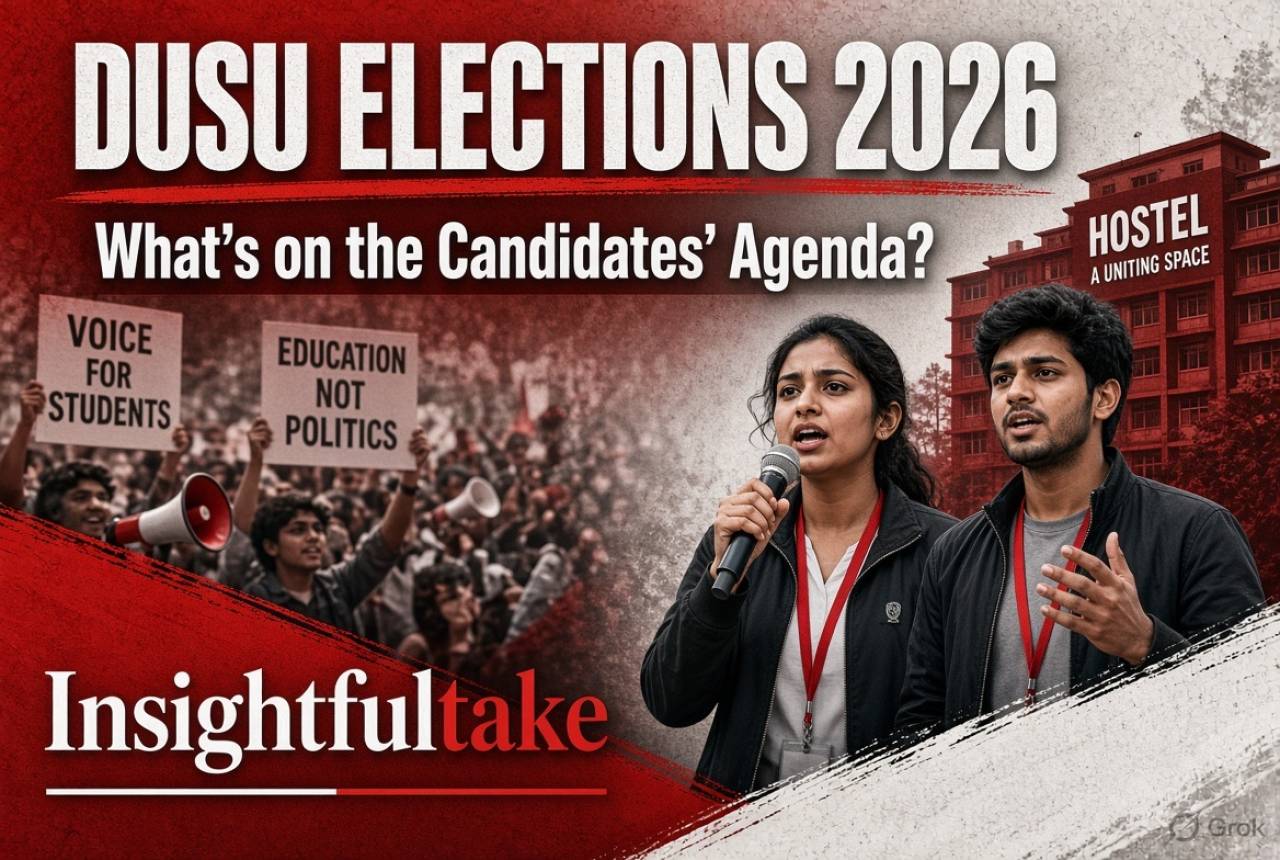
This year, DU’s presidential race is talking less about slogans and more about the problems students face every day.
Delhi University’s student body is gearing up for another high-stakes election season, with voting for the Delhi University Students’ Union scheduled for September 18. But this year, the campaign conversation has shifted noticeably away from the usual sloganeering and towards a subject that has become impossible to ignore: student housing and safety.
The shift did not happen in a vacuum. A recent paying-guest building collapse in Satya Niketan, one of the busiest student housing hubs near DU’s South Campus, has forced major candidates to address the fragile state of accommodation available to outstation students. Areas such as GTB Nagar, Kamla Nagar, Neb Sarai and Satya Niketan continue to house thousands of students who come to Delhi from other states. Many of these localities are dotted with poorly regulated PG buildings and rented flats operating with limited oversight.
Against this backdrop, leading presidential candidates have spoken about the need for more hostel seats within college campuses, along with stricter safety audits of private accommodation around the university.
Yash Dabas: A Listen-First Approach
Yash Dabas, the Akhil Bharatiya Vidyarthi Parishad’s nominee for president, is building his campaign around what he calls a listen-first approach to leadership.
A first-year MA student in Buddhist Studies at the Faculty of Arts, Dabas has spent much of his campaign visiting colleges and collecting written complaints from students. He says these responses have directly shaped his manifesto.
His pitch is straightforward: understand what students actually want before acting on their behalf, rather than assuming that elected representatives already know what is best for them.
Women’s safety on campus is another issue he has repeatedly highlighted. Dabas has promised to make DU’s existing safety mechanisms more proactive, particularly around late-night movement during festivals and cultural events.
Ananya Raturi: Safety Without Restrictions
Representing the joint candidacy of the All India Students’ Association and the Students’ Federation of India, Ananya Raturi has entered the race as the only female presidential contestant this year, a distinction she has openly emphasised.
A history graduate from Jesus and Mary College, Raturi argues that her candidacy itself represents a shift in a student political landscape that has long been dominated by male leadership.
Her core campaign message challenges an assumption she believes has gone unquestioned for too long: that keeping female students safe means restricting their movement rather than making the campus safer.
She has pointed to hostel curfews as an example of this approach. Her argument is that the university should improve the environment around students instead of limiting when they can leave their hostels or move around campus.
If elected, Raturi plans to bring female students together around common concerns so that issues of safety and representation can be pursued collectively rather than addressed in isolation.
From Ideology to Everyday Concerns
Taken together, this year’s campaign narratives point to a student body increasingly focused on tangible, everyday concerns rather than purely ideological battles.
Safe and affordable housing, meaningful representation for women, freedom from identity-based politics and basic digital infrastructure may not be glamorous campaign themes, but they reflect issues that students say directly affect their daily lives at the university.
Whether these promises translate into real change after the votes are counted remains to be seen. DUSU’s history includes many manifestos that quickly lose relevance once election season is over.
But the fact that a building collapse in a student housing colony has reshaped the tone of campus campaigning this year suggests that student politics at Delhi University may be responding, however slowly, to the ground realities students face.
With polling day approaching on September 18, the final decision rests with DU’s student electorate. The question is not only who wins the election, but which promises students believe are worth their vote.
DUSU Polls 2026: What Delhi University’s Presidential Hopefuls Are Really Promising Students
Delhi University’s student body is gearing up for another high-stakes election season, with voting for the Delhi University Students’ Union scheduled for September 18. But this year, the campaign conversation has shifted noticeably away from the usual sloganeering and towards a subject that has become impossible to ignore: student housing and safety.
The shift did not happen in a vacuum. A recent paying-guest building collapse in Satya Niketan, one of the busiest student housing hubs near DU’s South Campus, has forced major candidates to address the fragile state of accommodation available to outstation students. Areas such as GTB Nagar, Kamla Nagar, Neb Sarai and Satya Niketan continue to house thousands of students who come to Delhi from other states. Many of these localities are dotted with poorly regulated PG buildings and rented flats operating with limited oversight.
Against this backdrop, leading presidential candidates have spoken about the need for more hostel seats within college campuses, along with stricter safety audits of private accommodation around the university.
Yash Dabas: A Listen-First Approach
Yash Dabas, the Akhil Bharatiya Vidyarthi Parishad’s nominee for president, is building his campaign around what he calls a listen-first approach to leadership.
A first-year MA student in Buddhist Studies at the Faculty of Arts, Dabas has spent much of his campaign visiting colleges and collecting written complaints from students. He says these responses have directly shaped his manifesto.
His pitch is straightforward: understand what students actually want before acting on their behalf, rather than assuming that elected representatives already know what is best for them.
Women’s safety on campus is another issue he has repeatedly highlighted. Dabas has promised to make DU’s existing safety mechanisms more proactive, particularly around late-night movement during festivals and cultural events.
Ananya Raturi: Safety Without Restrictions
Representing the joint candidacy of the All India Students’ Association and the Students’ Federation of India, Ananya Raturi has entered the race as the only female presidential contestant this year, a distinction she has openly emphasised.
A history graduate from Jesus and Mary College, Raturi argues that her candidacy itself represents a shift in a student political landscape that has long been dominated by male leadership.
Her core campaign message challenges an assumption she believes has gone unquestioned for too long: that keeping female students safe means restricting their movement rather than making the campus safer.
She has pointed to hostel curfews as an example of this approach. Her argument is that the university should improve the environment around students instead of limiting when they can leave their hostels or move around campus.
If elected, Raturi plans to bring female students together around common concerns so that issues of safety and representation can be pursued collectively rather than addressed in isolation.
From Ideology to Everyday Concerns
Taken together, this year’s campaign narratives point to a student body increasingly focused on tangible, everyday concerns rather than purely ideological battles.
Safe and affordable housing, meaningful representation for women, freedom from identity-based politics and basic digital infrastructure may not be glamorous campaign themes, but they reflect issues that students say directly affect their daily lives at the university.
Whether these promises translate into real change after the votes are counted remains to be seen. DUSU’s history includes many manifestos that quickly lose relevance once election season is over.
But the fact that a building collapse in a student housing colony has reshaped the tone of campus campaigning this year suggests that student politics at Delhi University may be responding, however slowly, to the ground realities students face.
With polling day approaching on September 18, the final decision rests with DU’s student electorate. The question is not only who wins the election, but which promises students believe are worth their vote.
Delhi University’s student body is gearing up for another high-stakes election season, with voting for the Delhi University Students’ Union scheduled for September 18. But this year, the campaign conversation has shifted noticeably away from the usual sloganeering and towards a subject that has become impossible to ignore: student housing and safety.
The shift did not happen in a vacuum. A recent paying-guest building collapse in Satya Niketan, one of the busiest student housing hubs near DU’s South Campus, has forced major candidates to address the fragile state of accommodation available to outstation students. Areas such as GTB Nagar, Kamla Nagar, Neb Sarai and Satya Niketan continue to house thousands of students who come to Delhi from other states. Many of these localities are dotted with poorly regulated PG buildings and rented flats operating with limited oversight.
Against this backdrop, leading presidential candidates have spoken about the need for more hostel seats within college campuses, along with stricter safety audits of private accommodation around the university.
Yash Dabas: A Listen-First Approach
Yash Dabas, the Akhil Bharatiya Vidyarthi Parishad’s nominee for president, is building his campaign around what he calls a listen-first approach to leadership.
A first-year MA student in Buddhist Studies at the Faculty of Arts, Dabas has spent much of his campaign visiting colleges and collecting written complaints from students. He says these responses have directly shaped his manifesto.
His pitch is straightforward: understand what students actually want before acting on their behalf, rather than assuming that elected representatives already know what is best for them.
Women’s safety on campus is another issue he has repeatedly highlighted. Dabas has promised to make DU’s existing safety mechanisms more proactive, particularly around late-night movement during festivals and cultural events.
Ananya Raturi: Safety Without Restrictions
Representing the joint candidacy of the All India Students’ Association and the Students’ Federation of India, Ananya Raturi has entered the race as the only female presidential contestant this year, a distinction she has openly emphasised.
A history graduate from Jesus and Mary College, Raturi argues that her candidacy itself represents a shift in a student political landscape that has long been dominated by male leadership.
Her core campaign message challenges an assumption she believes has gone unquestioned for too long: that keeping female students safe means restricting their movement rather than making the campus safer.
She has pointed to hostel curfews as an example of this approach. Her argument is that the university should improve the environment around students instead of limiting when they can leave their hostels or move around campus.
If elected, Raturi plans to bring female students together around common concerns so that issues of safety and representation can be pursued collectively rather than addressed in isolation.
From Ideology to Everyday Concerns
Taken together, this year’s campaign narratives point to a student body increasingly focused on tangible, everyday concerns rather than purely ideological battles.
Safe and affordable housing, meaningful representation for women, freedom from identity-based politics and basic digital infrastructure may not be glamorous campaign themes, but they reflect issues that students say directly affect their daily lives at the university.
Whether these promises translate into real change after the votes are counted remains to be seen. DUSU’s history includes many manifestos that quickly lose relevance once election season is over.
But the fact that a building collapse in a student housing colony has reshaped the tone of campus campaigning this year suggests that student politics at Delhi University may be responding, however slowly, to the ground realities students face.
With polling day approaching on September 18, the final decision rests with DU’s student electorate. The question is not only who wins the election, but which promises students believe are worth their vote.
DUSU Polls 2026: What Delhi University’s Presidential Hopefuls Are Really Promising Students
Delhi University’s student body is gearing up for another high-stakes election season, with voting for the Delhi University Students’ Union scheduled for September 18. But this year, the campaign conversation has shifted noticeably away from the usual sloganeering and towards a subject that has become impossible to ignore: student housing and safety.
The shift did not happen in a vacuum. A recent paying-guest building collapse in Satya Niketan, one of the busiest student housing hubs near DU’s South Campus, has forced major candidates to address the fragile state of accommodation available to outstation students. Areas such as GTB Nagar, Kamla Nagar, Neb Sarai and Satya Niketan continue to house thousands of students who come to Delhi from other states. Many of these localities are dotted with poorly regulated PG buildings and rented flats operating with limited oversight.
Against this backdrop, leading presidential candidates have spoken about the need for more hostel seats within college campuses, along with stricter safety audits of private accommodation around the university.
Yash Dabas: A Listen-First Approach
Yash Dabas, the Akhil Bharatiya Vidyarthi Parishad’s nominee for president, is building his campaign around what he calls a listen-first approach to leadership.
A first-year MA student in Buddhist Studies at the Faculty of Arts, Dabas has spent much of his campaign visiting colleges and collecting written complaints from students. He says these responses have directly shaped his manifesto.
His pitch is straightforward: understand what students actually want before acting on their behalf, rather than assuming that elected representatives already know what is best for them.
Women’s safety on campus is another issue he has repeatedly highlighted. Dabas has promised to make DU’s existing safety mechanisms more proactive, particularly around late-night movement during festivals and cultural events.
Ananya Raturi: Safety Without Restrictions
Representing the joint candidacy of the All India Students’ Association and the Students’ Federation of India, Ananya Raturi has entered the race as the only female presidential contestant this year, a distinction she has openly emphasised.
A history graduate from Jesus and Mary College, Raturi argues that her candidacy itself represents a shift in a student political landscape that has long been dominated by male leadership.
Her core campaign message challenges an assumption she believes has gone unquestioned for too long: that keeping female students safe means restricting their movement rather than making the campus safer.
She has pointed to hostel curfews as an example of this approach. Her argument is that the university should improve the environment around students instead of limiting when they can leave their hostels or move around campus.
If elected, Raturi plans to bring female students together around common concerns so that issues of safety and representation can be pursued collectively rather than addressed in isolation.
From Ideology to Everyday Concerns
Taken together, this year’s campaign narratives point to a student body increasingly focused on tangible, everyday concerns rather than purely ideological battles.
Safe and affordable housing, meaningful representation for women, freedom from identity-based politics and basic digital infrastructure may not be glamorous campaign themes, but they reflect issues that students say directly affect their daily lives at the university.
Whether these promises translate into real change after the votes are counted remains to be seen. DUSU’s history includes many manifestos that quickly lose relevance once election season is over.
But the fact that a building collapse in a student housing colony has reshaped the tone of campus campaigning this year suggests that student politics at Delhi University may be responding, however slowly, to the ground realities students face.
With polling day approaching on September 18, the final decision rests with DU’s student electorate. The question is not only who wins the election, but which promises students believe are worth their vote.











Leave a Comment