
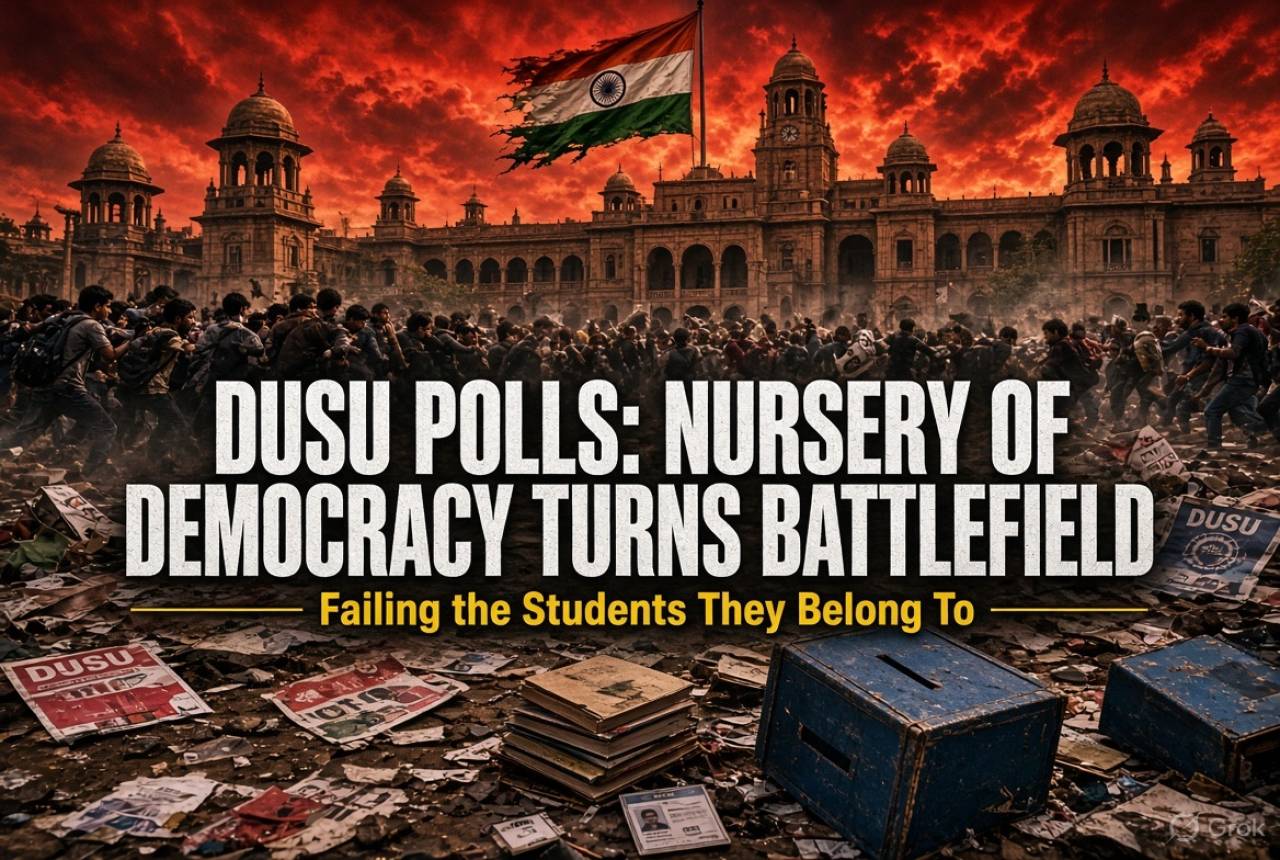
Delhi University’s student elections are meant to teach democracy. Court warnings over violence and campus disruption raise a harder question: what are students actually learning?
Every September, Delhi University's North Campus turns into a carnival of democracy. There are posters on every wall, SUVs with tinted windows, and candidates promising metro passes, cleaner hostels and better libraries. This year, the Delhi High Court stepped in to say what many students already know that the carnival has a violent underside, and no one is doing enough to stop it.
A Rebuke That Was Long Overdue
On Thursday, a bench led by Chief Justice DK Upadhyaya and Justice Tejas Karia pulled up the university, the Delhi Police and the student organisations for failing to prevent violence and vandalism during campaigning.
The court refused to stay Friday's polls, but it made its warning clear. If it was unhappy with the status reports due that day, it could withhold the counting of votes and defer the results.
The material before the court is disturbing. The application alleged hundreds of outsiders entering college premises, incidents of gunfire, injured students, and classrooms and libraries forcibly occupied.
Whatever the final findings, these are not the images of a students' union election. They are the images of a turf war.
Outsiders, Muscle and Money
The problem is not new, and it is not a mystery. Anyone who has walked through campus during DUSU season knows the pattern.
Candidates are often chosen for their ability to mobilise crowds and fund extravagant campaigns rather than for their ideas. Convoys of cars roll into colleges, and people who have no enrolment slip or admit card appear on campus.
Ordinary students, who just want to attend lectures, find themselves dodging rallies, sloganeering and worse.
The Lyngdoh Committee recommendations, which the court was asked to enforce, were meant to prevent exactly this. They set limits on campaign spending, restrict defacement of property and keep election activity within an orderly framework.
That they still need a court's intervention years later says something uncomfortable about how seriously those rules are taken.
Everyone Is Responsible, So No One Is
The court's anger was aimed at all sides for a reason.
The university has repeatedly assured the court that steps would be taken, and so has the Delhi Police. Student organisations, whose leaders have a duty to control their supporters, also came in for criticism.
The result is a familiar cycle of assurances, incidents, outrage and fresh assurances.
The Centre's counsel told the court that this year's situation was relatively calmer and that FIRs have been registered. That may be true, and the police deserve credit if it is.
But "calmer than before" is a low bar for an election that decides who represents hundreds of thousands of young people. If gunfire and forced occupation of classrooms are even alleged, the standard needs to be far higher than "less bad than last time".
What Is Really at Stake
The court described student unions as "nurseries of democracy," and that phrase deserves more attention than it usually gets.
A nursery shapes what grows in it.
If young people learn that elections are won through intimidation, that outsiders can walk in and take over spaces, and that authorities will look away until a judge steps in, that lesson does not stay on campus. It follows them into the wider political culture.
Then there are the students who are not in politics at all.
For them, a library occupied or a classroom emptied by fear is a direct loss of education, and no manifesto promise repays that.
Final Take
If this rebuke is to mean more than a headline, it must be followed by concrete steps:
- Strict Campus Access: Verified ID checks at college gates during the campaign period, with real consequences for outsiders who enter.
- Transparent Spending: Public disclosure of campaign expenses, checked independently, not just filed and forgotten.
- Personal Accountability: Candidates and organisations should answer for violence carried out by their supporters, including disqualification where warranted.
- Independent Oversight: A monitoring mechanism that does not depend on the goodwill of the very bodies being monitored.
- Student Voice: Regular consultation with non-political students, whose safety and studies are what these elections should serve.
The court has said it knows how to get things done if authorities cannot. But a university should not need a judge to keep its own campus safe.
The choice is between a students' union election that teaches young people how democracy works and one that teaches them how to break it.
Delhi University, its police and its student leaders need to show, this time with action, which one they want.
This version keeps the article's opinion-editorial character but improves hierarchy, readability, paragraph flow and publication formatting.
Every September, Delhi University's North Campus turns into a carnival of democracy. There are posters on every wall, SUVs with tinted windows, and candidates promising metro passes, cleaner hostels and better libraries. This year, the Delhi High Court stepped in to say what many students already know that the carnival has a violent underside, and no one is doing enough to stop it.
A Rebuke That Was Long Overdue
On Thursday, a bench led by Chief Justice DK Upadhyaya and Justice Tejas Karia pulled up the university, the Delhi Police and the student organisations for failing to prevent violence and vandalism during campaigning.
The court refused to stay Friday's polls, but it made its warning clear. If it was unhappy with the status reports due that day, it could withhold the counting of votes and defer the results.
The material before the court is disturbing. The application alleged hundreds of outsiders entering college premises, incidents of gunfire, injured students, and classrooms and libraries forcibly occupied.
Whatever the final findings, these are not the images of a students' union election. They are the images of a turf war.
Outsiders, Muscle and Money
The problem is not new, and it is not a mystery. Anyone who has walked through campus during DUSU season knows the pattern.
Candidates are often chosen for their ability to mobilise crowds and fund extravagant campaigns rather than for their ideas. Convoys of cars roll into colleges, and people who have no enrolment slip or admit card appear on campus.
Ordinary students, who just want to attend lectures, find themselves dodging rallies, sloganeering and worse.
The Lyngdoh Committee recommendations, which the court was asked to enforce, were meant to prevent exactly this. They set limits on campaign spending, restrict defacement of property and keep election activity within an orderly framework.
That they still need a court's intervention years later says something uncomfortable about how seriously those rules are taken.
Everyone Is Responsible, So No One Is
The court's anger was aimed at all sides for a reason.
The university has repeatedly assured the court that steps would be taken, and so has the Delhi Police. Student organisations, whose leaders have a duty to control their supporters, also came in for criticism.
The result is a familiar cycle of assurances, incidents, outrage and fresh assurances.
The Centre's counsel told the court that this year's situation was relatively calmer and that FIRs have been registered. That may be true, and the police deserve credit if it is.
But "calmer than before" is a low bar for an election that decides who represents hundreds of thousands of young people. If gunfire and forced occupation of classrooms are even alleged, the standard needs to be far higher than "less bad than last time".
What Is Really at Stake
The court described student unions as "nurseries of democracy," and that phrase deserves more attention than it usually gets.
A nursery shapes what grows in it.
If young people learn that elections are won through intimidation, that outsiders can walk in and take over spaces, and that authorities will look away until a judge steps in, that lesson does not stay on campus. It follows them into the wider political culture.
Then there are the students who are not in politics at all.
For them, a library occupied or a classroom emptied by fear is a direct loss of education, and no manifesto promise repays that.
Final Take
If this rebuke is to mean more than a headline, it must be followed by concrete steps:
- Strict Campus Access: Verified ID checks at college gates during the campaign period, with real consequences for outsiders who enter.
- Transparent Spending: Public disclosure of campaign expenses, checked independently, not just filed and forgotten.
- Personal Accountability: Candidates and organisations should answer for violence carried out by their supporters, including disqualification where warranted.
- Independent Oversight: A monitoring mechanism that does not depend on the goodwill of the very bodies being monitored.
- Student Voice: Regular consultation with non-political students, whose safety and studies are what these elections should serve.
The court has said it knows how to get things done if authorities cannot. But a university should not need a judge to keep its own campus safe.
The choice is between a students' union election that teaches young people how democracy works and one that teaches them how to break it.
Delhi University, its police and its student leaders need to show, this time with action, which one they want.
This version keeps the article's opinion-editorial character but improves hierarchy, readability, paragraph flow and publication formatting.












Leave a Comment