
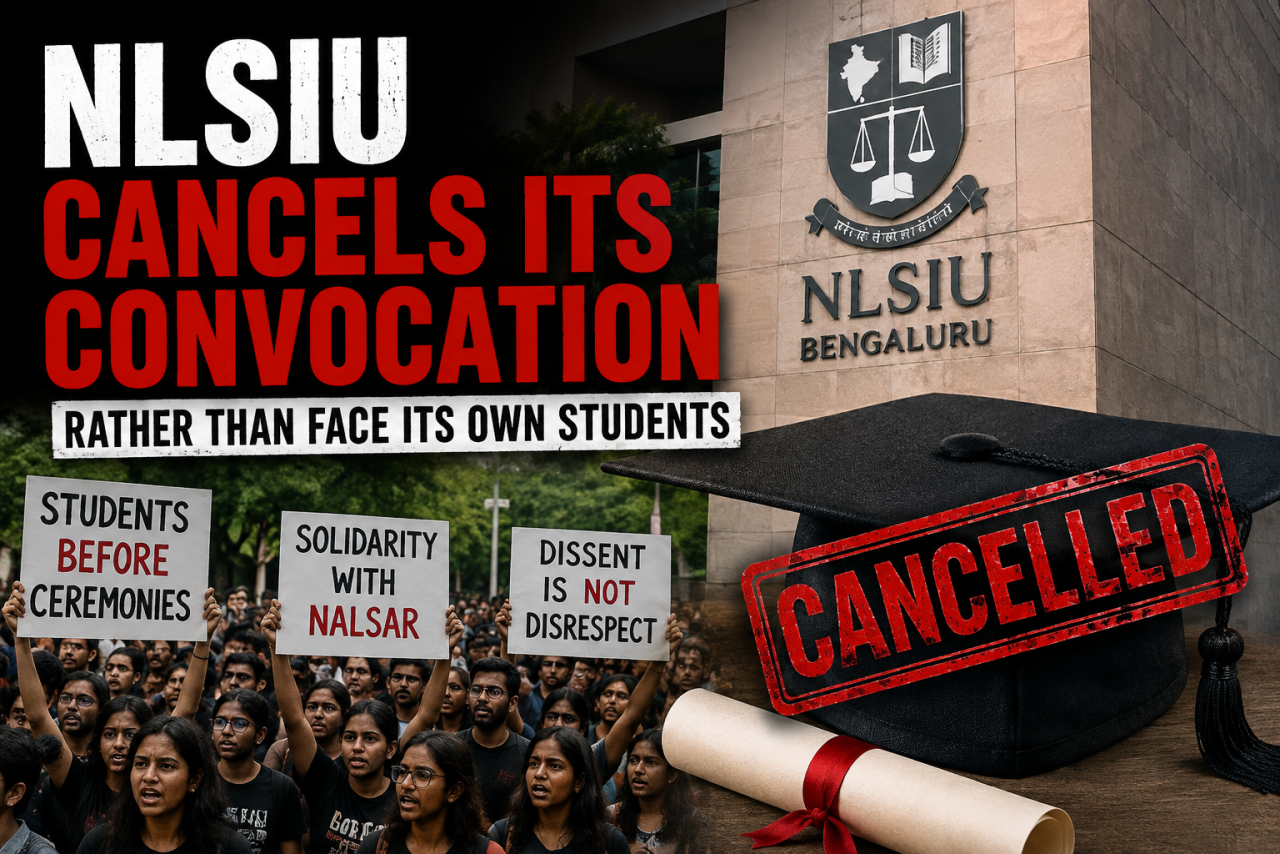
NLSIU’s cancelled convocation raises uncomfortable questions about student dissent, institutional autonomy and the limits of protest in India’s premier law schools.
The National Law School of India University (NLSIU), Bengaluru, has cancelled the graduation ceremony for its 2026 batch, just weeks before it was scheduled to take place.
The university’s 34th annual convocation was scheduled for September 12. On August 27, NLSIU informed students that the ceremony could not be held due to “unavoidable circumstances.”
Degrees will instead be awarded in absentia, subject to approval by the university’s governing bodies. Students will either be able to collect their certificates from campus or have them couriered to their homes.
NLSIU has not officially connected the cancellation to the student protests. But the timing has inevitably raised questions.
Where the Trouble Started
The controversy traces back to NALSAR University of Law in Hyderabad, nearly 570 kilometres away.
Students and faculty at NALSAR had objected to the proposed presence of Chief Justice of India (CJI) Surya Kant and Bar Council of India (BCI) chairman Manan Kumar Mishra at the university’s convocation.
The dispute took a dramatic turn on August 13, when the BCI temporarily blocked NALSAR’s graduating students from enrolling with state bar councils. Such enrolment is essential for law graduates who want to practise as advocates.
The BCI withdrew the order within hours. But the episode had already triggered a wider debate about institutional autonomy, student dissent and the powers of professional regulators.
NLSIU students were watching.
On August 15, a joint statement expressing solidarity with NALSAR was issued. It was signed by 165 graduating students, 409 current students and 128 alumni.
The statement raised two central objections. First, it opposed the attendance of the CJI and Mishra at NLSIU’s own convocation on grounds similar to those raised at NALSAR. Second, it demanded an unconditional apology from the BCI to NALSAR students and faculty over what the signatories described as an unconstitutional and illegal exercise of power.
A Meeting, Then a New Demand
The controversy became more complicated after that.
As Chancellor of NLSIU, the CJI has a formal institutional relationship with the university. Reports say he subsequently sought a meeting with graduating students to hear their concerns.
The meeting reportedly lasted close to 90 minutes. Students who attended have not publicly discussed what was said during the interaction.
According to student accounts, what followed was a request for the graduating batch to issue a fresh statement formally inviting the CJI to the convocation.
For some students, this appeared to amount to asking them to publicly retreat from the position they had already taken.
Others argued that objecting to the attendance of a public official at a university ceremony was itself a legitimate form of dissent and did not necessarily require students to extend a formal invitation.
The disagreement remained unresolved.
Within days, the convocation was cancelled.
Why This Story Matters Beyond One Campus
A convocation is, technically, a ceremony. The degree itself is the more important academic credential.
Under ordinary circumstances, therefore, cancelling a convocation might be little more than an administrative inconvenience.
This episode is different because it raises questions about how institutions respond when law students use the very tools that legal education teaches them to use: public statements, collective action, reasoned criticism and organised dissent.
The NALSAR episode had already raised concerns after the BCI temporarily intervened in the professional future of graduating students following a dispute over the presence of particular guests at a university ceremony.
The developments at NLSIU have added another layer to that debate.
Rather than hold a ceremony at which student opposition might have been visible, the university has removed the ceremony altogether.
For an institution that trains many of the country’s future lawyers and judges, that carries a symbolic weight far beyond a cancelled event.
The message some students and alumni fear they are receiving is uncomfortable: that publicly objecting to the presence of a powerful office-holder can come at the cost of a once-in-a-lifetime academic milestone.
Alumna Mousami Das described the cancellation as the loss of “a once-in-a-lifetime milestone” for students and their families.
The university, however, has not officially said that student dissent was the reason for cancelling the convocation.
NLSIU has also not responded to requests for comment from Hindustan Times.
That leaves the larger question unresolved. Was the cancellation simply the result of circumstances the university has described as unavoidable, or was it an institutional response to an increasingly uncomfortable confrontation with its own students?
Either way, what happens next may matter more than the ceremony that was supposed to take place on September 12.
The National Law School of India University (NLSIU), Bengaluru, has cancelled the graduation ceremony for its 2026 batch, just weeks before it was scheduled to take place.
The university’s 34th annual convocation was scheduled for September 12. On August 27, NLSIU informed students that the ceremony could not be held due to “unavoidable circumstances.”
Degrees will instead be awarded in absentia, subject to approval by the university’s governing bodies. Students will either be able to collect their certificates from campus or have them couriered to their homes.
NLSIU has not officially connected the cancellation to the student protests. But the timing has inevitably raised questions.
Where the Trouble Started
The controversy traces back to NALSAR University of Law in Hyderabad, nearly 570 kilometres away.
Students and faculty at NALSAR had objected to the proposed presence of Chief Justice of India (CJI) Surya Kant and Bar Council of India (BCI) chairman Manan Kumar Mishra at the university’s convocation.
The dispute took a dramatic turn on August 13, when the BCI temporarily blocked NALSAR’s graduating students from enrolling with state bar councils. Such enrolment is essential for law graduates who want to practise as advocates.
The BCI withdrew the order within hours. But the episode had already triggered a wider debate about institutional autonomy, student dissent and the powers of professional regulators.
NLSIU students were watching.
On August 15, a joint statement expressing solidarity with NALSAR was issued. It was signed by 165 graduating students, 409 current students and 128 alumni.
The statement raised two central objections. First, it opposed the attendance of the CJI and Mishra at NLSIU’s own convocation on grounds similar to those raised at NALSAR. Second, it demanded an unconditional apology from the BCI to NALSAR students and faculty over what the signatories described as an unconstitutional and illegal exercise of power.
A Meeting, Then a New Demand
The controversy became more complicated after that.
As Chancellor of NLSIU, the CJI has a formal institutional relationship with the university. Reports say he subsequently sought a meeting with graduating students to hear their concerns.
The meeting reportedly lasted close to 90 minutes. Students who attended have not publicly discussed what was said during the interaction.
According to student accounts, what followed was a request for the graduating batch to issue a fresh statement formally inviting the CJI to the convocation.
For some students, this appeared to amount to asking them to publicly retreat from the position they had already taken.
Others argued that objecting to the attendance of a public official at a university ceremony was itself a legitimate form of dissent and did not necessarily require students to extend a formal invitation.
The disagreement remained unresolved.
Within days, the convocation was cancelled.
Why This Story Matters Beyond One Campus
A convocation is, technically, a ceremony. The degree itself is the more important academic credential.
Under ordinary circumstances, therefore, cancelling a convocation might be little more than an administrative inconvenience.
This episode is different because it raises questions about how institutions respond when law students use the very tools that legal education teaches them to use: public statements, collective action, reasoned criticism and organised dissent.
The NALSAR episode had already raised concerns after the BCI temporarily intervened in the professional future of graduating students following a dispute over the presence of particular guests at a university ceremony.
The developments at NLSIU have added another layer to that debate.
Rather than hold a ceremony at which student opposition might have been visible, the university has removed the ceremony altogether.
For an institution that trains many of the country’s future lawyers and judges, that carries a symbolic weight far beyond a cancelled event.
The message some students and alumni fear they are receiving is uncomfortable: that publicly objecting to the presence of a powerful office-holder can come at the cost of a once-in-a-lifetime academic milestone.
Alumna Mousami Das described the cancellation as the loss of “a once-in-a-lifetime milestone” for students and their families.
The university, however, has not officially said that student dissent was the reason for cancelling the convocation.
NLSIU has also not responded to requests for comment from Hindustan Times.
That leaves the larger question unresolved. Was the cancellation simply the result of circumstances the university has described as unavoidable, or was it an institutional response to an increasingly uncomfortable confrontation with its own students?
Either way, what happens next may matter more than the ceremony that was supposed to take place on September 12.


















Leave a Comment