
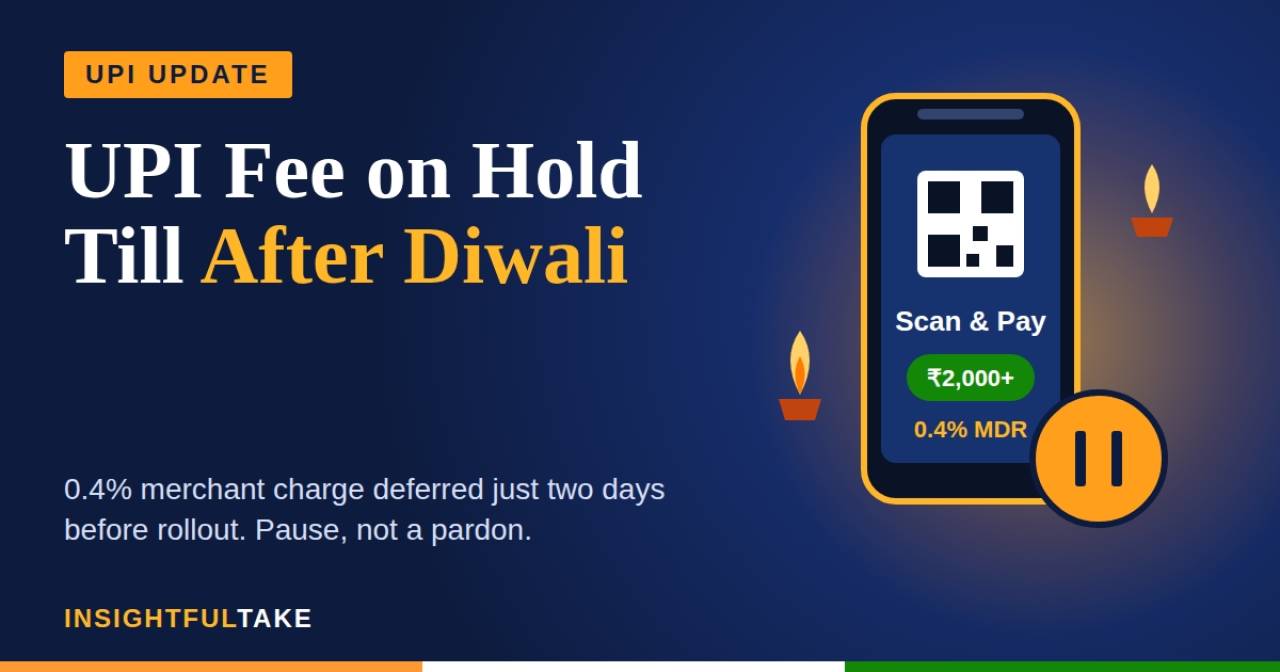
UPI’s proposed merchant fee is on hold until after Diwali, but nearly 48% of surveyed businesses say they may pass the cost on to customers.
For millions of Indians, a day now runs on a phone scan. The morning chai, vegetables from the neighbourhood cart, petrol before a long drive and sweets for Diwali are all paid for with a quick tap. So when reports emerged that a fee could soon be introduced on some UPI transactions, concern spread quickly. On October 14, just two days before the scheduled rollout, the National Payments Corporation of India (NPCI) hit the pause button.
NPCI, which operates India’s retail payment systems, has deferred a proposed 0.4% merchant discount rate (MDR) on selected person-to-merchant transactions above ₹2,000. The rollout was scheduled for October 15. A fresh date will be announced separately after the festive period, the payment body said.
The reasoning is straightforward: the festive season is not the time to introduce a change that could unsettle shoppers and shopkeepers.
What Was Supposed to Change?
A circular issued on September 15 outlined the proposed charges. Payments above ₹2,000 made to merchants through popular apps such as Paytm, PhonePe and BHIM would attract a 0.4% charge, capped at ₹300 for transactions of ₹75,000 and above.
NPCI had clarified that the charge would apply to merchants, not customers. Person-to-person transfers were to remain free, while essential services such as railways, telecom, fuel and insurance were assigned a flat ₹5 fee on payments above ₹2,000.
Petrol pumps drew particular attention. Under the proposed arrangement, fuel payments above ₹2,000 would attract a flat ₹5 charge, limiting the processing cost for pump operators handling large transactions. Everyday refuelling payments below ₹2,000 would continue to attract zero MDR.
In other words, the ordinary commuter making a smaller fuel payment would not face a direct charge under the proposal.
Why the Proposal Sparked a Storm
The assurances did little to silence critics. Several trade bodies and Opposition parties described the proposed fee as a tax in disguise.
Their concern was simple: even if the charge is formally imposed on merchants, businesses could pass the cost on to customers through higher prices or encourage buyers to use cash instead.
That possibility raises questions about India's digital payments drive. Over the past decade, UPI has become a routine part of life for street vendors, auto-rickshaw drivers, neighbourhood grocers and large retailers alike.
Introducing transaction costs could affect the very businesses and consumers who have helped make digital payments a national habit. The central concern is not just the size of the fee, but whether it could weaken confidence in a system built on convenience and widespread adoption.
What Small Businesses Are Saying
Small enterprises, which form the backbone of local markets, have welcomed the deferment.
India SME Forum president Vinod Kumar called the decision timely and sensible, praising the government's recognition of the need to protect micro, small and medium enterprises during the festive season.
He also pointed to a survey of 7,497 businesses that highlights how deeply UPI has become embedded in everyday commerce.
More than 97% of respondents said UPI had increased their sales or helped them retain customers. Nearly 93% reported improved cash flow or smoother collections.
But the survey also revealed a potential problem. Nearly 48% of respondents said they would add the proposed charges to the prices of their products or services.
That figure captures the heart of the debate. A fee imposed on a merchant may ultimately become an additional expense for the customer.
For small businesses operating on narrow margins, absorbing the charge may not always be practical. Passing it on, however, could make digital payments indirectly more expensive for consumers.
A Pause, Not a Cancellation
The distinction matters. NPCI has deferred the proposed fee, not scrapped it.
The UPI and Services Steering Committee has indicated that the charge will be implemented after Diwali, with the revised date yet to be announced.
For merchants, the uncertainty means that planning cannot stop. For consumers, the larger question remains unanswered: who will ultimately bear the cost of processing certain digital payments?
The deferment offers temporary relief during one of India's busiest shopping periods, but it does not settle the argument over how the country's digital payment infrastructure should be funded.
Final Take
For ordinary UPI users, the immediate takeaway is reassuring. Festive shopping, from buying new clothes and gold coins to sending gifts to relatives, can continue without concern about the proposed MDR charge being introduced on October 15.
Person-to-person UPI transfers were also expected to remain free under the original proposal.
However, consumers should distinguish between the direct payment rules and the possibility of indirect price increases. Even when a fee is legally payable by a merchant, businesses may attempt to recover that expense through their pricing.
The longer-term question will remain after the festive lights go out.
Digital payments depend on trust, affordability and convenience. A network handling billions of transactions cannot be treated as though the costs of operating it simply disappear. Payment infrastructure needs sustainable funding, but the method of raising that money matters.
Should merchants absorb the cost? Should payment service providers bear more of it? Or should the government consider a broader funding model that protects small businesses and consumers?
The answers will shape the next phase of India's digital payments journey. For now, shoppers can continue scanning their phones, while policymakers have more time to find a solution that supports the UPI ecosystem without discouraging the people who rely on it every day.
For millions of Indians, a day now runs on a phone scan. The morning chai, vegetables from the neighbourhood cart, petrol before a long drive and sweets for Diwali are all paid for with a quick tap. So when reports emerged that a fee could soon be introduced on some UPI transactions, concern spread quickly. On October 14, just two days before the scheduled rollout, the National Payments Corporation of India (NPCI) hit the pause button.
NPCI, which operates India’s retail payment systems, has deferred a proposed 0.4% merchant discount rate (MDR) on selected person-to-merchant transactions above ₹2,000. The rollout was scheduled for October 15. A fresh date will be announced separately after the festive period, the payment body said.
The reasoning is straightforward: the festive season is not the time to introduce a change that could unsettle shoppers and shopkeepers.
What Was Supposed to Change?
A circular issued on September 15 outlined the proposed charges. Payments above ₹2,000 made to merchants through popular apps such as Paytm, PhonePe and BHIM would attract a 0.4% charge, capped at ₹300 for transactions of ₹75,000 and above.
NPCI had clarified that the charge would apply to merchants, not customers. Person-to-person transfers were to remain free, while essential services such as railways, telecom, fuel and insurance were assigned a flat ₹5 fee on payments above ₹2,000.
Petrol pumps drew particular attention. Under the proposed arrangement, fuel payments above ₹2,000 would attract a flat ₹5 charge, limiting the processing cost for pump operators handling large transactions. Everyday refuelling payments below ₹2,000 would continue to attract zero MDR.
In other words, the ordinary commuter making a smaller fuel payment would not face a direct charge under the proposal.
Why the Proposal Sparked a Storm
The assurances did little to silence critics. Several trade bodies and Opposition parties described the proposed fee as a tax in disguise.
Their concern was simple: even if the charge is formally imposed on merchants, businesses could pass the cost on to customers through higher prices or encourage buyers to use cash instead.
That possibility raises questions about India's digital payments drive. Over the past decade, UPI has become a routine part of life for street vendors, auto-rickshaw drivers, neighbourhood grocers and large retailers alike.
Introducing transaction costs could affect the very businesses and consumers who have helped make digital payments a national habit. The central concern is not just the size of the fee, but whether it could weaken confidence in a system built on convenience and widespread adoption.
What Small Businesses Are Saying
Small enterprises, which form the backbone of local markets, have welcomed the deferment.
India SME Forum president Vinod Kumar called the decision timely and sensible, praising the government's recognition of the need to protect micro, small and medium enterprises during the festive season.
He also pointed to a survey of 7,497 businesses that highlights how deeply UPI has become embedded in everyday commerce.
More than 97% of respondents said UPI had increased their sales or helped them retain customers. Nearly 93% reported improved cash flow or smoother collections.
But the survey also revealed a potential problem. Nearly 48% of respondents said they would add the proposed charges to the prices of their products or services.
That figure captures the heart of the debate. A fee imposed on a merchant may ultimately become an additional expense for the customer.
For small businesses operating on narrow margins, absorbing the charge may not always be practical. Passing it on, however, could make digital payments indirectly more expensive for consumers.
A Pause, Not a Cancellation
The distinction matters. NPCI has deferred the proposed fee, not scrapped it.
The UPI and Services Steering Committee has indicated that the charge will be implemented after Diwali, with the revised date yet to be announced.
For merchants, the uncertainty means that planning cannot stop. For consumers, the larger question remains unanswered: who will ultimately bear the cost of processing certain digital payments?
The deferment offers temporary relief during one of India's busiest shopping periods, but it does not settle the argument over how the country's digital payment infrastructure should be funded.
Final Take
For ordinary UPI users, the immediate takeaway is reassuring. Festive shopping, from buying new clothes and gold coins to sending gifts to relatives, can continue without concern about the proposed MDR charge being introduced on October 15.
Person-to-person UPI transfers were also expected to remain free under the original proposal.
However, consumers should distinguish between the direct payment rules and the possibility of indirect price increases. Even when a fee is legally payable by a merchant, businesses may attempt to recover that expense through their pricing.
The longer-term question will remain after the festive lights go out.
Digital payments depend on trust, affordability and convenience. A network handling billions of transactions cannot be treated as though the costs of operating it simply disappear. Payment infrastructure needs sustainable funding, but the method of raising that money matters.
Should merchants absorb the cost? Should payment service providers bear more of it? Or should the government consider a broader funding model that protects small businesses and consumers?
The answers will shape the next phase of India's digital payments journey. For now, shoppers can continue scanning their phones, while policymakers have more time to find a solution that supports the UPI ecosystem without discouraging the people who rely on it every day.
















Leave a Comment