
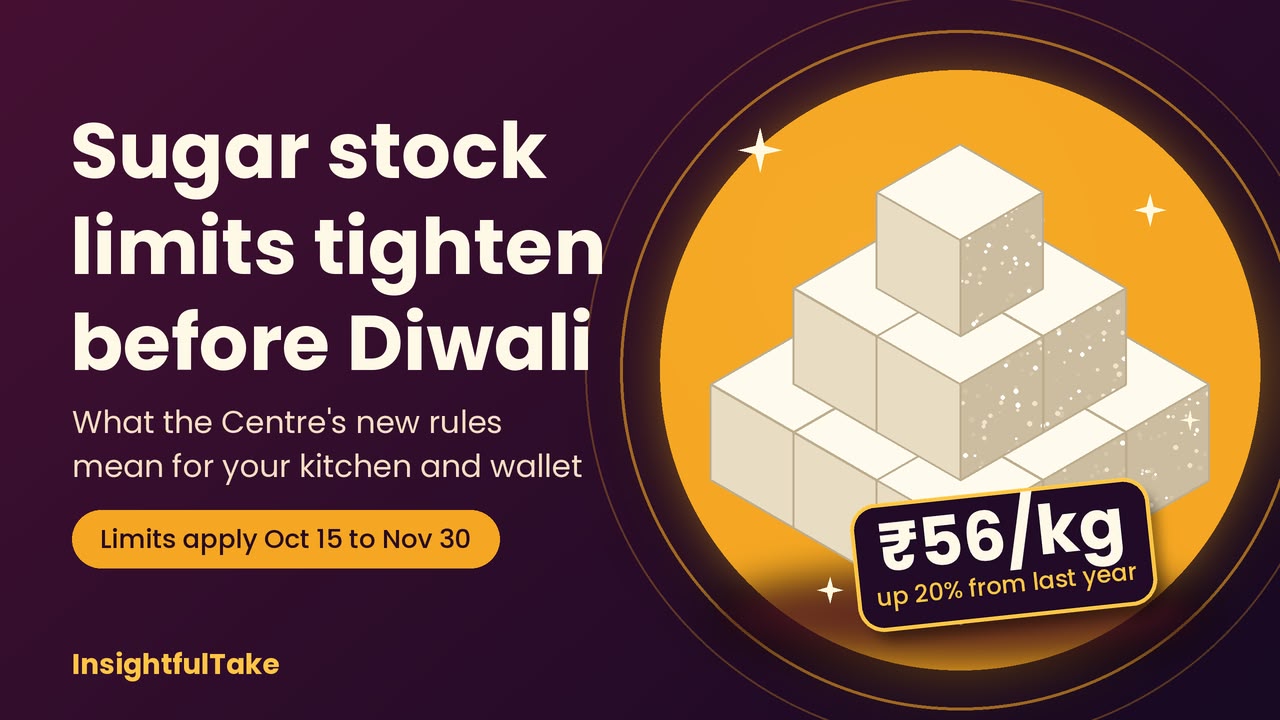
Sugar prices have cooled, but Diwali and Chhath could change the equation. The Centre is tightening stock limits before festive demand peaks.
Prices have cooled from their August peak, but the Centre isn't taking chances as Diwali sweets and Chhath prasad approach.
Mithai boxes, kheer, thekua and endless cups of chai all have one thing in common is sugar. As India enters one of its busiest buying periods, the Centre has tightened the amount of sugar that traders can hold in stock. The move is aimed at ensuring that festive demand does not turn into another round of price spikes.
What has changed
From October 15, sugar dealers will not be allowed to hold stock for more than 15 days or keep more than 1,000 quintals, or 100 tonnes, at any one location. The restrictions will remain in force until November 30, covering the peak festive period.
There is an exception for Kolkata and its extended metropolitan areas, as well as Assam, where the stock limit has been set at 2,000 quintals.
The Food Ministry has cited the region's supply-chain realities. Kolkata is a major distribution hub that receives sugar from Uttar Pradesh, Maharashtra and Karnataka before supplying eastern and northeastern markets. Longer transportation distances and the logistical challenges of serving the Northeast mean traders in these areas require larger inventory buffers.
Why tighten limits when prices are already falling?
This is the key question.
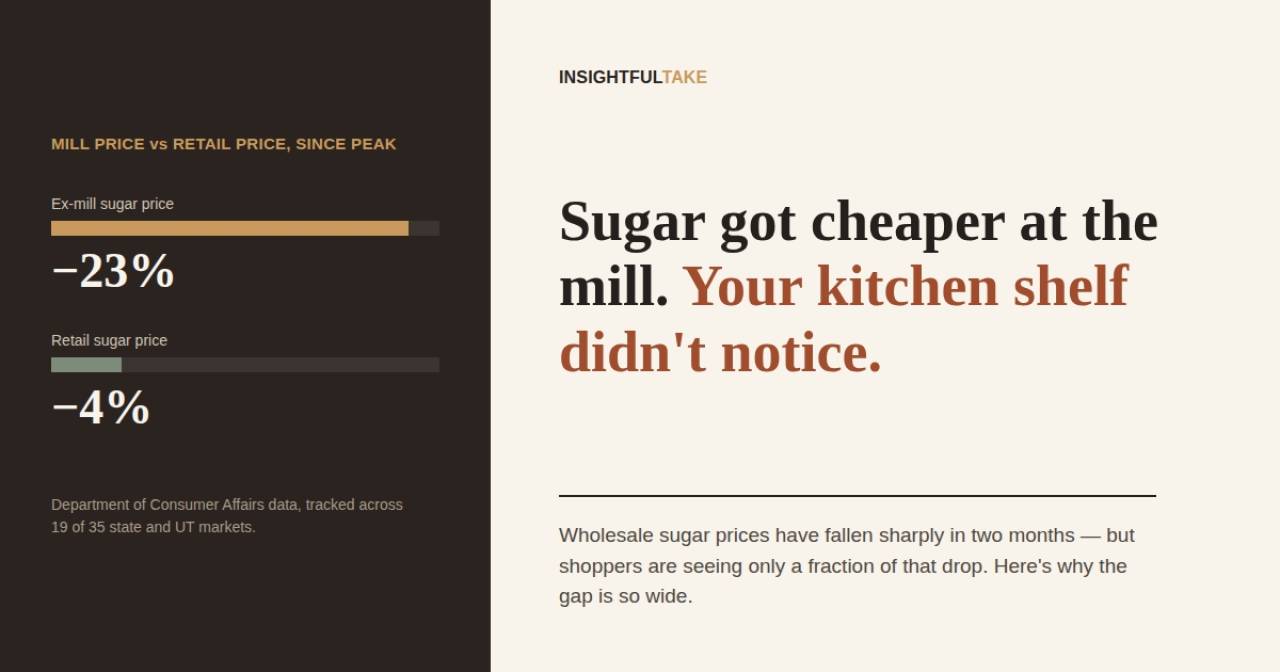
Sugar prices are not currently showing signs of a crisis. According to the government, retail sugar prices have fallen about 15% from their August peak, while ex-mill prices, or the rates charged by mills to bulk buyers, have declined by around 28%. Ex-mill prices are now roughly ₹4,500 to ₹4,800 per quintal.
Yet retail sugar still averages around ₹56 per kg, about 20% higher than a year ago.
It gives policymakers a reason to act before the festive demand cycle gathers pace. Diwali and Chhath bring predictable increases in household purchases as well as demand from sweet shops, caterers and food businesses.
Stock limits are therefore being used as a preventive measure. The idea is to discourage excessive accumulation and speculative trading while keeping sugar moving from mills through wholesalers and retailers to consumers.
The price gap worth watching
The difference between the ex-mill price of roughly ₹45 to ₹48 per kg and the retail average of ₹56 leaves a gap of around ₹8 to ₹11 per kg.
That difference does not automatically represent excessive margins. Transport costs, wholesale expenses and retail margins are part of the final price. But the government expects retail prices to ease further as lower factory-gate prices move through the supply chain.
That pass-through will be the real test.
A fall in mill prices does not necessarily reach a consumer's local kirana store immediately. The stock limits are intended to encourage faster inventory turnover and prevent traders from holding cheaper supplies for longer periods in anticipation of higher prices.
If that works, consumers could see some further relief just as festive demand reaches its peak. If it does not, the gap between mill and retail prices is likely to remain under scrutiny.
What it means for households and businesses
For households: There is little reason to panic-buy. With supply being monitored and prices already easing, purchasing substantially more sugar than needed could add to the very demand pressure the government is trying to contain.
For small traders and sweet shops: The 15-day holding limit will require tighter inventory planning. Businesses that normally purchase large quantities to lock in prices may have to adjust their buying cycles, particularly if they operate across several storage locations.
For dealers in eastern India: The higher limit for Kolkata and Assam reflects the longer and more complicated supply chains serving these markets. The exemption is therefore less about preferential treatment and more about allowing adequate working inventory where transportation takes longer.
A new sugar season begins
The stock restrictions also come at the start of the new sugar season. The 2026-27 sugar season began on October 1, and the government has advised mills to begin crushing according to the agro-climatic conditions in their respective regions.
That matters because sugar recovery depends partly on the maturity and quality of the sugarcane being crushed. Starting operations according to local crop conditions can help mills avoid rushing into crushing before the cane is ready.
For consumers, however, the bigger question is what the new season produces.
Sugar sits at the intersection of farm economics and household budgets. Cane farmers need timely crushing and payments, mills need viable operations, and consumers want affordable and predictable prices. Stock limits can address short-term trading behaviour, but the new season's cane availability and sugar output will have a much greater influence on prices in the months ahead.
What to watch next
Three developments will matter over the coming weeks:
- Whether retail sugar prices fall further as lower ex-mill prices move through the supply chain
- Whether the November 30 stock-limit deadline is extended if festive demand remains strong
- How the new crushing season performs and what it indicates about sugar availability in the months ahead
The bottom line
The government's latest move is a precaution rather than a response to an immediate supply crisis. Prices have been cooling, and the Centre appears to be trying to ensure that the festive demand surge does not reverse that trend.
For households, buy what you need, avoid panic buying and let the market do its work.
There should be enough room for the sugar in your chai, the mithai on the table and the thekua prepared for Chhath.
Prices have cooled from their August peak, but the Centre isn't taking chances as Diwali sweets and Chhath prasad approach.
Mithai boxes, kheer, thekua and endless cups of chai all have one thing in common is sugar. As India enters one of its busiest buying periods, the Centre has tightened the amount of sugar that traders can hold in stock. The move is aimed at ensuring that festive demand does not turn into another round of price spikes.
What has changed
From October 15, sugar dealers will not be allowed to hold stock for more than 15 days or keep more than 1,000 quintals, or 100 tonnes, at any one location. The restrictions will remain in force until November 30, covering the peak festive period.
There is an exception for Kolkata and its extended metropolitan areas, as well as Assam, where the stock limit has been set at 2,000 quintals.
The Food Ministry has cited the region's supply-chain realities. Kolkata is a major distribution hub that receives sugar from Uttar Pradesh, Maharashtra and Karnataka before supplying eastern and northeastern markets. Longer transportation distances and the logistical challenges of serving the Northeast mean traders in these areas require larger inventory buffers.
Why tighten limits when prices are already falling?
This is the key question.
Sugar prices are not currently showing signs of a crisis. According to the government, retail sugar prices have fallen about 15% from their August peak, while ex-mill prices, or the rates charged by mills to bulk buyers, have declined by around 28%. Ex-mill prices are now roughly ₹4,500 to ₹4,800 per quintal.
Yet retail sugar still averages around ₹56 per kg, about 20% higher than a year ago.
It gives policymakers a reason to act before the festive demand cycle gathers pace. Diwali and Chhath bring predictable increases in household purchases as well as demand from sweet shops, caterers and food businesses.
Stock limits are therefore being used as a preventive measure. The idea is to discourage excessive accumulation and speculative trading while keeping sugar moving from mills through wholesalers and retailers to consumers.
The price gap worth watching
The difference between the ex-mill price of roughly ₹45 to ₹48 per kg and the retail average of ₹56 leaves a gap of around ₹8 to ₹11 per kg.
That difference does not automatically represent excessive margins. Transport costs, wholesale expenses and retail margins are part of the final price. But the government expects retail prices to ease further as lower factory-gate prices move through the supply chain.
That pass-through will be the real test.
A fall in mill prices does not necessarily reach a consumer's local kirana store immediately. The stock limits are intended to encourage faster inventory turnover and prevent traders from holding cheaper supplies for longer periods in anticipation of higher prices.
If that works, consumers could see some further relief just as festive demand reaches its peak. If it does not, the gap between mill and retail prices is likely to remain under scrutiny.
What it means for households and businesses
For households: There is little reason to panic-buy. With supply being monitored and prices already easing, purchasing substantially more sugar than needed could add to the very demand pressure the government is trying to contain.
For small traders and sweet shops: The 15-day holding limit will require tighter inventory planning. Businesses that normally purchase large quantities to lock in prices may have to adjust their buying cycles, particularly if they operate across several storage locations.
For dealers in eastern India: The higher limit for Kolkata and Assam reflects the longer and more complicated supply chains serving these markets. The exemption is therefore less about preferential treatment and more about allowing adequate working inventory where transportation takes longer.
A new sugar season begins
The stock restrictions also come at the start of the new sugar season. The 2026-27 sugar season began on October 1, and the government has advised mills to begin crushing according to the agro-climatic conditions in their respective regions.
That matters because sugar recovery depends partly on the maturity and quality of the sugarcane being crushed. Starting operations according to local crop conditions can help mills avoid rushing into crushing before the cane is ready.
For consumers, however, the bigger question is what the new season produces.
Sugar sits at the intersection of farm economics and household budgets. Cane farmers need timely crushing and payments, mills need viable operations, and consumers want affordable and predictable prices. Stock limits can address short-term trading behaviour, but the new season's cane availability and sugar output will have a much greater influence on prices in the months ahead.
What to watch next
Three developments will matter over the coming weeks:
- Whether retail sugar prices fall further as lower ex-mill prices move through the supply chain
- Whether the November 30 stock-limit deadline is extended if festive demand remains strong
- How the new crushing season performs and what it indicates about sugar availability in the months ahead
The bottom line
The government's latest move is a precaution rather than a response to an immediate supply crisis. Prices have been cooling, and the Centre appears to be trying to ensure that the festive demand surge does not reverse that trend.
For households, buy what you need, avoid panic buying and let the market do its work.
There should be enough room for the sugar in your chai, the mithai on the table and the thekua prepared for Chhath.

























Leave a Comment