
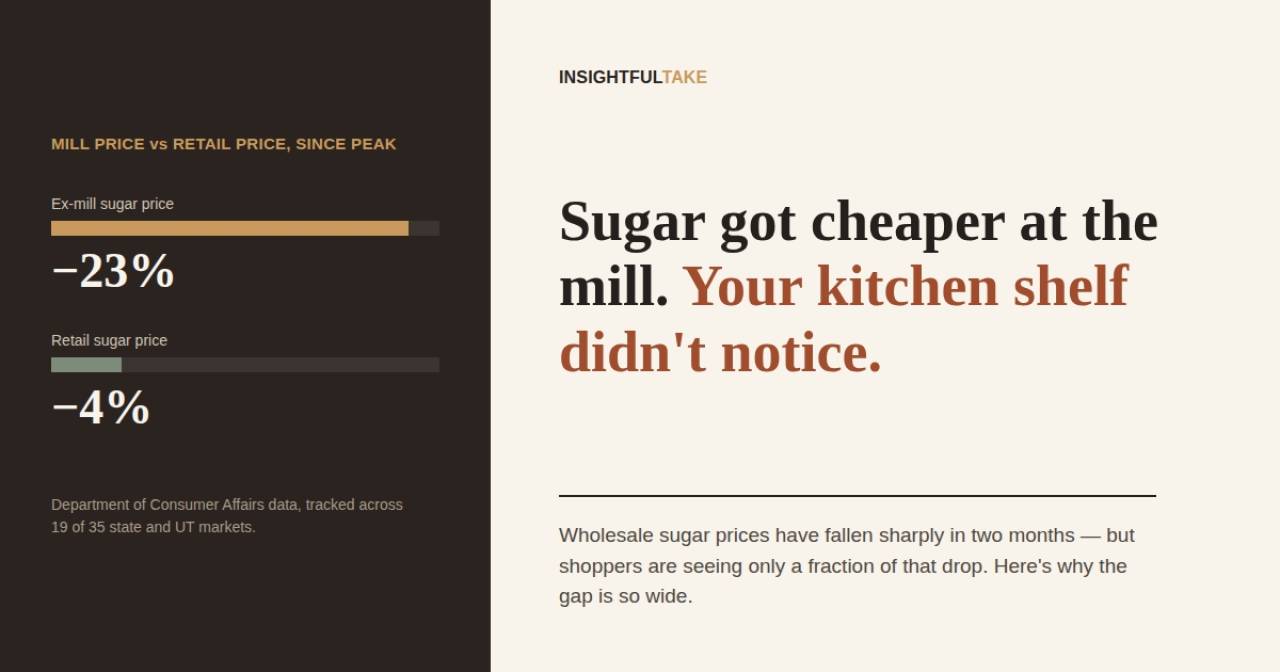
Mill prices have fallen more than 23 percent, but consumers are seeing only limited relief. The widening gap exposes how slowly lower prices travel through India’s sugar supply chain.
Sugar prices have fallen sharply at the mill gate over the past two months. But for consumers, the relief has barely arrived. The gap between what mills charge and what households pay has widened, raising questions about how quickly lower commodity prices actually travel through India’s supply chain.
What the Numbers Show
Ex-mill sugar prices, the rates at which mills sell to wholesalers, have fallen by more than 23 percent from their peak earlier this year. By early September, mills were quoting around ₹62 to ₹65 per kg, compared with prices above ₹80 per kg just weeks earlier.
Retail prices tell a different story.
According to price data tracked by the Department of Consumer Affairs, the all-India average retail price has declined only slightly from its peak, with the overall fall standing at just over 4 percent.
In simple terms, mills have absorbed a much larger price correction than consumers have seen at the shop counter.
State-level figures reveal an even wider variation. Retail sugar prices are relatively low in states such as Punjab and Haryana, where prices are closer to the ex-mill rate. In contrast, consumers in parts of the Northeast and island territories pay considerably more.
Manipur, Tripura, Meghalaya and the Andaman and Nicobar Islands report retail prices well above the national average, with freight and logistics costs adding to the final price. Meghalaya currently records the highest retail price, while Ladakh is among the states and Union Territories with lower prices.
Why the Gap Exists
Industry representatives point to several reasons why the fall in mill prices has not immediately reached consumers.
The first is a simple matter of timing.
Retailers often sell stock purchased when prices were higher. Even when wholesale prices fall, shopkeepers may continue selling existing inventory at earlier rates. It can take one to two weeks for that stock to clear before lower procurement costs begin showing up on shelves.
The second factor is inventory behaviour.
Distributors and retailers may hold back from aggressively reducing prices if they expect the market to turn again. Some may also wait for a clearer indication that the lower mill prices will hold before replenishing their stocks.
Even limited inventory holding can slow the transmission of lower prices through the supply chain.
Government policy is another part of the equation. Sugar imports have faced restrictions over the years, while stock-limit rules and other regulatory measures influence how dealers and traders manage inventories. These factors can affect how quickly cheaper supply moves from mills into wholesale and retail markets.
What It Means for Households
For households, the immediate takeaway is that retail sugar prices could fall further, but probably not as sharply or as quickly as mill prices have.
Trade representatives expect retail prices to begin easing over the next 10 days to two weeks as older inventories are sold and cheaper sugar moves through the distribution network.
There is another reason sugar prices can remain relatively sticky. Consumers have limited substitutes for sugar in everyday use. Demand therefore tends to remain fairly steady even when prices rise.
That reduces the pressure on retailers to immediately cut prices when their procurement costs decline.
Final Take
The sugar market illustrates a familiar problem in India's food economy. A fall in the price received by producers does not necessarily translate into an equivalent fall for consumers.
The difference is particularly striking in this case. A more than 23 percent decline at the mill level has so far translated into a retail decline of only a little over 4 percent.
That does not automatically mean retailers are pocketing the entire difference. Transportation, distribution margins, old inventory, local taxes and regional supply conditions can all influence the final price paid by consumers.
But the gap does raise a broader question about price transmission.
When commodity prices fall sharply at the production end, how long should consumers have to wait before seeing the benefit?
For now, households should expect gradual relief rather than an immediate correction. And with the festive season approaching, when demand for sugar and other food commodities typically rises, state-level retail prices may be more revealing than the national average.
The real test will be whether the sharp fall at the mill gate eventually finds its way to the kitchen shelf.
Sugar prices have fallen sharply at the mill gate over the past two months. But for consumers, the relief has barely arrived. The gap between what mills charge and what households pay has widened, raising questions about how quickly lower commodity prices actually travel through India’s supply chain.
What the Numbers Show
Ex-mill sugar prices, the rates at which mills sell to wholesalers, have fallen by more than 23 percent from their peak earlier this year. By early September, mills were quoting around ₹62 to ₹65 per kg, compared with prices above ₹80 per kg just weeks earlier.
Retail prices tell a different story.
According to price data tracked by the Department of Consumer Affairs, the all-India average retail price has declined only slightly from its peak, with the overall fall standing at just over 4 percent.
In simple terms, mills have absorbed a much larger price correction than consumers have seen at the shop counter.
State-level figures reveal an even wider variation. Retail sugar prices are relatively low in states such as Punjab and Haryana, where prices are closer to the ex-mill rate. In contrast, consumers in parts of the Northeast and island territories pay considerably more.
Manipur, Tripura, Meghalaya and the Andaman and Nicobar Islands report retail prices well above the national average, with freight and logistics costs adding to the final price. Meghalaya currently records the highest retail price, while Ladakh is among the states and Union Territories with lower prices.
Why the Gap Exists
Industry representatives point to several reasons why the fall in mill prices has not immediately reached consumers.
The first is a simple matter of timing.
Retailers often sell stock purchased when prices were higher. Even when wholesale prices fall, shopkeepers may continue selling existing inventory at earlier rates. It can take one to two weeks for that stock to clear before lower procurement costs begin showing up on shelves.
The second factor is inventory behaviour.
Distributors and retailers may hold back from aggressively reducing prices if they expect the market to turn again. Some may also wait for a clearer indication that the lower mill prices will hold before replenishing their stocks.
Even limited inventory holding can slow the transmission of lower prices through the supply chain.
Government policy is another part of the equation. Sugar imports have faced restrictions over the years, while stock-limit rules and other regulatory measures influence how dealers and traders manage inventories. These factors can affect how quickly cheaper supply moves from mills into wholesale and retail markets.
What It Means for Households
For households, the immediate takeaway is that retail sugar prices could fall further, but probably not as sharply or as quickly as mill prices have.
Trade representatives expect retail prices to begin easing over the next 10 days to two weeks as older inventories are sold and cheaper sugar moves through the distribution network.
There is another reason sugar prices can remain relatively sticky. Consumers have limited substitutes for sugar in everyday use. Demand therefore tends to remain fairly steady even when prices rise.
That reduces the pressure on retailers to immediately cut prices when their procurement costs decline.
Final Take
The sugar market illustrates a familiar problem in India's food economy. A fall in the price received by producers does not necessarily translate into an equivalent fall for consumers.
The difference is particularly striking in this case. A more than 23 percent decline at the mill level has so far translated into a retail decline of only a little over 4 percent.
That does not automatically mean retailers are pocketing the entire difference. Transportation, distribution margins, old inventory, local taxes and regional supply conditions can all influence the final price paid by consumers.
But the gap does raise a broader question about price transmission.
When commodity prices fall sharply at the production end, how long should consumers have to wait before seeing the benefit?
For now, households should expect gradual relief rather than an immediate correction. And with the festive season approaching, when demand for sugar and other food commodities typically rises, state-level retail prices may be more revealing than the national average.
The real test will be whether the sharp fall at the mill gate eventually finds its way to the kitchen shelf.


























Leave a Comment