
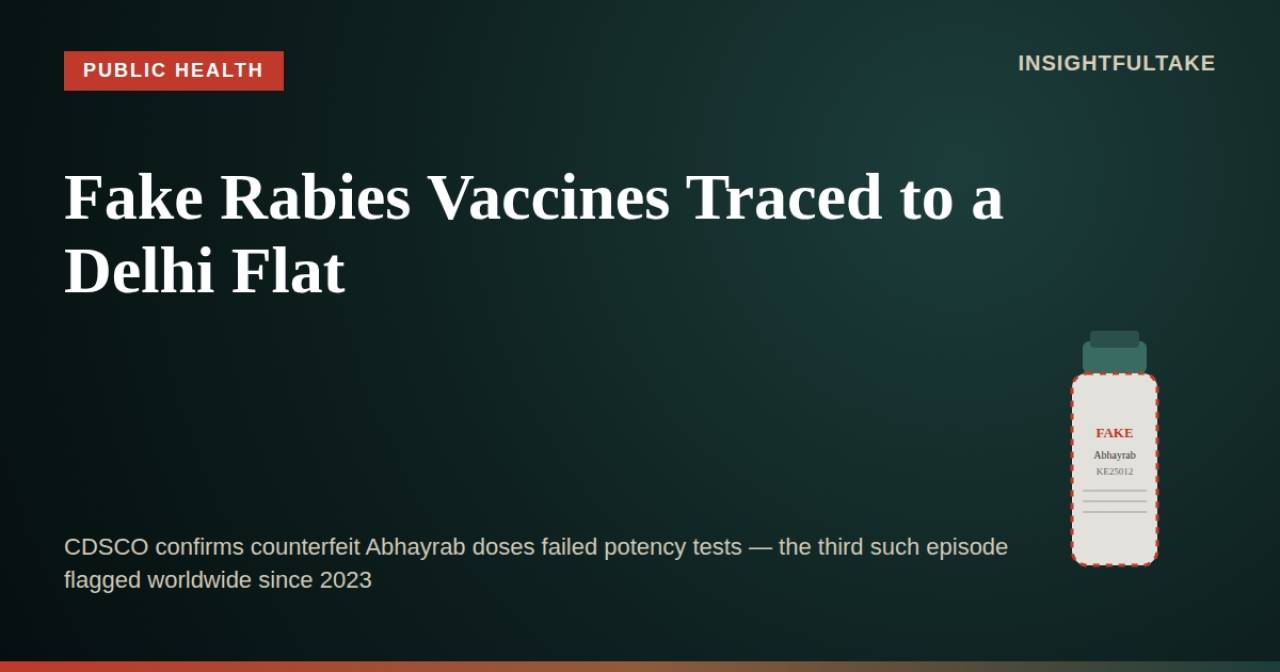
A fake rabies vaccine found in a Delhi flat has exposed a dangerous gap in India’s drug supply chain, raising a troubling question about who is protecting patients from counterfeit medicines.
A counterfeit batch of Abhayrab was traced to an unlicensed residential flat in north Delhi. Laboratory tests found the vaccine failed potency standards and showed multiple differences from genuine samples, raising wider questions about India’s drug-safety checks.
The discovery of a fake rabies vaccine in a Delhi flat has exposed a disturbing weakness in India's medicine supply chain.
The Central Drugs Standard Control Organisation (CDSCO) has confirmed that a batch of Abhayrab, an anti-rabies vaccine, was found to be misbranded and substandard after being recovered from an unlicensed residential premises in north Delhi. Four people have been arrested in connection with the case.
But the details in the regulator's forensic findings raise a larger question. How much stands between a counterfeit medicine and the patient who ultimately receives it?
The Delhi Flat Where the Vaccine Was Found
The case began on April 22, when the Delhi Police Crime Branch, working with drug inspectors from the Delhi government, raided a flat in Mukherjee Nagar.
Officials recovered vials of Abhayrab from batch KE25012. The premises did not have any licence to manufacture medicines.
Samples were subsequently sent to the Central Drugs Laboratory in Kasauli, India's reference facility for vaccine testing. The laboratory's findings eventually revealed that the seized vaccine was not simply a poorly stored or expired product. It was counterfeit.
The Vaccine Failed a Critical Test
The most serious finding concerned potency.
Laboratory testing found that the vaccine failed the potency test, meaning it did not contain sufficient antigen to generate the level of protective immunity expected from a genuine rabies vaccine.
That is particularly alarming because rabies leaves virtually no room for error. Once clinical symptoms appear, the disease is almost invariably fatal.
The seized vials were also found stored at room temperature, despite the vaccine requiring storage between 2°C and 8°C.
But perhaps the clearest evidence of counterfeiting came when officials compared the seized vials with genuine retention samples from the same batch.
They identified 17 distinct differences.
Fake Details That Were Surprisingly Easy to Miss
Some of the differences were visible once investigators knew what to look for.
The counterfeit vials had blue caps, while genuine Abhayrab vials use green caps. The seal carried a hologram that does not appear on the authentic product.
The QR code printed on the packaging could not be verified through GS1, the international organisation associated with barcode standards and identification systems.
There were other discrepancies too.
The name of Louis Pasteur was misspelled as "L. Posteur." The preservative concentration was expressed using the wrong unit of measurement. The printed artwork number did not correspond with the genuine reference version.
Even the manufacturing licence number printed for the diluent was found to be fabricated.
Taken together, the discrepancies point to a product deliberately designed to resemble the real thing.
Manufacturer Says the Vaccine Was Never Made by It
Indian Immunologicals Limited, which manufactures Abhayrab through its Human Biologicals Institute in Telangana, has stated that the seized vials were never produced at its facility.
The company's position, based on the laboratory findings, is that no part of the counterfeit batch left India.
That distinction is important, especially because Abhayrab has previously been the subject of counterfeit-product alerts outside India.
In late 2023, Australian health authorities warned about counterfeit Abhayrab products circulating in India and advised travellers who had received the vaccine there to consider replacement doses.
Indian Immunologicals disputed the warning at the time, saying it related to a single batch that had already been withdrawn and could cause unnecessary public concern.
Then, in January 2025, Zimbabwe's medicines authority issued another warning concerning a falsified Abhayrab product being distributed through unauthorised channels.
The Delhi seizure therefore appears to be at least the third documented episode involving counterfeit Abhayrab products since 2023.
Why a Fake Rabies Vaccine Is Especially Dangerous
Counterfeit medicines are dangerous in any form. But a fake rabies vaccine carries an unusually high risk.
Rabies is almost always fatal once symptoms appear. India continues to account for a significant share of global rabies deaths, with government estimates putting annual deaths at around 20,000, predominantly following dog bites.
Post-exposure vaccination is one of the most important tools for preventing the disease after exposure.
That makes a counterfeit vaccine particularly dangerous because it can create a false sense of security.
A patient may believe that they have received the necessary protection when, in reality, the vaccine may not generate adequate immunity.
The danger is not immediately visible. There may be no obvious reaction telling the patient that something is wrong.
By the time rabies symptoms appear, the opportunity for effective intervention may have disappeared.
This May Be Bigger Than One Delhi Operation
The sophistication of the counterfeit product also deserves attention.
The people behind it did not simply put a fake label on a bottle.
The product reportedly contained lookalike packaging, altered markings, a hologram and other details designed to imitate a legitimate pharmaceutical product.
That raises the possibility of a wider supply network rather than a single isolated operation.
Investigators will therefore need to determine not only who manufactured the fake vaccine but also where it came from, how it entered the distribution chain and how far it travelled before being detected.
Those questions matter because finding a counterfeit vaccine at one residential premises does not necessarily reveal the full extent of its circulation.
Detection Is Not the Same as Prevention
The regulator has advised state drug controllers to increase vigilance over the movement of the affected batch.
That is necessary, but it is also reactive.
The counterfeit vaccine had already reached an unlicensed location and, according to the regulator's account, entered the market before authorities detected it.
The bigger challenge is therefore prevention.
Hospitals, clinics and pharmacies need stronger systems for verifying medicines before they reach patients. Where applicable, batch numbers, packaging details and product authentication systems should be checked rather than relying solely on visual inspection.
Patients and caregivers can also play a role by asking pharmacies and healthcare providers to verify vaccine details, particularly when purchasing or receiving critical medicines after an emergency.
The Question India Cannot Ignore
The Delhi case is not just about four arrests or one fake batch of rabies vaccine.
It exposes a vulnerability that could affect many other medicines if counterfeiters find ways to exploit gaps in manufacturing, storage and distribution.
India has one of the world's largest pharmaceutical industries. That makes the integrity of its medicine supply chain not merely a commercial issue but a public-health necessity.
A counterfeit vaccine that looks genuine until laboratory testing exposes it is a reminder that the weakest point in the system may not be the manufacturing plant.
It may be somewhere much closer to the patient.
The real test now is not simply whether authorities can catch the next counterfeit batch. It is whether they can prevent it from reaching the market in the first place.
A counterfeit batch of Abhayrab was traced to an unlicensed residential flat in north Delhi. Laboratory tests found the vaccine failed potency standards and showed multiple differences from genuine samples, raising wider questions about India’s drug-safety checks.
The discovery of a fake rabies vaccine in a Delhi flat has exposed a disturbing weakness in India's medicine supply chain.
The Central Drugs Standard Control Organisation (CDSCO) has confirmed that a batch of Abhayrab, an anti-rabies vaccine, was found to be misbranded and substandard after being recovered from an unlicensed residential premises in north Delhi. Four people have been arrested in connection with the case.
But the details in the regulator's forensic findings raise a larger question. How much stands between a counterfeit medicine and the patient who ultimately receives it?
The Delhi Flat Where the Vaccine Was Found
The case began on April 22, when the Delhi Police Crime Branch, working with drug inspectors from the Delhi government, raided a flat in Mukherjee Nagar.
Officials recovered vials of Abhayrab from batch KE25012. The premises did not have any licence to manufacture medicines.
Samples were subsequently sent to the Central Drugs Laboratory in Kasauli, India's reference facility for vaccine testing. The laboratory's findings eventually revealed that the seized vaccine was not simply a poorly stored or expired product. It was counterfeit.
The Vaccine Failed a Critical Test
The most serious finding concerned potency.
Laboratory testing found that the vaccine failed the potency test, meaning it did not contain sufficient antigen to generate the level of protective immunity expected from a genuine rabies vaccine.
That is particularly alarming because rabies leaves virtually no room for error. Once clinical symptoms appear, the disease is almost invariably fatal.
The seized vials were also found stored at room temperature, despite the vaccine requiring storage between 2°C and 8°C.
But perhaps the clearest evidence of counterfeiting came when officials compared the seized vials with genuine retention samples from the same batch.
They identified 17 distinct differences.
Fake Details That Were Surprisingly Easy to Miss
Some of the differences were visible once investigators knew what to look for.
The counterfeit vials had blue caps, while genuine Abhayrab vials use green caps. The seal carried a hologram that does not appear on the authentic product.
The QR code printed on the packaging could not be verified through GS1, the international organisation associated with barcode standards and identification systems.
There were other discrepancies too.
The name of Louis Pasteur was misspelled as "L. Posteur." The preservative concentration was expressed using the wrong unit of measurement. The printed artwork number did not correspond with the genuine reference version.
Even the manufacturing licence number printed for the diluent was found to be fabricated.
Taken together, the discrepancies point to a product deliberately designed to resemble the real thing.
Manufacturer Says the Vaccine Was Never Made by It
Indian Immunologicals Limited, which manufactures Abhayrab through its Human Biologicals Institute in Telangana, has stated that the seized vials were never produced at its facility.
The company's position, based on the laboratory findings, is that no part of the counterfeit batch left India.
That distinction is important, especially because Abhayrab has previously been the subject of counterfeit-product alerts outside India.
In late 2023, Australian health authorities warned about counterfeit Abhayrab products circulating in India and advised travellers who had received the vaccine there to consider replacement doses.
Indian Immunologicals disputed the warning at the time, saying it related to a single batch that had already been withdrawn and could cause unnecessary public concern.
Then, in January 2025, Zimbabwe's medicines authority issued another warning concerning a falsified Abhayrab product being distributed through unauthorised channels.
The Delhi seizure therefore appears to be at least the third documented episode involving counterfeit Abhayrab products since 2023.
Why a Fake Rabies Vaccine Is Especially Dangerous
Counterfeit medicines are dangerous in any form. But a fake rabies vaccine carries an unusually high risk.
Rabies is almost always fatal once symptoms appear. India continues to account for a significant share of global rabies deaths, with government estimates putting annual deaths at around 20,000, predominantly following dog bites.
Post-exposure vaccination is one of the most important tools for preventing the disease after exposure.
That makes a counterfeit vaccine particularly dangerous because it can create a false sense of security.
A patient may believe that they have received the necessary protection when, in reality, the vaccine may not generate adequate immunity.
The danger is not immediately visible. There may be no obvious reaction telling the patient that something is wrong.
By the time rabies symptoms appear, the opportunity for effective intervention may have disappeared.
This May Be Bigger Than One Delhi Operation
The sophistication of the counterfeit product also deserves attention.
The people behind it did not simply put a fake label on a bottle.
The product reportedly contained lookalike packaging, altered markings, a hologram and other details designed to imitate a legitimate pharmaceutical product.
That raises the possibility of a wider supply network rather than a single isolated operation.
Investigators will therefore need to determine not only who manufactured the fake vaccine but also where it came from, how it entered the distribution chain and how far it travelled before being detected.
Those questions matter because finding a counterfeit vaccine at one residential premises does not necessarily reveal the full extent of its circulation.
Detection Is Not the Same as Prevention
The regulator has advised state drug controllers to increase vigilance over the movement of the affected batch.
That is necessary, but it is also reactive.
The counterfeit vaccine had already reached an unlicensed location and, according to the regulator's account, entered the market before authorities detected it.
The bigger challenge is therefore prevention.
Hospitals, clinics and pharmacies need stronger systems for verifying medicines before they reach patients. Where applicable, batch numbers, packaging details and product authentication systems should be checked rather than relying solely on visual inspection.
Patients and caregivers can also play a role by asking pharmacies and healthcare providers to verify vaccine details, particularly when purchasing or receiving critical medicines after an emergency.
The Question India Cannot Ignore
The Delhi case is not just about four arrests or one fake batch of rabies vaccine.
It exposes a vulnerability that could affect many other medicines if counterfeiters find ways to exploit gaps in manufacturing, storage and distribution.
India has one of the world's largest pharmaceutical industries. That makes the integrity of its medicine supply chain not merely a commercial issue but a public-health necessity.
A counterfeit vaccine that looks genuine until laboratory testing exposes it is a reminder that the weakest point in the system may not be the manufacturing plant.
It may be somewhere much closer to the patient.
The real test now is not simply whether authorities can catch the next counterfeit batch. It is whether they can prevent it from reaching the market in the first place.
















Leave a Comment