
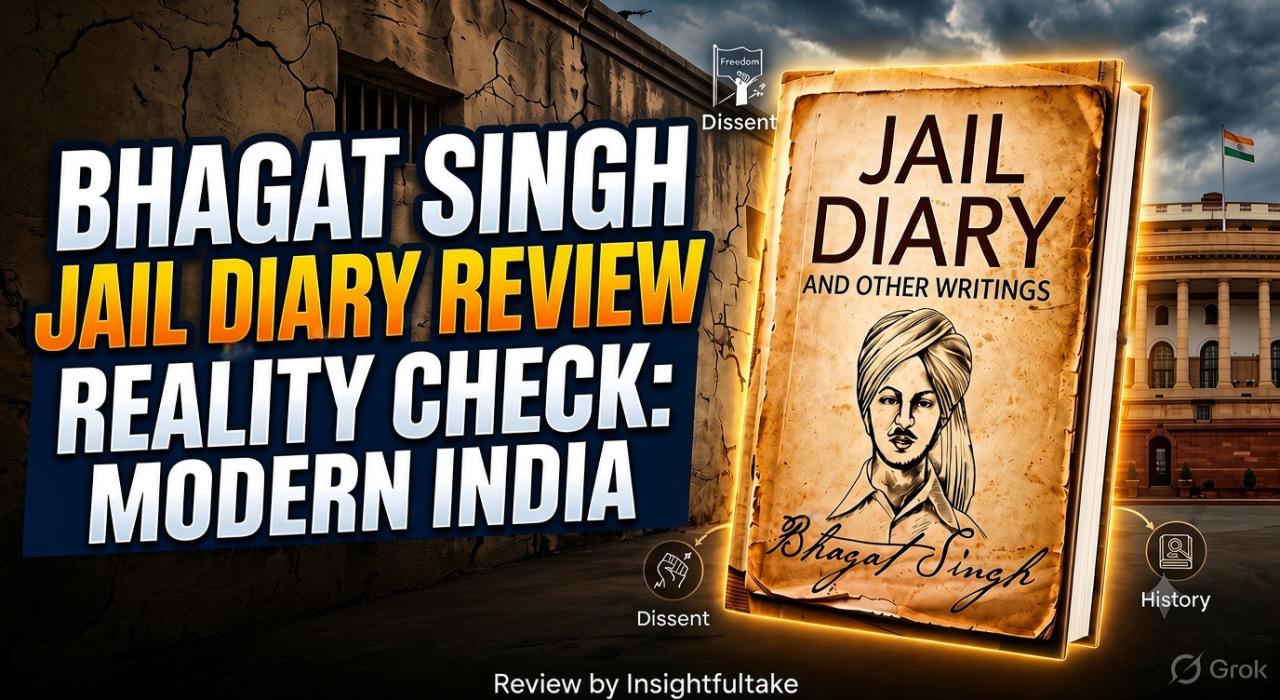
Bhagat Singh was more than a revolutionary icon. His Jail Diary reveals a thinker whose ideas on freedom, equality and dissent remain relevant to India today.
In contemporary India, Bhagat Singh is a widely recognised figure, yet his ideas are not always given the attention they deserve. His image, with a felt hat or turban and a sharp moustache, appears across political platforms and public campaigns. He is often remembered as a fearless revolutionary and nationalist. However, Jail Diary and Other Writings presents a deeper picture of the man. It reveals Bhagat Singh as an intellectual, a keen reader and a political thinker who believed that ideas could be as powerful as revolutionary action.
Written during his imprisonment between 1929 and 1931, before his execution at the age of 23, the Jail Diary offers a valuable insight into his intellectual world. Reading it today helps us examine the meaning of freedom, the health of Indian democracy and the social inequalities that continue to shape the country.
What the Jail Diary Reveals
The Jail Diary is not a conventional personal memoir. It is a collection of notes, quotations, extracts from books and reflections that reveal the range of Bhagat Singh’s reading. Even while facing execution, he continued to study political philosophy, social reform, literature and questions of human freedom.
His intellectual interests included several major traditions of political and social thought.
- Political philosophy: The ideas of Karl Marx, Friedrich Engels, Vladimir Lenin and Leon Trotsky informed his understanding of class struggle, economic exploitation and political power.
- Liberty and equality: The writings of thinkers such as Thomas Paine and Voltaire, along with anarchist Mikhail Bakunin, exposed him to debates about individual freedom, authority and social justice.
- Literature and poetry: His reading also reflected an interest in human suffering, freedom and the struggle for a more just society.
The collection is often read alongside two of his best-known essays, Why I Am an Atheist and To Young Political Workers. These writings help explain his commitment to reason, political awareness and social change. They also show that he did not want young Indians to follow political leaders or established beliefs without questioning them.
Bhagat Singh’s revolutionary outlook was therefore not limited to opposition to British rule. He wanted people to examine the structures of power and inequality that shaped their lives.
Bhagat Singh’s Ideas and Contemporary India
1. Nationalism Must Leave Room for Reason
Political debates in India often place national pride at the centre of public life. Patriotism is important, but it becomes less meaningful when it discourages questioning or treats criticism as disloyalty.
In Why I Am an Atheist, Bhagat Singh argues for questioning inherited beliefs and testing ideas through reason. His position was not simply a rejection of religion. It reflected a wider belief that people should not accept any idea merely because it has tradition, authority or popular support behind it.
This principle remains relevant today. Citizens must be able to question governments, examine public claims and challenge social practices without being labelled enemies of the nation. A healthy democracy needs informed citizens who can distinguish evidence from propaganda and public interest from political convenience.
For Bhagat Singh, intellectual freedom was part of the larger struggle for human freedom. His legacy invites Indians to understand patriotism not as unquestioning obedience, but as a willingness to think critically about the country's direction.
2. Political Freedom Must Include Economic Justice
Bhagat Singh did not see independence as an end in itself. He was concerned about what freedom would mean for peasants, workers and the poor if political power changed hands but economic exploitation continued.
This concern remains relevant in India, where debates over rural distress, wages, employment, labour rights and unequal access to opportunities continue. Economic growth can improve living standards, but national progress cannot be measured by headline figures alone. It must also be judged by whether ordinary people have secure livelihoods, fair wages, access to education and a reasonable chance to improve their lives.
Bhagat Singh’s socialist outlook encouraged people to look beyond the identity of those holding political office and examine how power and wealth are distributed.
His ideas raise a fundamental question for modern India: how meaningful is political freedom when large sections of society struggle to secure basic economic dignity?
The Jail Diary does not offer ready-made answers to every present-day problem. Its value lies in the questions it asks about the relationship between independence, equality and justice.
3. Dissent Is Essential to Democracy
Bhagat Singh and his comrades used court proceedings, public statements and prison hunger strikes to draw attention to their political demands and the treatment of prisoners under colonial rule. They understood that resistance could take the form of public argument as well as direct action.
Their experience also highlights the importance of dissent. Democracy depends on more than elections. It requires space for citizens, journalists, writers, students and political opponents to question those in power.
Bhagat Singh is often associated with the assertion that “by crushing individuals, they cannot kill ideas.” The thought captures an important principle: political authority may silence individuals, but it cannot permanently settle a debate by suppressing those who raise difficult questions.
In contemporary India, this principle matters whenever public discussion turns to civil liberties, the rights of protesters, freedom of expression or the treatment of political dissenters. Criticism should be assessed on its substance and evidence, not dismissed merely because it challenges the government or the dominant political view.
A democracy grows stronger when disagreement leads to debate and scrutiny rather than intimidation. Bhagat Singh’s example reminds us that the freedom to question authority is not separate from democracy. It is one of its foundations.
Strengths and Limitations of the Book
The Jail Diary and Other Writings offers readers direct access to Bhagat Singh’s intellectual interests and political concerns. Its greatest strength is that it allows readers to explore the ideas behind the revolutionary image.
The book also has limitations. Its notes and excerpts do not form a continuous narrative, and readers unfamiliar with early twentieth-century political debates may find some references difficult to follow. A basic understanding of the freedom movement and the political ideas of that period can help readers appreciate the material more fully.
These limitations do not reduce its historical importance. Instead, they make the book a starting point for further reading and reflection.
Conclusion: A Text for the Modern Citizen
Jail Diary and Other Writings is more than a record of a revolutionary’s reading. It offers an opportunity to understand the ideas that shaped Bhagat Singh’s vision of freedom and social change.
Remembering him only through portraits, slogans and ceremonial tributes leaves much of his intellectual legacy unexplored. His commitment to reason, equality, secularism and political awareness deserves the same attention as his courage and sacrifice.
For contemporary India, the challenge is to engage with Bhagat Singh as a thinker rather than merely as a national icon. His writings encourage citizens to question inherited beliefs, examine economic injustice and defend the right to dissent.
For students, readers and anyone interested in the foundations of Indian democracy, the Jail Diary remains a valuable work. Its lasting significance lies not in providing a fixed political formula, but in encouraging people to think independently about what freedom should mean and whom it should serve.


















Leave a Comment