
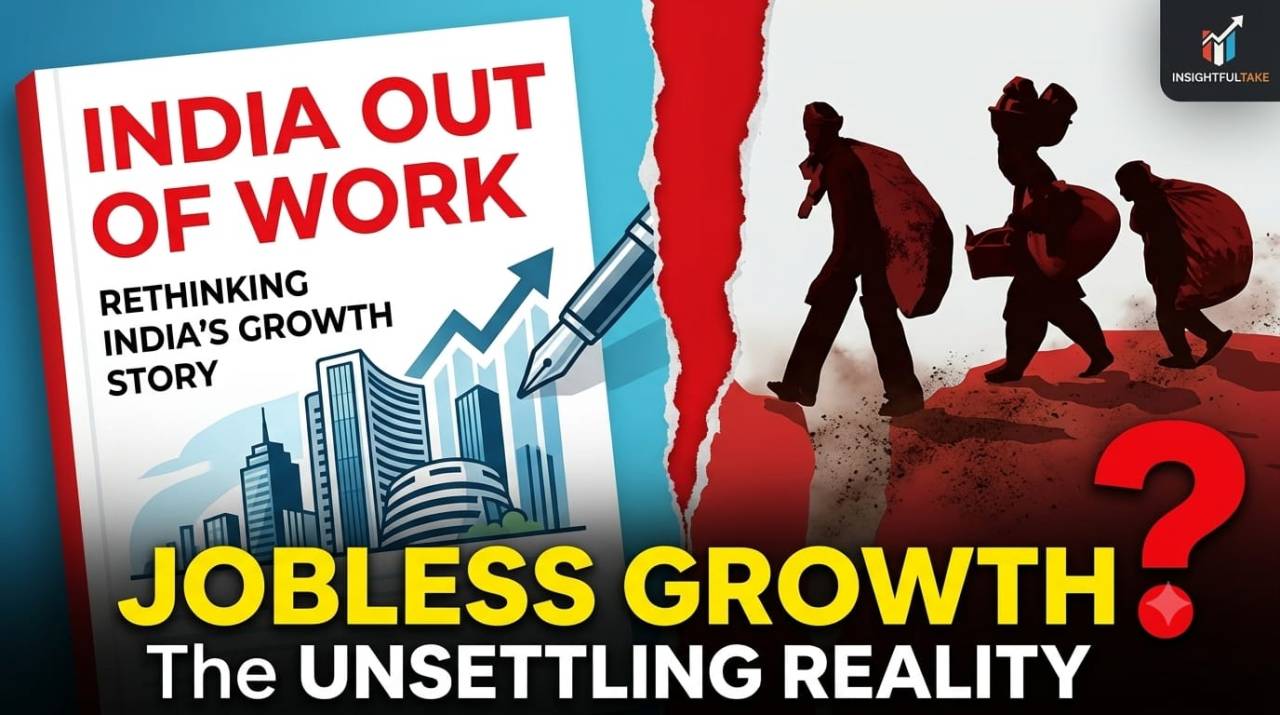
India's economy is growing, but millions of young people are still searching for quality jobs. India Out of Work explains why this gap could shape the country's future more than GDP ever will.
India's economic story has long been told through impressive GDP figures, booming stock markets, and its emergence as one of the world's fastest-growing major economies. Yet beneath these encouraging numbers lies a troubling contradiction. Economic growth has failed to generate enough quality jobs for the country's rapidly expanding workforce.
In India Out of Work: Rethinking India's Growth Story, economists Santosh Mehrotra and Jajati Parida examine this disconnect with clarity and evidence. Published by Bloomsbury, the book challenges the popular narrative of India's economic success and argues that the country's greatest challenge is not merely sustaining growth but ensuring that growth creates meaningful employment.
Rather than relying on political rhetoric, the authors present a carefully researched analysis of what economists describe as "jobless growth." Their message is both simple and urgent. India is currently enjoying a demographic dividend, a period in which the working-age population significantly exceeds the dependent population. However, this opportunity is temporary. With only about 15 years remaining before the demographic window begins to close, the country risks growing old before it grows rich.
The Myth of Modern Development
One of the book's strongest arguments is its examination of India's unusual development trajectory.
Historically, countries that industrialized successfully witnessed workers moving from low-productivity agriculture into manufacturing and formal services, where productivity and incomes were higher. India, however, has experienced a worrying reversal.
Mehrotra and Parida reveal that between 2020 and 2024, nearly 80 million people moved back into agriculture. This reverse migration was driven not by agricultural prosperity but by the absence of sufficient non-farm employment, particularly during and after the pandemic. Even more concerning, the manufacturing sector, which should have absorbed surplus rural labour, witnessed a decline in employment for five consecutive years beginning in 2016.
Instead of progressing toward a modern industrial economy, millions of young Indians have found themselves returning to low-income farming or unpaid family work, exposing deep structural weaknesses in the labour market.
Key Structural Bottlenecks
The book identifies several long-standing barriers that continue to hinder quality employment generation.
The Rise of NEETs
The number of young people who are Not in Education, Employment, or Training (NEET) crossed 100 million in 2020 and has remained alarmingly high. This represents a significant loss of human potential and highlights the widening gap between education and employment.
The Gender Divide
The authors draw attention to India's persistently low female labour force participation. Even when women enter the workforce, many are confined to unpaid family work or insecure, low-paying jobs, often because of economic pressures within households.
The Informal Economy Trap
More than 90 percent of India's workforce continues to work in the informal sector. Without social security, health benefits, stable incomes, or legal protections, millions remain vulnerable despite being employed.
A Practical Roadmap for Reform
India Out of Work goes beyond diagnosing the problem and offers a comprehensive roadmap for addressing it.
The authors argue that India must sustain annual economic growth of around 9 percent over the next decade while creating nearly 350 million non-farm jobs by 2055. Achieving these goals will require targeted public investment, stronger industrial policies, large-scale skill development, and renewed emphasis on labour-intensive manufacturing sectors capable of generating employment at scale.
The book also stresses that economic policy should be evaluated not merely by output but by its ability to improve livelihoods and expand opportunities.
Final Take
Written in clear, accessible language, India Out of Work succeeds in making complex economic concepts understandable without sacrificing analytical depth. Mehrotra and Parida shift the conversation away from headline GDP numbers and toward a more meaningful measure of national progress: productive employment.
This is an important and timely book for policymakers, business leaders, researchers, students, and anyone interested in understanding India's economic future. It offers both a sobering assessment of the country's employment crisis and a thoughtful blueprint for overcoming it.
Ultimately, India Out of Work reminds readers that the true measure of India's economic success will not be how quickly its economy grows, but whether that growth creates opportunities for millions of Indians to build secure, productive, and dignified lives.
India's economic story has long been told through impressive GDP figures, booming stock markets, and its emergence as one of the world's fastest-growing major economies. Yet beneath these encouraging numbers lies a troubling contradiction. Economic growth has failed to generate enough quality jobs for the country's rapidly expanding workforce.
In India Out of Work: Rethinking India's Growth Story, economists Santosh Mehrotra and Jajati Parida examine this disconnect with clarity and evidence. Published by Bloomsbury, the book challenges the popular narrative of India's economic success and argues that the country's greatest challenge is not merely sustaining growth but ensuring that growth creates meaningful employment.
Rather than relying on political rhetoric, the authors present a carefully researched analysis of what economists describe as "jobless growth." Their message is both simple and urgent. India is currently enjoying a demographic dividend, a period in which the working-age population significantly exceeds the dependent population. However, this opportunity is temporary. With only about 15 years remaining before the demographic window begins to close, the country risks growing old before it grows rich.
The Myth of Modern Development
One of the book's strongest arguments is its examination of India's unusual development trajectory.
Historically, countries that industrialized successfully witnessed workers moving from low-productivity agriculture into manufacturing and formal services, where productivity and incomes were higher. India, however, has experienced a worrying reversal.
Mehrotra and Parida reveal that between 2020 and 2024, nearly 80 million people moved back into agriculture. This reverse migration was driven not by agricultural prosperity but by the absence of sufficient non-farm employment, particularly during and after the pandemic. Even more concerning, the manufacturing sector, which should have absorbed surplus rural labour, witnessed a decline in employment for five consecutive years beginning in 2016.
Instead of progressing toward a modern industrial economy, millions of young Indians have found themselves returning to low-income farming or unpaid family work, exposing deep structural weaknesses in the labour market.
Key Structural Bottlenecks
The book identifies several long-standing barriers that continue to hinder quality employment generation.
The Rise of NEETs
The number of young people who are Not in Education, Employment, or Training (NEET) crossed 100 million in 2020 and has remained alarmingly high. This represents a significant loss of human potential and highlights the widening gap between education and employment.
The Gender Divide
The authors draw attention to India's persistently low female labour force participation. Even when women enter the workforce, many are confined to unpaid family work or insecure, low-paying jobs, often because of economic pressures within households.
The Informal Economy Trap
More than 90 percent of India's workforce continues to work in the informal sector. Without social security, health benefits, stable incomes, or legal protections, millions remain vulnerable despite being employed.
A Practical Roadmap for Reform
India Out of Work goes beyond diagnosing the problem and offers a comprehensive roadmap for addressing it.
The authors argue that India must sustain annual economic growth of around 9 percent over the next decade while creating nearly 350 million non-farm jobs by 2055. Achieving these goals will require targeted public investment, stronger industrial policies, large-scale skill development, and renewed emphasis on labour-intensive manufacturing sectors capable of generating employment at scale.
The book also stresses that economic policy should be evaluated not merely by output but by its ability to improve livelihoods and expand opportunities.
Final Take
Written in clear, accessible language, India Out of Work succeeds in making complex economic concepts understandable without sacrificing analytical depth. Mehrotra and Parida shift the conversation away from headline GDP numbers and toward a more meaningful measure of national progress: productive employment.
This is an important and timely book for policymakers, business leaders, researchers, students, and anyone interested in understanding India's economic future. It offers both a sobering assessment of the country's employment crisis and a thoughtful blueprint for overcoming it.
Ultimately, India Out of Work reminds readers that the true measure of India's economic success will not be how quickly its economy grows, but whether that growth creates opportunities for millions of Indians to build secure, productive, and dignified lives.


























Leave a Comment