
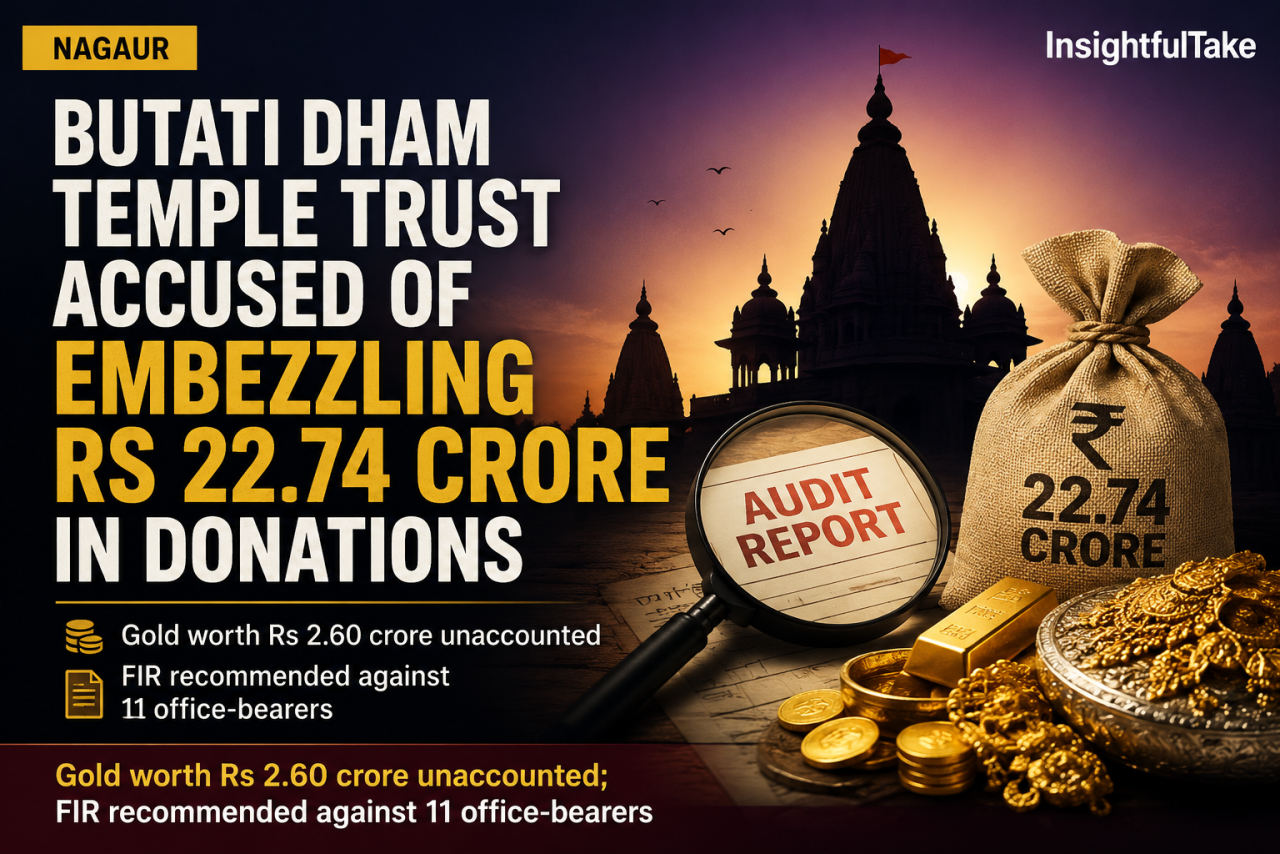
An audit at Rajasthan's Butati Dham has uncovered alleged financial irregularities, missing gold, and recommended criminal action against trust officials.
A district-level inquiry in Rajasthan's Nagaur has placed the trust managing the renowned Butati Dham temple under intense scrutiny after auditors flagged alleged financial irregularities worth Rs 22.74 crore and uncovered significant discrepancies in records of gold and silver donations. The inquiry has led to a recommendation for registering an FIR against the trust's chairman, Devendra Singh, and ten other office-bearers.
The findings, made public on July 12, 2026, stem from an investigation ordered by the Nagaur district collector following complaints about the management of donations received at Sant Shri Chaturdasi Maharaj Temple, popularly known as Butati Dham.
Collector-Ordered Inquiry Examined Two Years of Financial Records
The investigation panel reviewed donation registers, expenditure records, and stock entries for gold and silver covering the financial years 2023-24 and 2024-25. The audit identified several instances where expenditure appeared inconsistent with available records.
One of the most notable observations was a 335 percent increase in kitchen expenses within a year. Investigators said the sharp rise was not supported by any corresponding increase in the number of devotees or temple events that could justify such spending.
Expenditure Records Raise Multiple Questions
According to the report, the trust spent Rs 49.49 lakh on constructing a community kitchen (bhojanshala). However, investigators alleged that the project was completed without obtaining approval from the donor (Bhamashah) who had originally funded it, after which the expenditure was shown as the trust's own.
The audit also highlighted:
- Rs 26.99 lakh and Rs 90.64 lakh spent on room construction over two financial years.
- Rs 31.37 lakh spent on vehicle purchases.
- Rs 82.41 lakh spent on CCTV installation and building repairs.
- Rs 18.12 lakh spent on clothing, including suits and kurta-pajamas, without supporting bills.
- Rs 31.33 lakh spent on toilet construction.
- Rs 17.87 lakh spent on guest room maintenance.
- Rs 97.48 lakh spent on furniture, painting, and general repairs.
The panel further noted that several contracts were awarded without inviting competitive tenders, despite expenditure exceeding thresholds where such procedures are generally expected.
Gold and Silver Donations Show Major Discrepancies
The inquiry also uncovered serious inconsistencies in records relating to gold and silver offerings made by devotees.
Investigators estimated that precious metals worth nearly Rs 2.60 crore could not be properly accounted for. While existing records showed around 36 kilograms of gold and silver in stock, nearly 250 kilograms of offerings received during the two years under review could not be reconciled with official registers.
The report also states that around 280 kilograms of donated gold and silver were never entered into official records, while approximately 35.5 kilograms were recorded without being weighed, making independent verification of their value difficult.
Trust Chairman Rejects Allegations
Trust chairman Devendra Singh has denied any wrongdoing.
He said the trust is prepared to provide all documents sought by investigators and expressed confidence that a proper examination of the records would establish that no financial irregularities had been committed by the committee.
Case Highlights Wider Oversight Challenges
The Butati Dham case has once again drawn attention to the financial oversight of religious trusts in India.
Many temple trusts manage donations worth hundreds of crores annually, but audit standards and regulatory oversight differ significantly across states. Unlike corporate entities or many registered charitable organisations, temple trusts often function under state-specific endowment laws, with varying levels of financial scrutiny.
Experts have long pointed out that gold and silver donations present additional auditing challenges because accurate accounting depends on proper weighing, valuation, purity testing, and timely entries in official registers.
The Nagaur inquiry itself was initiated only after complaints prompted intervention by the district administration rather than through routine financial audits, highlighting the dependence on complaint-driven investigations in many such cases.
Final Take
The Nagaur administration has recommended that an FIR be registered against the eleven named office-bearers. Authorities are also expected to conduct further verification of the discrepancies involving gold and silver donations.
The outcome of the criminal investigation and any subsequent legal proceedings will determine whether funds or precious metals can be recovered and whether the case prompts broader reforms in the financial governance and auditing of temple trusts across India.
A district-level inquiry in Rajasthan's Nagaur has placed the trust managing the renowned Butati Dham temple under intense scrutiny after auditors flagged alleged financial irregularities worth Rs 22.74 crore and uncovered significant discrepancies in records of gold and silver donations. The inquiry has led to a recommendation for registering an FIR against the trust's chairman, Devendra Singh, and ten other office-bearers.
The findings, made public on July 12, 2026, stem from an investigation ordered by the Nagaur district collector following complaints about the management of donations received at Sant Shri Chaturdasi Maharaj Temple, popularly known as Butati Dham.
Collector-Ordered Inquiry Examined Two Years of Financial Records
The investigation panel reviewed donation registers, expenditure records, and stock entries for gold and silver covering the financial years 2023-24 and 2024-25. The audit identified several instances where expenditure appeared inconsistent with available records.
One of the most notable observations was a 335 percent increase in kitchen expenses within a year. Investigators said the sharp rise was not supported by any corresponding increase in the number of devotees or temple events that could justify such spending.
Expenditure Records Raise Multiple Questions
According to the report, the trust spent Rs 49.49 lakh on constructing a community kitchen (bhojanshala). However, investigators alleged that the project was completed without obtaining approval from the donor (Bhamashah) who had originally funded it, after which the expenditure was shown as the trust's own.
The audit also highlighted:
- Rs 26.99 lakh and Rs 90.64 lakh spent on room construction over two financial years.
- Rs 31.37 lakh spent on vehicle purchases.
- Rs 82.41 lakh spent on CCTV installation and building repairs.
- Rs 18.12 lakh spent on clothing, including suits and kurta-pajamas, without supporting bills.
- Rs 31.33 lakh spent on toilet construction.
- Rs 17.87 lakh spent on guest room maintenance.
- Rs 97.48 lakh spent on furniture, painting, and general repairs.
The panel further noted that several contracts were awarded without inviting competitive tenders, despite expenditure exceeding thresholds where such procedures are generally expected.
Gold and Silver Donations Show Major Discrepancies
The inquiry also uncovered serious inconsistencies in records relating to gold and silver offerings made by devotees.
Investigators estimated that precious metals worth nearly Rs 2.60 crore could not be properly accounted for. While existing records showed around 36 kilograms of gold and silver in stock, nearly 250 kilograms of offerings received during the two years under review could not be reconciled with official registers.
The report also states that around 280 kilograms of donated gold and silver were never entered into official records, while approximately 35.5 kilograms were recorded without being weighed, making independent verification of their value difficult.
Trust Chairman Rejects Allegations
Trust chairman Devendra Singh has denied any wrongdoing.
He said the trust is prepared to provide all documents sought by investigators and expressed confidence that a proper examination of the records would establish that no financial irregularities had been committed by the committee.
Case Highlights Wider Oversight Challenges
The Butati Dham case has once again drawn attention to the financial oversight of religious trusts in India.
Many temple trusts manage donations worth hundreds of crores annually, but audit standards and regulatory oversight differ significantly across states. Unlike corporate entities or many registered charitable organisations, temple trusts often function under state-specific endowment laws, with varying levels of financial scrutiny.
Experts have long pointed out that gold and silver donations present additional auditing challenges because accurate accounting depends on proper weighing, valuation, purity testing, and timely entries in official registers.
The Nagaur inquiry itself was initiated only after complaints prompted intervention by the district administration rather than through routine financial audits, highlighting the dependence on complaint-driven investigations in many such cases.
Final Take
The Nagaur administration has recommended that an FIR be registered against the eleven named office-bearers. Authorities are also expected to conduct further verification of the discrepancies involving gold and silver donations.
The outcome of the criminal investigation and any subsequent legal proceedings will determine whether funds or precious metals can be recovered and whether the case prompts broader reforms in the financial governance and auditing of temple trusts across India.




























Leave a Comment