
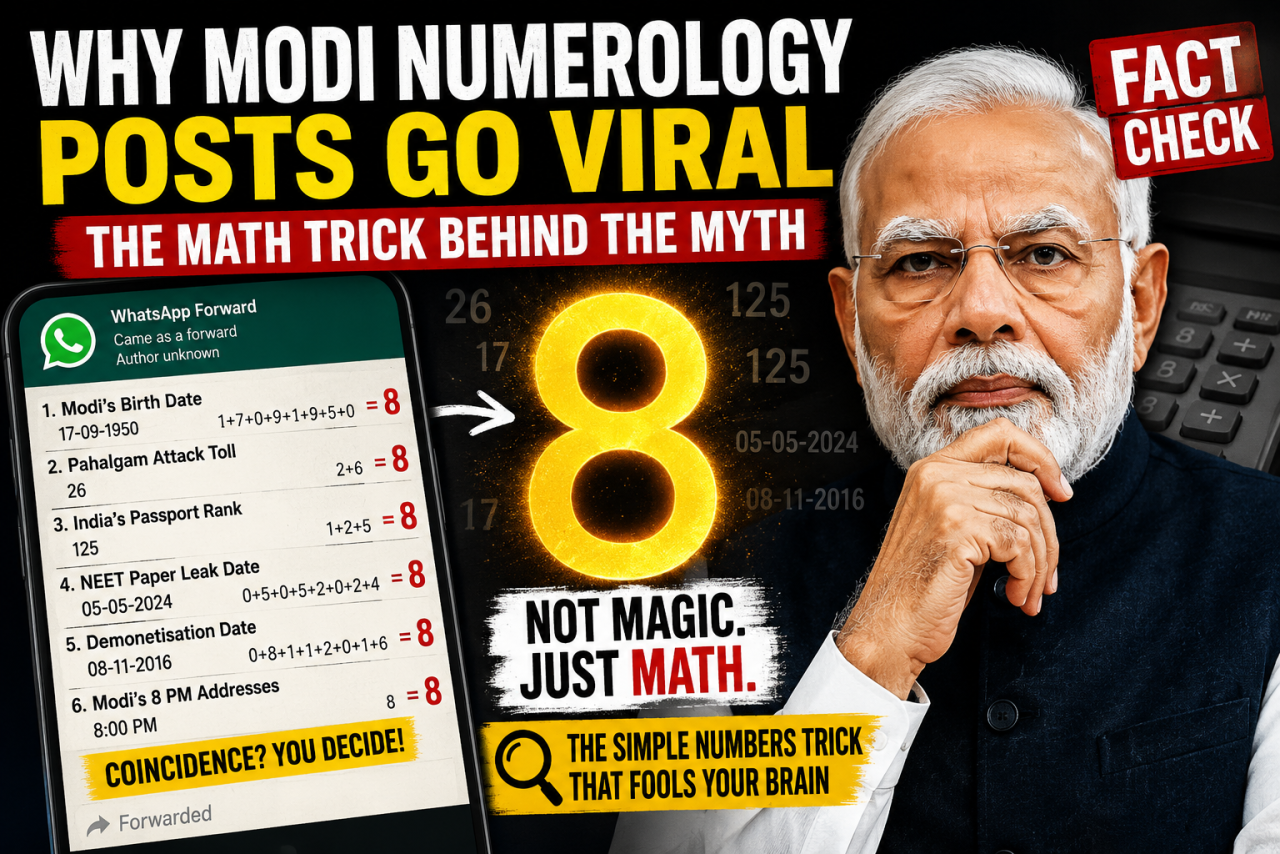
A viral WhatsApp post claims the number 8 connects Narendra Modi to major events. The real story is less about numerology and more about how our brains see patterns.
A tweet by veteran journalist Paranjoy Guha Thakurta recently crossed 12,000 views after he shared a WhatsApp forward claiming that several events linked to Prime Minister Narendra Modi were mysteriously connected by the number 8.
The post listed six unrelated facts, including Modi's birth date, the death toll in the Pahalgam terror attack, India's passport ranking, the NEET paper leak date, demonetisation, and the Prime Minister's 8 PM television addresses. In each case, the digits were added together until they produced the number 8.
The message quickly gained traction, collecting hundreds of reposts and likes. Yet its popularity reveals less about hidden numerical patterns and more about how the human mind naturally looks for meaning in coincidences.
The Simple Mathematics Behind the Pattern
The technique is straightforward.
Take any number and repeatedly add its digits until only a single digit remains. In numerology, this is often called finding the "digital root."
For example:
- 17 becomes 1 + 7 = 8
- 26 becomes 2 + 6 = 8
- 125 becomes 1 + 2 + 5 = 8
At first glance, the repetition appears striking. However, there are only nine possible outcomes, from 1 to 9.
That means if someone collects enough dates, rankings, casualty figures, election results, or government decisions, roughly one out of every nine numbers will naturally reduce to whichever digit they are looking for. The remaining numbers simply disappear from the story.
This is a classic example of what statisticians call the Texas Sharpshooter Fallacy. Imagine someone firing bullets randomly at a barn and then painting a target around the cluster that landed closest together. The pattern appears meaningful only because the evidence that does not fit has been ignored.
The same reasoning has long appeared in numerology, astrology, so-called "Bible codes," lucky-number marketing, and many conspiracy theories. The pattern exists because the selection was made after the fact, not because the numbers reveal a hidden truth.
A Small but Important Detail About the Passport Ranking
One claim in the viral post deserves closer attention.
It cites India's passport ranking as 125, a figure published by Arton Capital's Passport Power Rank, which uses its own methodology.
However, the more widely referenced Henley Passport Index places India at 80th in its 2026 rankings, an improvement from the previous year. The two rankings are not directly comparable because they measure global mobility using different criteria.
Both figures are technically valid within their respective systems. Yet viral social media posts rarely explain which index they are using. The more dramatic number usually attracts more attention.
Why These Posts Spread So Easily
Research examining political misinformation on Indian WhatsApp networks has found that misleading text and image-based content often spreads widely regardless of factual accuracy.
Numerology-based posts are particularly successful for several reasons.
First, they create suspense. Every new line appears to uncover another surprising coincidence, encouraging readers to continue until the final "reveal."
Second, they combine genuine events with unsupported conclusions. The Pahalgam terror attack, the NEET examination controversy, and demonetisation are all real and significant developments. By placing them inside a numerological framework, the post borrows credibility from authentic news while presenting an unsupported connection.
Third, they usually circulate without identifiable authorship. Many such messages begin with phrases like, "Received on WhatsApp, author unknown." This allows people to forward the content without accepting responsibility for its claims, making it easier for misinformation to spread across social media.
A Familiar Political Tactic
Numerological interpretations involving Indian political leaders are not new. Leaders from different political parties have long been associated with astrological predictions, lucky numbers, and symbolic coincidences, especially during election campaigns.
What has changed is the speed and scale of digital platforms.
A simple WhatsApp message can now become a screenshot, reach X within minutes, and circulate widely without any information about who created it, what evidence was excluded, or whether its claims were ever verified.
The Real Test of Any Pattern
Patterns can be fascinating, but they are not automatically meaningful.
Whenever a viral post claims to reveal a hidden connection through numbers, the most important question is not "What does this prove?" It is "What has been left out?"
A collection of numbers that all reduce to 8 may look extraordinary. But without showing the countless dates, figures, and events that reduce to every other digit, the pattern tells us very little.
In the age of viral forwards and algorithm-driven engagement, selective evidence often travels faster than careful reasoning. Recognising that simple mathematical trick is one of the easiest ways to avoid being misled.
A tweet by veteran journalist Paranjoy Guha Thakurta recently crossed 12,000 views after he shared a WhatsApp forward claiming that several events linked to Prime Minister Narendra Modi were mysteriously connected by the number 8.
The post listed six unrelated facts, including Modi's birth date, the death toll in the Pahalgam terror attack, India's passport ranking, the NEET paper leak date, demonetisation, and the Prime Minister's 8 PM television addresses. In each case, the digits were added together until they produced the number 8.
The message quickly gained traction, collecting hundreds of reposts and likes. Yet its popularity reveals less about hidden numerical patterns and more about how the human mind naturally looks for meaning in coincidences.
The Simple Mathematics Behind the Pattern
The technique is straightforward.
Take any number and repeatedly add its digits until only a single digit remains. In numerology, this is often called finding the "digital root."
For example:
- 17 becomes 1 + 7 = 8
- 26 becomes 2 + 6 = 8
- 125 becomes 1 + 2 + 5 = 8
At first glance, the repetition appears striking. However, there are only nine possible outcomes, from 1 to 9.
That means if someone collects enough dates, rankings, casualty figures, election results, or government decisions, roughly one out of every nine numbers will naturally reduce to whichever digit they are looking for. The remaining numbers simply disappear from the story.
This is a classic example of what statisticians call the Texas Sharpshooter Fallacy. Imagine someone firing bullets randomly at a barn and then painting a target around the cluster that landed closest together. The pattern appears meaningful only because the evidence that does not fit has been ignored.
The same reasoning has long appeared in numerology, astrology, so-called "Bible codes," lucky-number marketing, and many conspiracy theories. The pattern exists because the selection was made after the fact, not because the numbers reveal a hidden truth.
A Small but Important Detail About the Passport Ranking
One claim in the viral post deserves closer attention.
It cites India's passport ranking as 125, a figure published by Arton Capital's Passport Power Rank, which uses its own methodology.
However, the more widely referenced Henley Passport Index places India at 80th in its 2026 rankings, an improvement from the previous year. The two rankings are not directly comparable because they measure global mobility using different criteria.
Both figures are technically valid within their respective systems. Yet viral social media posts rarely explain which index they are using. The more dramatic number usually attracts more attention.
Why These Posts Spread So Easily
Research examining political misinformation on Indian WhatsApp networks has found that misleading text and image-based content often spreads widely regardless of factual accuracy.
Numerology-based posts are particularly successful for several reasons.
First, they create suspense. Every new line appears to uncover another surprising coincidence, encouraging readers to continue until the final "reveal."
Second, they combine genuine events with unsupported conclusions. The Pahalgam terror attack, the NEET examination controversy, and demonetisation are all real and significant developments. By placing them inside a numerological framework, the post borrows credibility from authentic news while presenting an unsupported connection.
Third, they usually circulate without identifiable authorship. Many such messages begin with phrases like, "Received on WhatsApp, author unknown." This allows people to forward the content without accepting responsibility for its claims, making it easier for misinformation to spread across social media.
A Familiar Political Tactic
Numerological interpretations involving Indian political leaders are not new. Leaders from different political parties have long been associated with astrological predictions, lucky numbers, and symbolic coincidences, especially during election campaigns.
What has changed is the speed and scale of digital platforms.
A simple WhatsApp message can now become a screenshot, reach X within minutes, and circulate widely without any information about who created it, what evidence was excluded, or whether its claims were ever verified.
The Real Test of Any Pattern
Patterns can be fascinating, but they are not automatically meaningful.
Whenever a viral post claims to reveal a hidden connection through numbers, the most important question is not "What does this prove?" It is "What has been left out?"
A collection of numbers that all reduce to 8 may look extraordinary. But without showing the countless dates, figures, and events that reduce to every other digit, the pattern tells us very little.
In the age of viral forwards and algorithm-driven engagement, selective evidence often travels faster than careful reasoning. Recognising that simple mathematical trick is one of the easiest ways to avoid being misled.














Leave a Comment